
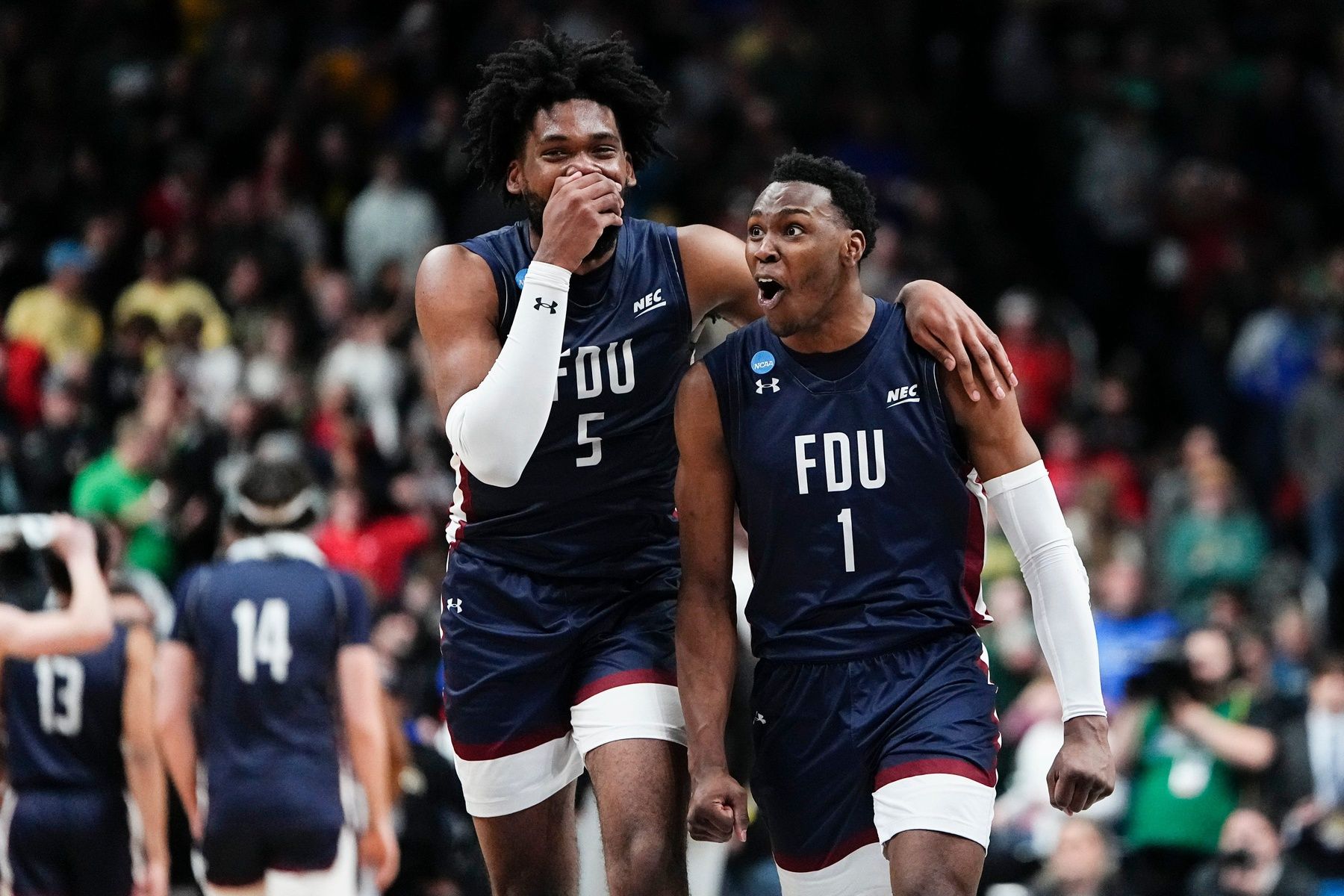
Two times. That’s how often a No. 16 seed has defeated a No. 1 seed in 164 tournament matchups since the NCAA expanded to 64 teams in 1985.
For 33 years, the upset everyone waited for seemed impossible. The top seeds had won 135 consecutive games against the lowest seeds in the bracket. Then UMBC happened. Five years later, Fairleigh Dickinson proved it wasn’t a fluke.
How UMBC and Fairleigh Dickinson Pulled Off Historic 16-Over-1 Upsets?
The 16-over-1 upset remains college basketball’s rarest achievement, but the impossible has now happened twice in the past eight tournaments. With the 2026 NCAA Tournament underway and the University of Maryland, Baltimore County, having just completed its first appearance in the field since its historic run, it is worth revisiting the moments that rewrote March Madness history.
On March 16, 2018, the University of Virginia entered its first-round game against UMBC as a 20.5-point favorite. The Cavaliers were 31-2, the No. 1 overall seed, and their defense allowed opponents barely 53.4 points per game. The Retrievers were a conference tournament champion that most fans couldn’t even name: the America East.
What followed wasn’t just an upset; it was a demolition. UMBC won 74-54, outscoring Virginia 53-33 in the second half after a 21-21 halftime tie. Senior guard Jairus Lyles poured in 28 points, and the Retrievers shot 54.2% from the field while holding the Cavaliers to just 41.1%.
MARCH MADNESS: Fill In Your Bracket Now!
One Virginia opponent that season failed to reach 53.4 points in a single game. UMBC scored nearly that many in a single half. The victory turned the school into a national sensation overnight. School applications spiked, and booster involvement surged.
Suddenly, four letters that had been anonymous became synonymous with March’s greatest upset. Virginia, meanwhile, used the loss as fuel for a redemption tour that culminated in a national championship the following year.
Five years later, Fairleigh Dickinson University one-upped the Retrievers in terms of sheer improbability. The Knights entered the 2023 tournament as the 68th and last-ranked team in the field, having lost their conference championship game to Merrimack, which was ineligible for the tournament due to its Division I transition.
FDU had the shortest roster in Division I basketball, averaging just over 6-foot-1. Its opponent was Purdue University, led by 7-foot-4 All-American center Zach Edey.
FDU was a 23.5-point underdog, the largest point spread ever overcome in tournament history. Coach Tobin Anderson, in his first season at the school after taking over a program that went 4-22 the previous year, told his team after its First Four win over Texas Southern: “The more I watch Purdue, the more I think we can beat them.” He was right.
The Knights held Purdue scoreless for more than five and a half minutes down the stretch and won 63-58. Sean Moore scored 19 points to lead a relentless defensive charge that swarmed Edey and forced the Boilermakers’ young guards into 16 turnovers. Only 2.36% of bracket entries had predicted FDU to win.
How Close Calls Paved the Way for 16-Over-1 Upsets
Before UMBC and FDU, the closest a No. 16 seed came to pulling off the upset was Georgetown University’s 50-49 escape against Princeton University in 1989. The Hoyas, featuring freshman Alonzo Mourning and senior Big East Player of the Year Charles Smith, needed Mourning to block two shots in the final seconds to survive.
Bob Scrabis’ 3-pointer with 15 seconds left was swatted away, and Kit Mueller’s buzzer-beater never had a chance against Mourning’s length. That game, dubbed “the one that saved March Madness,” helped convince the NCAA to preserve automatic bids for smaller conferences.
Princeton entered as a 23-point underdog and proved that David could hang with Goliath, even if he couldn’t quite slay him. Other close calls have dotted the tournament’s history. Oklahoma beat East Tennessee State 72-71 in 1989, the same year as the Georgetown-Princeton game. Purdue survived Western Carolina 73-71 in 1996. But none of those matchups delivered the knockout blow until Lyles and UMBC changed everything.
Now the question isn’t whether it can happen again, but when. No. 1 seeds still own a 162-2 record against No. 16 seeds, a 98.78% winning percentage that makes the top line of the bracket the safest pick in sports.
But twice in five years, teams that had no business being competitive rewrote the script. UMBC’s return to this year’s tournament, which ended with an 86-83 First Four loss to Howard University on March 17, 2026, serves as a reminder that lightning can strike. And as Fairleigh Dickinson proved, it can strike twice.
