
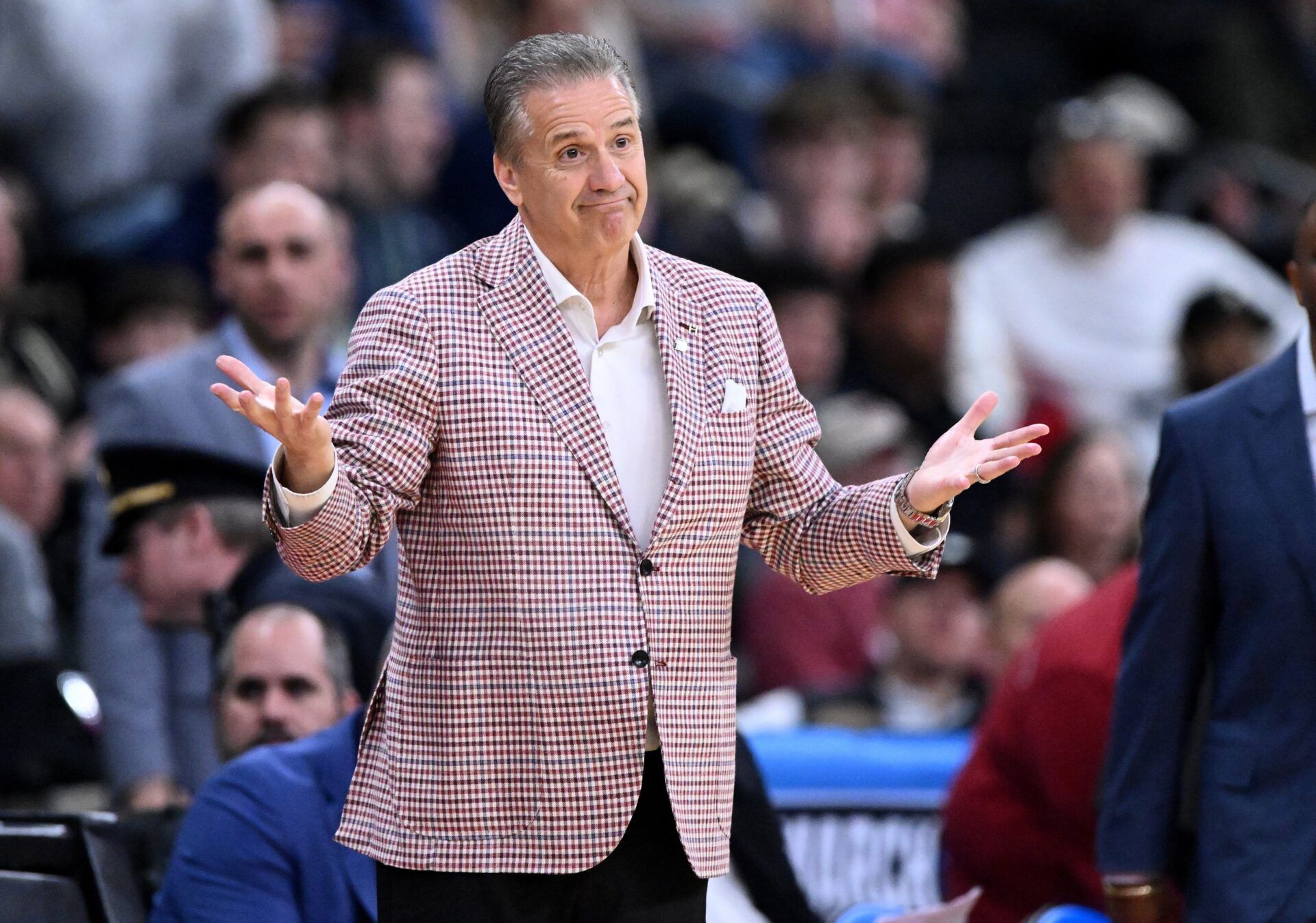
When you reach the level of professional excellence that legendary college basketball coach John Calipari boasts, it’s common to implement innovative approaches that others would consider unthinkable.
The Arkansas Razorback leader recently provided further proof of this by revealing his strategy for team construction.

John Calipari Explains How He Likes to Construct a College Roster — ‘Give Me Eight or Nine, 10 Guys’
During an interview with the popular podcast Two Cents Penny Hardaway, hosted by NBA legend Penny Hardaway, Arkansas HC John Calipari revealed that he doesn’t plan to fill the 15-player roster allowed for NCAA basketball teams. In fact, he plans to play with a much smaller number.
“I don’t want to have a team of 14, 13 guys. Give me eight or nine, 10 guys, and let me take care of those guys, ‘cuz the others are transferring at the end of the year anyway,” Calipari said.
“Now, if we have a lot of injuries, it could be a [problem]. We had that this year, and that was trouble… but I still only want to have eight or nine, a tenth guy that knows he’s 10th.”
He continued, “That means you care more about the kids than you right, because if I care about them, I got to put myself in a worse position than them.”
However, Calipari’s strategy isn’t solely driven by technical reasons. In fact, the reason is much more human-related than athletic. Quite simply, the head coach believes he can take care of a small team in a more comprehensive way than a full roster without compromising competitive results.
“I can impact young people. I want to help about 25, 30 more families, and if I get to a point where I can’t have an impact because of this environment, or I can’t coach the way I coach, then I won’t do it anymore.”
He elaborated, “People that I walk around, they’re like: ‘He’s like a new man’. I got a new challenge, and I got another place that I can do something unique for young people and still win.”
RELATED: Arkansas HC John Calipari Sets Unwanted Record at NBA Draft 2025
Although understaffing the roster is still a novel approach, it is not uncommon for coaches to use it.
Its proponents, including Calipari himself, highlight the advantages of this approach, which include fostering team cohesion, providing greater clarity in each player’s role, and facilitating individual development.
Naturally, there are also risks. The most obvious is injury, as a short roster has limited depth. When players need to be cut, even if it’s just one, the workload for the rest increases significantly.
In short, it’s a strategy that must be well thought out, as it requires a high degree of creativity and preparation from both the coaching staff and the players.
Regardless, last season was a successful first year in Fayetteville for Calipari. He led the team to their fourth Sweet 16 in five years. Going into 2025, though, the expectations will be much loftier.
