
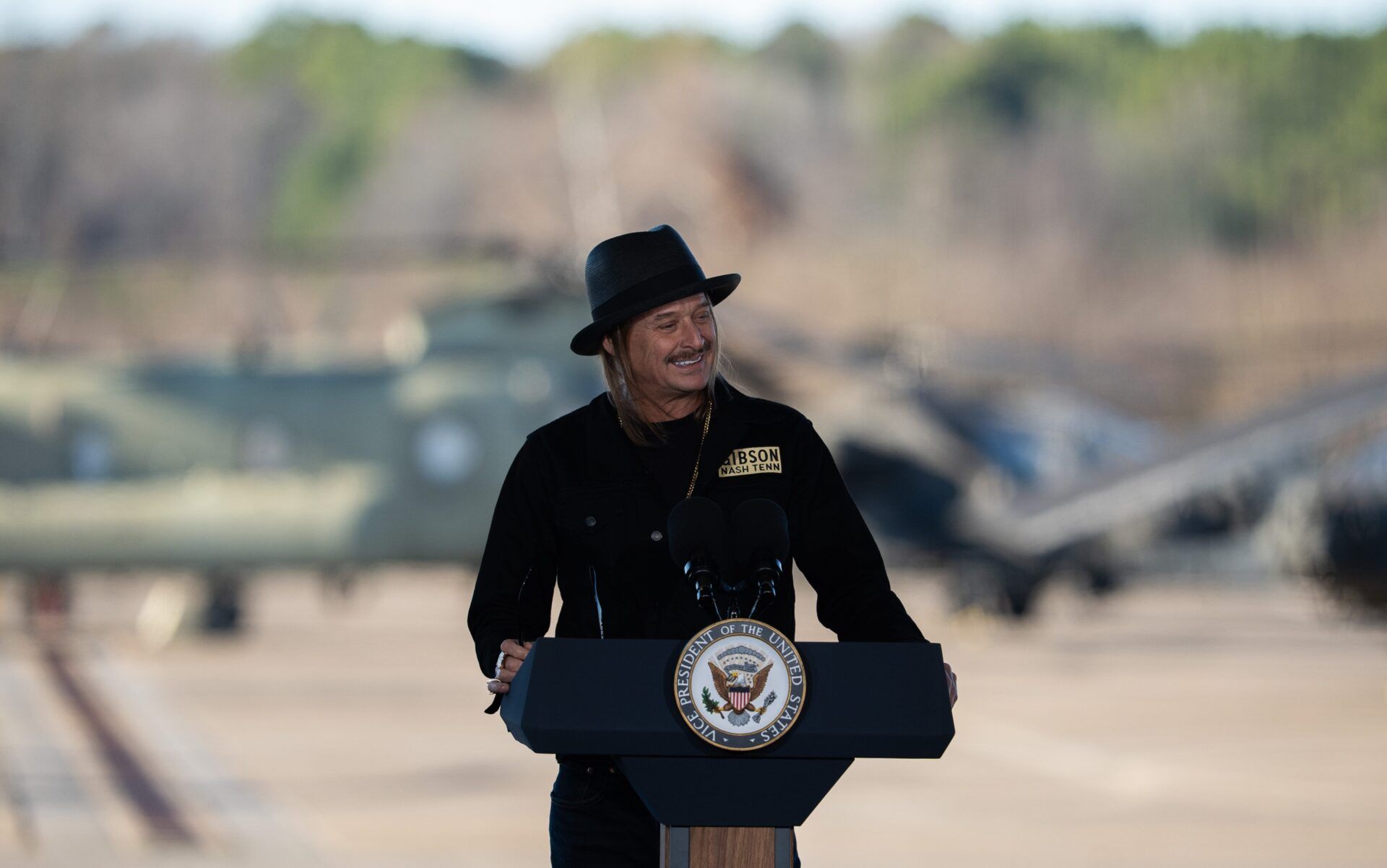
As millions tuned in for Super Bowl Sunday’s spectacle, a parallel performance unfolded away from the main stage.
What was billed as an alternative patriotic showcase quickly became a flashpoint for debate, drawing both political attention and musical scrutiny. By the time the night ended, one performance stood at the center of the loudest criticism.
Kid Rock Faces Backlash Over Lip Sync Controversy at Turning Point USA Halftime Event
Turning Point USA staged its “All American Halftime Show” during the Super Bowl, running roughly 30 minutes and streaming live on YouTube to more than 4 million viewers, according to the New York Times.
The program featured Brantley Gilbert, Gabby Barrett, and Lee Brice, before closing with Kid Rock. The show opened with a guitar rendition of the national anthem, followed by country performances and ending with a tribute to Turning Point founder Charlie Kirk.
The alternative broadcast emerged after the NFL selected Bad Bunny as the official halftime headliner. The decision sparked backlash from some conservatives, including former President Donald Trump, who wrote on social media that the halftime show was “absolutely terrible” and that viewers could not understand it.
Despite predictions that millions would choose the alternative show, reports described a modest in-person turnout at the soundstage venue. While YouTube viewership peaked at 6.1 million, the New York Times noted it was far below the massive audience drawn by the official halftime show in recent years.
Online discussion during the stream focused less on music and more on political identity, with many commenters referencing religion, patriotism, and opposition to Bad Bunny rather than the performances themselves.
The sharpest attention, however, centered on Kid Rock’s closing act. His set included “Bawitdaba” and ended with a cover of “‘Til You Can’t,” popularized by Cody Johnson. Soon after, social media users began questioning whether the performance was live.
Conservative commentator Ron Filipkowski wrote on X, “Dude lip synched the whole thing in jorts.” His remark questioned the authenticity of the performance and implied it lacked genuine live vocals.
Dude lip synched the whole thing in jorts. pic.twitter.com/DkmOYKJ5Qp
— Ron Filipkowski (@RonFilipkowski) February 9, 2026
Another user, J.J. Abbott, posted, “Kid Rock couldn’t even be bothered to sing live. Instead, some truly awful lip-syncing.” He framed the performance as careless and disappointing for viewers expecting a live show.
Kid Rock couldn’t even be bothered to sing live. Instead, some truly awful lip-syncing. A perfectly executed TPUSA grift by Kid. pic.twitter.com/U8AuPfcHhA
— J.J. Abbott (@jjabbott) February 9, 2026
Fact Post wrote that Kid Rock appeared to forget lyrics while lip-syncing. The comment suggested visible mismatches between the audio and performance.
Kid Rock appears to forget the lyrics to his song while lip syncing at the Turning Point USA halftime show. pic.twitter.com/5MsrI6rOLM
— FactPost (@factpostnews) February 9, 2026
Brian Krassenstein mocked the performance as “What a joke!!!” He highlighted how the incident quickly became a subject of ridicule online.
LOL! Kid Rock appears to have been lip synching his lyrics.
What do you think?
What a joke!!! pic.twitter.com/wwtcOXZ3Wc
— Brian Krassenstein (@krassenstein) February 9, 2026
Dean Blundell added, “Come for the lip syncing disaster, stay for the geriatric hillbilly Kid Rock in Jean Shorts.” He sharply criticised to portray the performance as both embarrassing and outdated.
Jesus would have hated the TPUSA “halfway” show.
Come for the lip syncing disaster, stay for the geriatric hillbilly Kid Rock in Jean Shorts.
— Dean Blundell🇨🇦 (@ItsDeanBlundell) February 9, 2026
Brian Allen summarized the backlash, saying the performance sparked ridicule after viewers noticed his mouth did not match the audio.
His statement reflected the broader online sentiment that the performance lacked authenticity.
Kid Rock’s performance at Turning Point USA’s “All-American Halftime Show” drew heavy online criticism after fans pointed out he appeared to be lip syncing — his mouth not matching the audio — during his set, sparking jokes and ridicule across social media.
Not live.
Not… pic.twitter.com/wA7P4JRaR5— Brian Allen (@allenanalysis) February 9, 2026
Beyond the online criticism, observers noted the broader contrast between the two halftime shows.
While Turning Point USA framed its event as a patriotic alternative, audience response suggested many viewers tuned in for political solidarity rather than musical appreciation. The conversation surrounding Kid Rock’s performance ultimately overshadowed the broadcast’s intended message.
In the end, the alternative halftime show succeeded in drawing attention, but not entirely for the reasons organizers hoped.
Instead of becoming a defining musical counterpoint, the event became a cultural flashpoint, with Kid Rock’s performance at the center of a debate over authenticity, audience appeal, and the power of spectacle on one of television’s biggest nights.
