
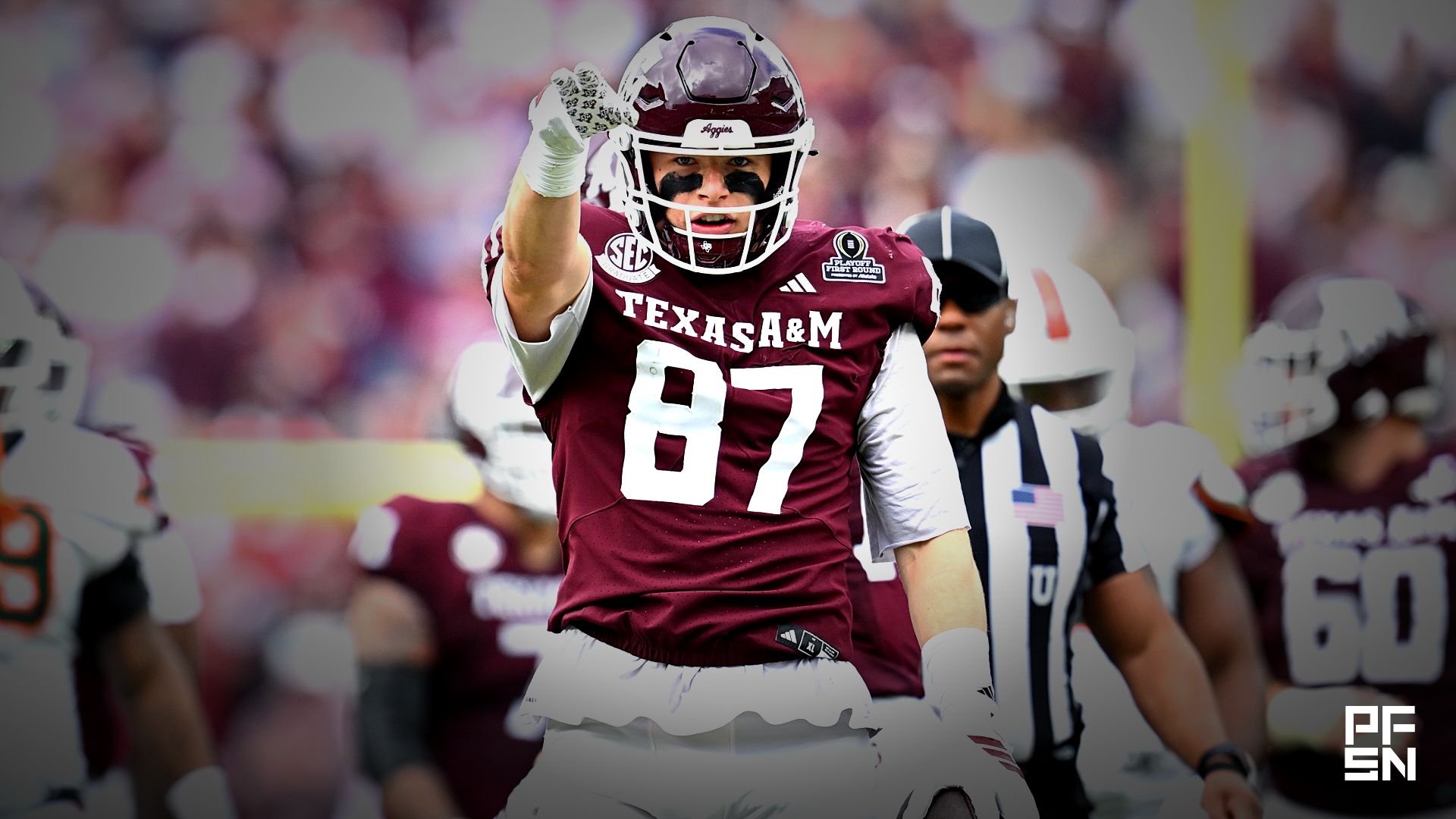
When the Jacksonville Jaguars submitted their second-round card in the 2026 NFL Draft, audible gasps could be heard across the draft community. It wasn’t necessarily gasps of excitement either.
Jaguars fans weren’t the only ones confused by the selection of Texas A&M tight end Nate Boerkircher. It was viewed as a massive reach by industry consensus, prompting PFSN analysts to hand out their first F grade of the draft.

Jaguars Selection of Nate Boerkircher Earns the First Failing Grade of the Draft
On the Day 2 episode of the “Football Debate Club” live draft show, PFSN draft analysts Cam Mellor, Jacob Infante, and Ian Cummings broke down each team’s decisions, one selection at a time. When it came to the Jags picking Boerkircher, they didn’t mince words.
“Here’s the thing. It is a surprise,” remarked Cummings. “We know what the reason is. He’s an elite blocking target, all right?”
Despite his undisputed prowess in the trenches, taking Boerkircher this early baffled the experts. Cummings gave the pick a flat F, while co-analyst Infante offered only slightly more grace with a D-.
According to PFSN’s scouting profile, the more than 6’5″, 245-pound Boerkircher entered the draft with a 76.9 overall grade, ranking as the 203rd prospect on the consensus board.
His CFB TE Impact Metric Score of 76.2 is heavily buoyed by an imposing 9.3 out of 10 blocking trait, masking the fact that his receiving metrics lag far behind top-tier tight ends.
Boerkircher is widely praised for being a tenacious, technically sound blocker who acquires leverage well and plays with functional strength. But in the modern NFL, a second-round tight end is generally expected to be a dynamic receiving threat.
Boerkircher recorded just 38 catches for 417 yards over his entire six-year collegiate career, spending his final season with the Aggies, where he logged only 19 receptions for 198 yards.
“This is a guy who is not going to be an immediate catalyst as a pass catcher, right?” Cummings explained, drawing a comparison to the Arizona Cardinals’ unexpected day-two selection of Tip Reiman a couple of years ago. When analyzing his 2025 highlights, the analysts noted his highly limited route tree.
“He was in a chip to chip protect, and then… he’s just the outlet at that point,” added Mellor.
The crux of the F grade isn’t an indictment of Boerkircher’s blocking, which the PFSN analysts acknowledge matters “a great deal at the tight end position.” Rather, it is a question of draft value and opportunity cost.
“The reason that this is important and why it is a reach is because there were other better receivers on the board who are still really good blockers,” Cummings argued.
At the time of the Jaguars’ pick, superior dual-threat prospects remained available. Cummings quickly pointed out that “Oscar Delp has not been picked yet,” highlighting Delp’s “sub four, five speed at six foot five” and his ability as an “elite pass and run blocker.”
Other well-regarded names like Max Klare, Eli Raridon, and Dallen Bentley were also on the board, all of whom offer significantly more receiving upside.
BE AN NFL GM: PFSN’s Ultimate GM Simulator
Modern NFL offenses require versatility to disguise looks and keep defenses guessing. “You need to be able to be a threat as a pass or a runner on any given down from any given alignment,” Cummings concluded.
While Boerkircher will certainly bolster Jacksonville’s run game, spending a premium second-round pick on a one-dimensional inline blocker was a gamble.
