
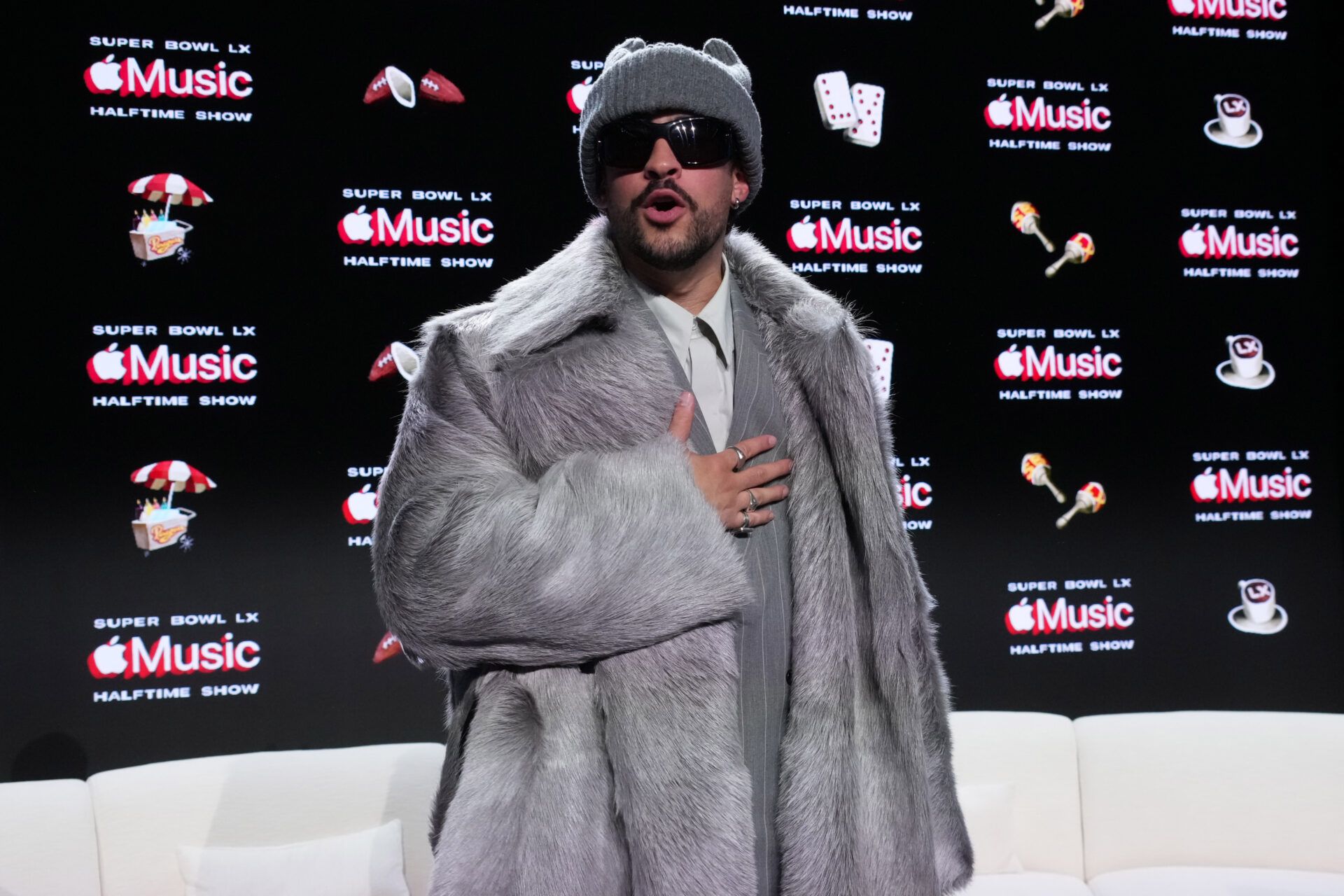
Tonight, Bad Bunny will headline the Super Bowl 60 halftime show. The performance is both highly anticipated and polarizing, as it even prompted Turning Point USA to create their own “All-American” alternative halftime show. This begs the question: Where is Bad Bunny from, and is he an American?
Where Is Bad Bunny From?
Benito Antonio Martínez Ocasio, also known as Bad Bunny, was born in Bayamón, Puerto Rico, on March 10, 1994. That makes him a United States citizen. Full stop. No naturalization required, no visa necessary, no legal ambiguity whatsoever.
Puerto Ricans have held automatic U.S. citizenship since the Jones-Shafroth Act became law in 1917, and Bad Bunny was born 77 years after that legislation passed. Turning Point USA has been criticized for their “All-American Halftime Show” as it implies that Bad Bunny isn’t American when that isn’t the case.
A 2017 poll found that only 54% of Americans knew Puerto Ricans are U.S. citizens. Conservative commentator Benny Johnson bemoaned the fact that the rapper has “no songs in English,” while conservative pundit Tomi Lahren complained that Bad Bunny is “not an American artist.” President Donald Trump called the halftime-show selection “absolutely ridiculous.”
The backlash intensified after Bad Bunny won Album of the Year at the Grammys and he use his speech to call out Immigration and Customs Enforcement (ICE).
“Before I say thanks to God, I’m going to say, ICE out,” Bad Bunny said during his acceptance speech. Bad Bunny refused to perform in the United States as of late due to concerns that ICE “could be outside” his concerts. Homeland Security Secretary Kristi Noem promised that ICE “would be all over the Super Bowl” once Bad Bunny was announced as the halftime performer.
Bad Bunny’s political views may be polarizing, but his citizenship status shouldn’t be part of the debate. Bad Bunny is an American citizen yet his selection has been more controversial than actual international stars such as Shakira, Rihanna, and The Weeknd who headlined despite being citizens of Colombia, Barbados, and Canada, respectively. None faced questions about belonging or alternative halftime show broadcasts.
Despite the criticism, the NFL has doubled down and shown support for Bad Bunny.
“It’s carefully thought through,” NFL Commissioner Roger Goodell said when addressing the controversy. “Bad Bunny is one of the great artists in the world, and that’s one of the reasons we chose him. But the other reason is he understood the platform he was on, and that this platform is used to unite people.”
Bad Bunny was Spotify’s most-streamed artist globally in 2025 with 19.8 billion streams, dethroning Taylor Swift (who held the title the previous two years). He has over 80 million monthly Spotify listeners.
The NFL is prioritizing globalization with the International Series and in 2024, NFL Senior Vice President of Global Brand and Consumer Marketing Marissa Solis stated that the league’s growth goals are “mathematically impossible without Latinos,” citing over 39 million Latino fans in the United States.
Puerto Rico is home to 3.2 million U.S. citizens by birth, though they cannot vote for president or elect voting representatives to Congress while residing on the island.
For his part, Bad Bunny has taken the controversy in stride. Previously, he said that viewers “had four months to learn Spanish,” but he walked back that comment this week.
“I’m excited, but at the same time, I feel more excited about the people than even me, my family, my friends, the people who have always believed in me,” Bad Bunny said of his performance. “This moment, the culture, that’s what makes these shows special. I know I told them they had four months to learn Spanish. They don’t even have to learn Spanish. They can learn to dance.”