
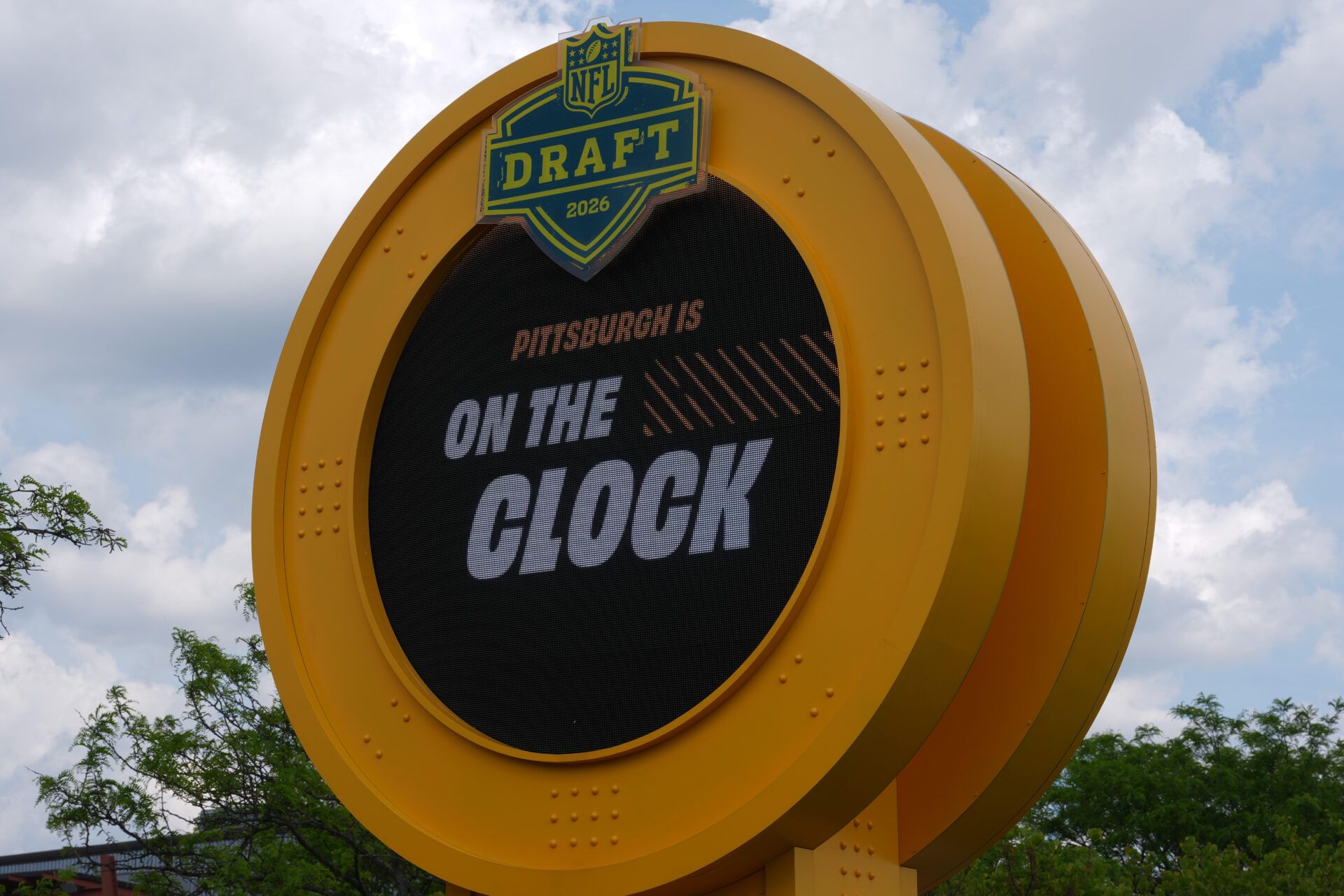
The 2026 NFL Draft runs three days in Pittsburgh, April 23 through April 25, with 257 total picks across seven rounds. Thursday night’s first round is the main event, and it should run a little shorter than you remember.
The NFL cut the time between first-round picks from 10 minutes to eight minutes in December, the first such change since 2008. That math means the opening round could end as much as 64 minutes earlier than past drafts if every team uses the full clock, or somewhere in the neighborhood of 45 minutes earlier in practice.
The 2026 NFL Draft Schedule Day by Day
Round 1 begins Thursday, April 23, at 8 p.m. ET from the Draft Theater on the North Shore outside Acrisure Stadium. Thirty-two picks will be made, but 12 teams are reshuffled from the usual one-each distribution: six teams (Jacksonville, Green Bay, Atlanta, Cincinnati, Indianapolis, Denver) enter Round 1 without a pick, while six others (Giants, Cowboys, Browns, Jets, Dolphins, Chiefs) hold two.
Yahoo Sports projects the round will wrap around 10:40 p.m. ET, running roughly 160 minutes of air time. Last year’s opening round ended around 11:43 p.m. ET.
Rounds 2 and 3 run Friday, April 24, starting at 7 p.m. ET. This is the longest single broadcast of draft weekend. Round 2 has 32 picks at seven minutes each (a maximum of 224 minutes), and Round 3 adds another 32 picks plus compensatory selections at five minutes each. In practice, Friday night usually wraps sometime between midnight and 1 a.m. ET depending on trade activity, since teams often move faster than the maximum clock in Rounds 2 and 3.
Rounds 4 through 7 run Saturday, April 25, starting at noon ET. This is the longest day by sheer volume, with roughly 160 picks across four rounds. Rounds 4 through 6 use a five-minute clock, Round 7 drops to four minutes, and Mr. Irrelevant, the final pick of the draft, belongs to the Denver Broncos at No. 257. Saturday typically ends in the early evening.
The draft airs on ABC, ESPN, ESPN Deportes, and NFL Network, with streaming on NFL+, Disney+, and the ESPN App. The Las Vegas Raiders hold the No. 1 overall pick after finishing 3-14 in 2025. The NFL has announced that 33 compensatory picks were awarded to 15 teams, positioned in Rounds 3 through 7.
Why This Year’s Draft Will Run Shorter Than Last Year’s
The pick-time rule change is the biggest structural tweak to the draft clock since 2008, when the league dropped from 15 minutes to 10. Commissioner Roger Goodell floated the idea publicly on The Pat McAfee Show during last year’s draft in Green Bay, suggesting a seven-minute first round with one two-minute extension per team. The league moved to eight minutes with no extension. The clock for every other round stayed the same.
Here is the breakdown of time limits per round for 2026: Round 1 is eight minutes, Round 2 is seven minutes, Rounds 3 through 6 are five minutes each, and Round 7 is four minutes. The shortened first-round clock affects only the maximum. Teams don’t typically use the full allotment.
The first pick is usually slow because the team has often made its choice known. Mid-round picks are faster. Trades can stall the clock in either direction depending on how close a deal gets to the buzzer.
In raw minutes at maximum clock, the 2026 draft will include roughly 21 hours of picking time for the base 224 picks (32 in each round). That breaks down as 256 minutes in Round 1, 224 in Round 2, 160 each in Rounds 3 through 6, and 128 in Round 7. The 33 compensatory selections distributed across Rounds 3 through 7 add roughly another 2 to 2.5 hours of maximum picking time on top of that. In practice, the total runs significantly shorter because teams rarely use the full clock in the later rounds.
One schedule note worth keeping in mind: last year’s first round ran about three hours and 43 minutes across 32 picks, which works out to roughly seven minutes per pick on average even under the 10-minute rule. The rule change officially saves two minutes per pick at the maximum. Practically, it saves closer to 30 to 45 minutes over the course of the round.
That’s still a meaningfully shorter night for viewers who have complained for years about Round 1 dragging past midnight on the East Coast.