
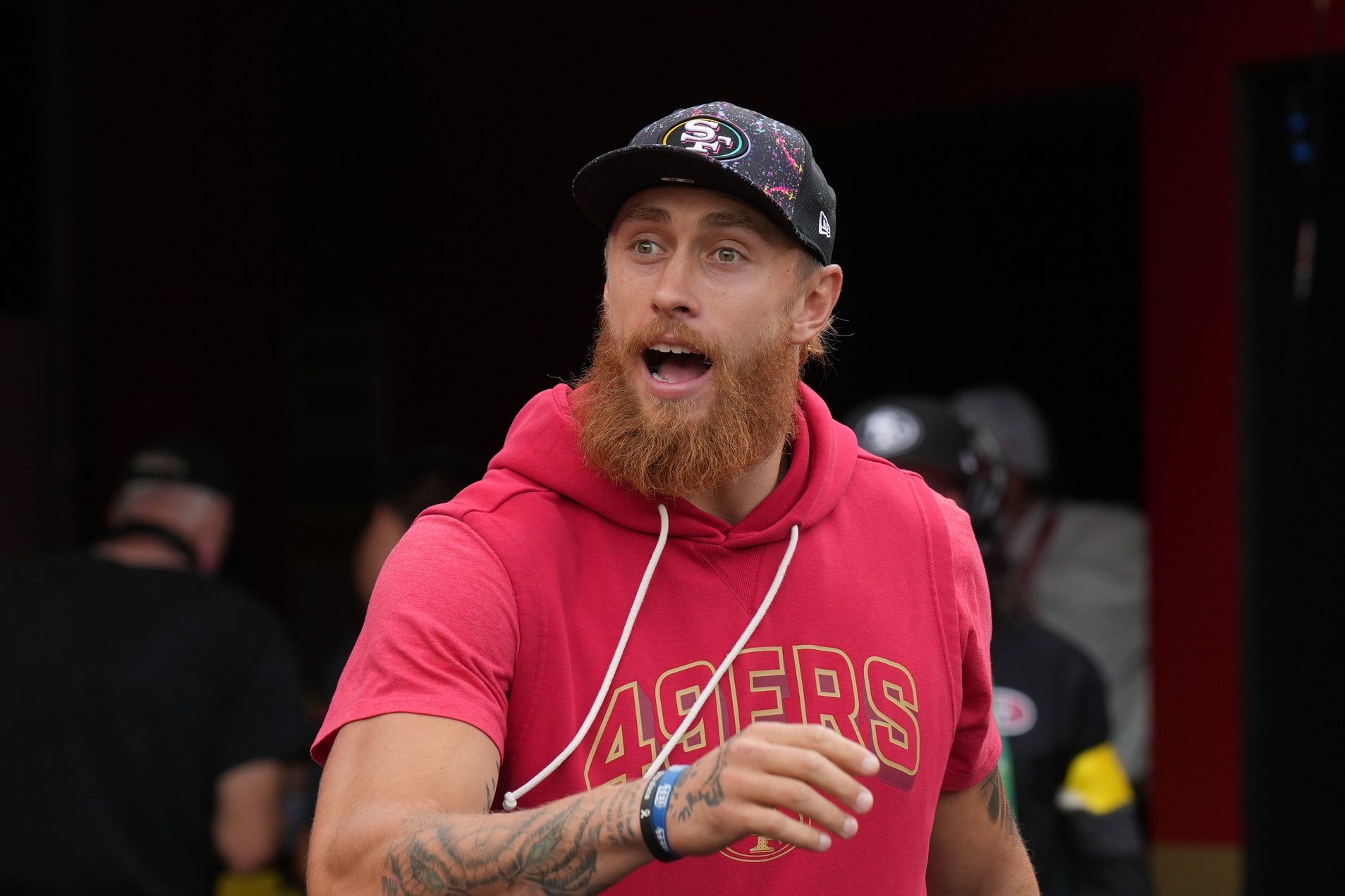
George Kittle remains on injured reserve with a hamstring injury suffered in Week 1 and will miss his fourth straight game Thursday night against the Los Angeles Rams.
That appearance marks the final game of his IR minimum, with Week 6 at Tampa Bay the first date he is eligible to return under league rules.

What Happened to George Kittle, and When Will He Return From Injury?
Kittle’s hamstring pull in Week 1 prompted the San Francisco 49ers to place the tight end on short-term injured reserve, which requires a four-game absence before an activation is possible. Since then, he has missed Weeks 2-4 and will be out again in Week 5.
The 49ers’ receiving depth has been stretched during that span, with wide receivers Jauan Jennings and Ricky Pearsall also sidelined this week, and quarterback Brock Purdy ruled out, amplifying the impact of Kittle’s absence.
Notable 49ers OUT tonight:
❌ QB Brock Purdy
❌ WR Ricky Pearsall
❌ WR Brandon Aiyuk
❌ WR Jauan Jennings
❌ TE George Kittle
❌ DE Nick Bosa+1.5 ➡️ +8.5 📉 @bet365_us pic.twitter.com/ybAIEiGVIC
— Covers (@Covers) October 2, 2025
Team officials have consistently framed Kittle’s timeline as short-term. General manager John Lynch, speaking on KNBR last week, said Kittle is “doing really well,” noting, “we put him on that short-term IR. He’s not even eligible until after the Rams game. I think Tampa would be the first game that George is eligible. He’s tracking well, putting in a lot of really good work, like George always does.”
Week 6 is the earliest realistic return, and team signals suggest it is in play. By the Buccaneers game, Kittle will have satisfied the four-game minimum and accumulated roughly five weeks of recovery time from the initial pull. If he maintains health through early-week work, the team can open his practice window and move toward activation in time for Sunday.
Other reports also indicated the possibility of up to five weeks out for the hamstring, which would slide a return to Week 7 (against the Falcons) if the staff opts for extra ramp time. That range aligns with standard soft-tissue management for dynamic athletes: target the first eligible date if the player clears workload milestones without setbacks; otherwise, take an additional week if re-ramp data points indicate caution.
Procedurally, the 49ers can first “designate to return” from IR, opening a 21-day practice window. During that window, Kittle can practice without occupying a spot on the 53-man roster while the staff evaluates position-specific movements (accelerations, hard breaks, blocking strain) across consecutive days. Activation requires a corresponding roster move once medical and conditioning benchmarks are met.
In Kittle’s absence, San Francisco has leaned on depth at tight end. Jake Tonges has handled most of the targets and, through the first four weeks, totaled 12 receptions for 125 yards and two touchdowns, while Luke Farrell and Brayden Willis have rotated snaps based on personnel packages.
Still, Kittle’s eventual return restores a first-read option in play-action, a middle-of-the-field stressor against zone, and an elite blocker who helps rebalance the run game and pass protection — critical elements for the offense as injuries have forced adjustments across the passing unit.
As the short week closes and the Rams game completes Kittle’s IR minimum, the focus shifts to next week’s checkpoints: opening the 21-day window, clearing consecutive practices, and confirming game-level readiness. If those boxes are checked without setbacks, a Week 6 activation is realistic. If not, the fallback remains Week 7, preserving both the player’s long-term health and the team’s flexibility within the IR return framework.
