
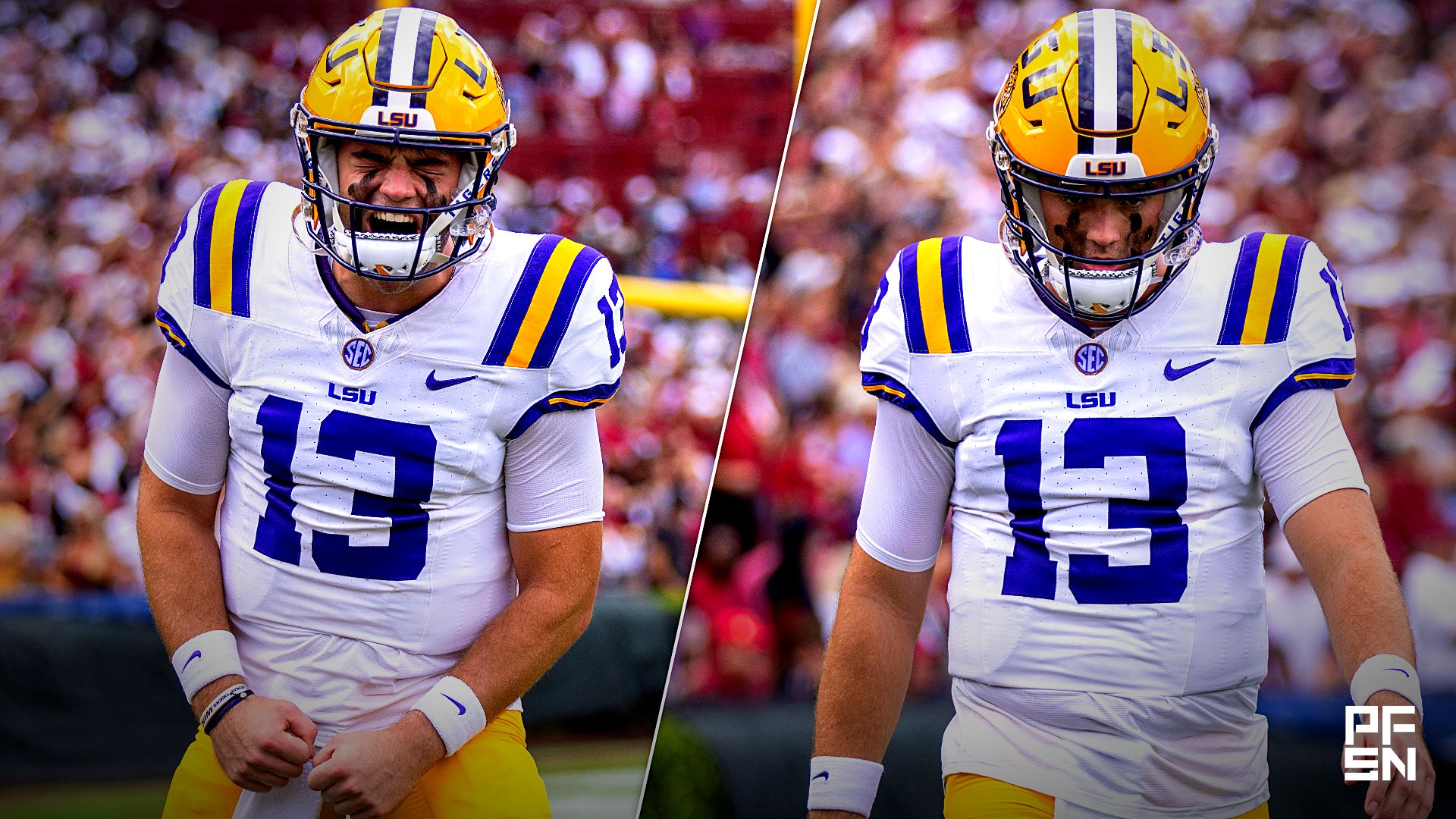
Garrett Nussmeier entered the 2026 NFL Draft as one of the more debated quarterbacks in the class. Some evaluators saw a poised pocket passer with strong processing traits, while others questioned how his game would translate against NFL speed.
By the time the weekend wrapped, that split opinion turned into a steep fall, as Nussmeier slid all the way to the seventh round before landing with the Kansas City Chiefs. It was a surprising outcome for a player once discussed in the same tier as some of the draft’s top passers, and it left many wondering what really happened behind the scenes.
How Medical Concerns and Play Style Impacted Garrett Nussmeier’s NFL Draft Stock
More details emerged about why teams hesitated once the draft dust settled. According to former NFL quarterback Matt Simms, it was not just one issue but a combination that created concern across front offices.
“I think that’s also why it spooked a few teams as well, just with that type of injury, not wanting to see that kind of linger, especially at the quarterback position, and then his style of play on top of that,” he said on SiriusXM NFL Radio’s “Airing It Out.”
That comment points to the two biggest factors that shaped Nussmeier’s slide: medical evaluations revealed concerns about a lingering knee issue and nerve-related complications tied to a cyst near his spinal cord.
For teams investing in a quarterback, even mid-round, durability matters. When there is uncertainty around how a nerve-related issue could affect mechanics or long-term availability, hesitation follows.
Simms knows of what he speaks because of his own experience dealing with nerve damage during his playing career. He understands how unpredictable those injuries can be, especially for quarterbacks who rely on consistent mechanics and timing. It’s not always about whether a player can perform on a given day, but whether teams trust that performance to hold up over the long haul.
The second part of Simms’ evaluation is just as important. Nussmeier’s play style has always been a bit of a double-edged sword. He can push the ball downfield, attack tight windows, and operate with confidence in structure. But that same aggressive mindset can lead to streaky results.
Simms explained it with a familiar comparison, noting that Nussmeier’s game can swing between high-level execution and risk-heavy decisions. For teams already weighing medical concerns, that inconsistency likely amplified the risk profile. When stacked against other quarterbacks in the class, even small concerns can become deciding factors.
Pre-Draft Momentum Clashed with Late Concerns in Nussmeier’s Evaluation
What makes the slide more surprising is how much momentum Nussmeier built during the pre-draft process. After throwing for 1,927 yards, 12 touchdowns, and 5 interceptions in 9 games before an injury-shortened 2025 season, he entered the offseason with questions about his mechanics and overall trajectory. By the time scouts saw him again in January, the conversation had started to shift.
At the Senior Bowl, Nussmeier looked far more comfortable. His footwork was cleaner, his timing sharper, and his confidence stood out in a competitive quarterback group.
He earned MVP honors in the game, completing efficient throws and showing mobility with a rushing touchdown and a successful two-point conversion. Even his lone interception came on a receiver drop, which only added context to an otherwise strong performance.
That progress carried into the NFL Combine, where his arm strength and mechanics appeared improved compared to the fall. After spending time rehabbing and refining his motion, he looked more in control of his delivery. For a stretch, it felt like he had regained ground in a crowded quarterback class.
That is what makes the final result so baffling. Nussmeier, who graded a C in PFSN’s CFB QB Impact Metric, was once projected to be in the mix with players like Carson Beck, who went much earlier in the draft, and even ahead of others who ultimately came off the board before him. Instead, he became the No. 10 quarterback selected overall, falling behind names like Drew Allar, Cade Klubnik, and a guy few have heard of in Rutgers’ Athan Kaliakmanis.
The disconnect between expectations and reality shows just how finicky the evaluation process can be. Teams are constantly balancing film, traits, medical reports, and long-term projection, but in Nussmeier’s case, the late-stage medical concerns appear to have tipped the scales.
BE AN NFL GM: PFSN’s Ultimate GM Simulator
Joining the Chiefs gives Nussmeier a chance to develop without immediate pressure. In a system that values timing and structure, his strengths could translate if he continues trending in the right direction physically.
But for now, his draft slide serves as a reminder that for quarterbacks, the margin for doubt is small, and even one or two concerns can change everything.
