
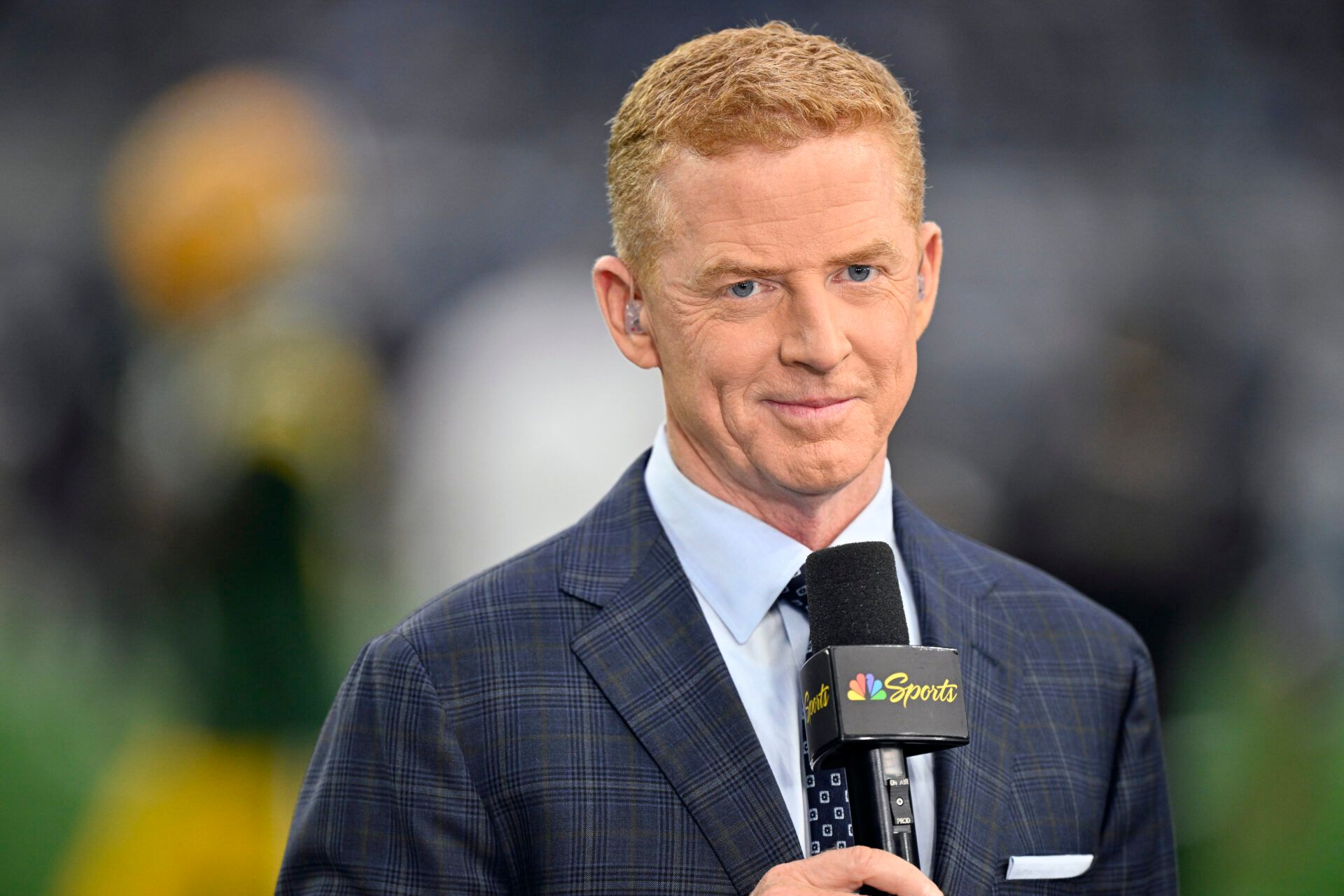
Former Dallas Cowboys head coach Jason Garrett and former NFL quarterback Chris Simms delivered pointed critiques of the league’s fourth-down aggression in an exclusive interview with PFSN, arguing that coaches have abandoned situational judgment in favor of analytics-driven groupthink.
This comes after Sean Payton’s failed fourth-down conversion cost the Denver Broncos a chance to build a two-score lead in the AFC Championship, and the Chicago Bears’ repeated gambles against the Los Angeles Rams contributed to their divisional-round exit.
Jason Garrett, Chris Simms Make Feelings Clear on NFL’s Go-For-It-Every-Time Mentality
Simms argued that the analytics movement ignores the psychological impact of a failed fourth-down conversion.
“We drive down the field, an 11-play drive and, man, it was a good drive. We got to the 6-yard line or 8-yard line, and we go for it and fail and we’re walking off the field after we didn’t get the first down, it’s deflating,” Simms said. “Is there a formula in all of these people’s [analytics] for what that does to your sideline emotionally?
“One sideline is going, ‘We just got a good drive, and we got nothing,’ while the other sideline is going, ‘Yeah! Let’s go! Woo!’ The defense is running out there like, ‘We thought you guys were going to make that fourth-and-1! Oh gosh, hold on, now we gotta get ready.’ “I think there are things like the psychology that are being missed a little bit in these situations. That’s where I think it needs to be reevaluated.”
Garrett’s objection cuts to the core of the analytics movement: sample size. Unlike baseball hitters with thousands of at-bats to validate their approach against lefties or sliders, NFL coaches face maybe 25 fourth-down decisions per season. Building an identity around always going for it, Garrett argues, is statistical malpractice.
“This is different than a baseball player who gets up 500 times a year and has a 10-year career and has 5,000 at-bats. You get a good feel if you can hit a lefty. You get a good feel if you can hit a slider because you have all these actuaries that tell you that,” Garrett told PFSN. “But if you have 25 fourth downs over the course of one season, is that enough evidence to say every one of them, we’re going to go for it?”
The problem compounds when coaches commit to an identity before evaluating the situation. Garrett called out the trap of reputation-based decision-making, where coaches known as gamblers feel pressured to stay aggressive even when the game calls for points.
“I’m for the guys who are aggressive in their mentality, go for it on the fourth down, but understand that I’m not painting myself into a corner just because I’m known as a gambler,” Garrett told PFSN. “‘Hey, I’m not going to change now! We’re gonna go be aggressive!’ Every one of those decisions, it’s a simple explanation. Let’s do what’s best for the team to win this game today.”
Simms called out two examples: Payton in the AFC Championship and Dan Campbell’s Detroit Lions in the 2024 NFC title game.
Leading 7-0 in the second quarter with backup quarterback Jarrett Stidham, Payton’s Broncos faced fourth-and-1 at the Patriots’ 14-yard line. A field goal would’ve put them up 10-0 with a defense that had held New England to 11 yards or fewer on every drive. Payton went for it, and the pass fell incomplete. The Broncos never got that close again and lost 10-7 in a snowstorm.
“You got a defense, you’re playing at home, and you can go up two scores with a backup quarterback and you’re playing an offense in New England that hasn’t been good in like four weeks and they’re going to feel the pressure of being down 10-0 on the road, and you let them off the hook!” Simms said. “The game flipped from that point, talking about the momentum. There’s no formula for that.”
“We saw the Bears do it in the Rams playoff game a little bit,” Simms said, referencing the pattern of aggressive calls that kept Chicago from building a cushion in a game they eventually lost in overtime.
Garrett acknowledged the analytics movement has pushed coaches in a positive direction, crediting the research for encouraging more fourth-down attempts in advantageous situations. But he drew a clear line between data-informed aggression and data-driven dogma.
“I think a lot of people have studied these fourth-down situations and have really encouraged and urged coaches to go for them. And to be honest with you, I don’t always agree with it. I think analytics has a place. I think analytics, in a very good way, has pushed coaches to go for it more. But I think these are singular decisions,” Garrett said.
The most painful example remains fresh in Detroit’s memory. In the 2024 NFC Championship, Dan Campbell’s Lions led San Francisco 24-7 at halftime before blowing a 17-point advantage. Twice in the second half, Campbell eschewed field goals from the 28-yard line and the 30-yard line. Both fourth-down attempts failed. The 49ers scored 27 unanswered points and advanced to the Super Bowl.
MORE: Try PFSN’s Free NFL Mock Draft Simulator With Trades
Simms framed it as a failure to adapt to game flow.
“I would argue the Detroit Lions would have been in the Super Bowl against Kansas City a few years ago if he just kicked a field goal and went up by 17 late in the third quarter,” Simms said. “Those are things where, again, I just look at it and go: play the game for what it is and what you’re seeing right now, not what you think it might be at one moment later on down the road because you don’t know that.”
Garrett’s critique hit the same target from a different angle: Campbell had painted himself into a corner by establishing a reputation as the league’s most aggressive coach. Once known as the guy who always goes for it, backing down becomes a perceived weakness rather than smart situational football.
“It always bothers me when you hear coaches say, ‘We’re going for it on all the fourth downs in this game,'” Garrett said. “Each one is its own decision. … Sometimes it means go for it, sometimes it means punt it or kick a field goal. That’s how I look at it.”
Where Garrett focused on sample size and situational independence, Simms attacked the hubris embedded in win probability models. Both men arrived at the same conclusion: coaches are trying to predict the unpredictable.
“It’s too much of the crystal ball and being like, ‘I know how the game’s gonna play out.’ Well, no, it didn’t play out that way,” Simms said. “It’s a field-goal type of game and you passed up three opportunities already to kick a field goal.”
The weather in Denver provided a perfect case study. Payton knew snow was forecast for later in the game. He knew his backup quarterback was making his first start of the season. He knew his defense had held New England to 11 yards or fewer on every drive to that point. Yet he trusted the model over the reality unfolding in front of him.
Campbell’s decisions in the NFC Championship followed similar logic. Up 17 at halftime against a Kyle Shanahan-led offense that had sputtered, the analytics suggested maintaining aggression. What the spreadsheets could not account for: Josh Reynolds dropping two catchable passes on fourth down, Jahmyr Gibbs fumbling, and the complete momentum reversal that followed each failed conversion.
“With Dan Campbell, it’s been good and bad,” Simms said. “There were games where his guys converted and then there were games this year where I’m on my shows going, ‘What are we doing? You’re the better team!’ Why do we always got to just continue to apply the pressure and put them under pressure?”