
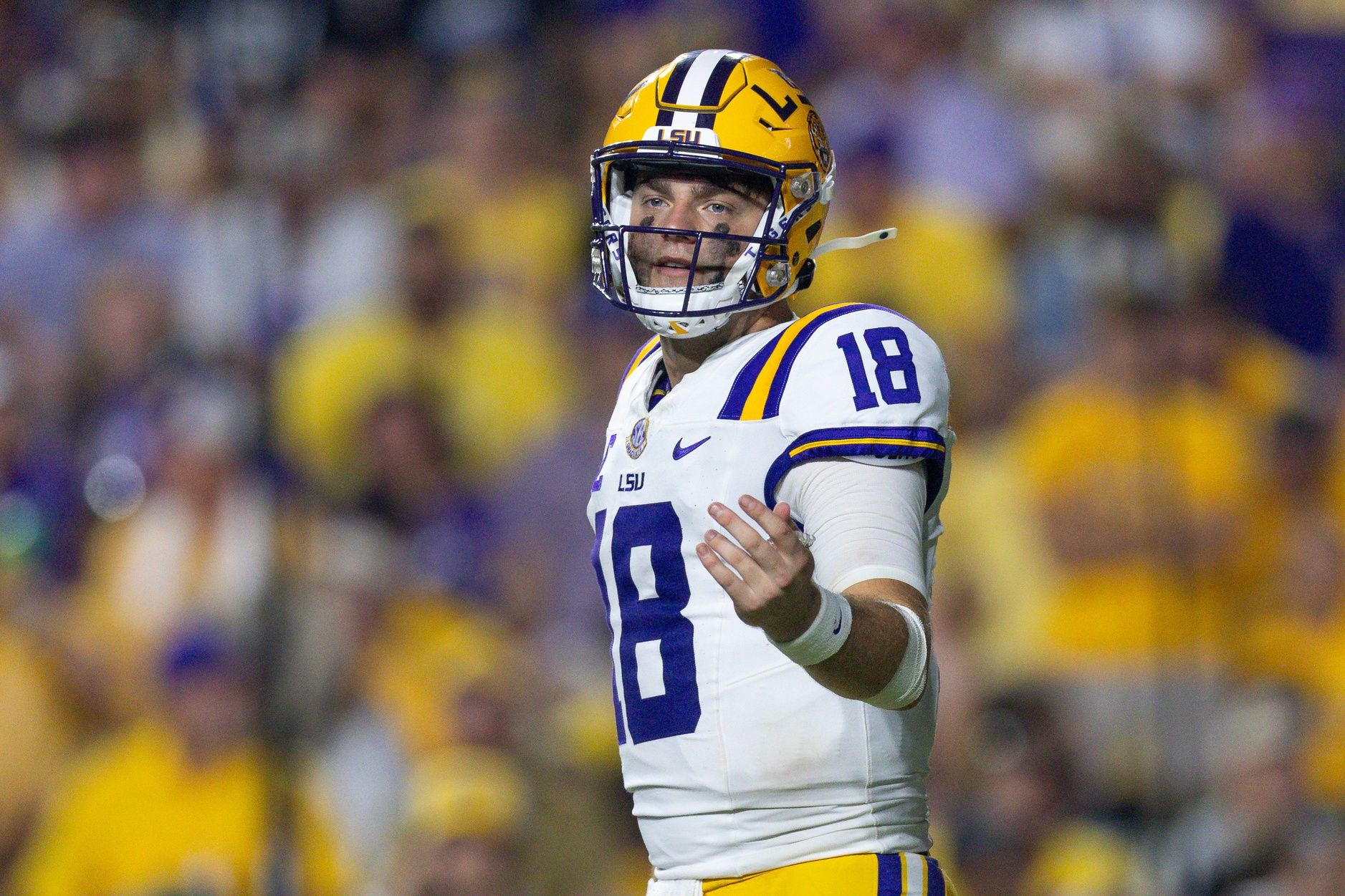
Every summer, we’re in a rush to find out what kind of QB class the next one is. We could tell the 2022 class was relatively barren at the most important position in football. We knew we had something special with Caleb Williams and Drake Maye in 2024.
Sometimes, however, it seems we’re in too much of a hurry. Jayden Daniels largely had early Day 3 grades entering his final season. Cam Ward was in a similar bucket before his lone campaign at Miami. Bo Nix had been all but written off before his transfer to Oregon.
These QBs are who the tape tells you they are. But the tape can also change over time, as people change and grow and enter new situations. We’re still very early in the 2026 NFL Draft cycle, and there’s still a lot of football left to be played. We have to be patient, but still, there are questions we can ask about the current class, as it stands.
Are There Any First-Round QBs for 2026 NFL Draft?
Encased within this question, there are two questions. Will there be any first-round QBs in the 2026 NFL Draft? The answer is almost assuredly yes. It’s been 30 years since the last draft in which a QB was not selected in Round 1: The 1996 NFL Draft class.
Even in bad QB classes, we see that subpar round-adjusted prospects can be elevated in the event of scarcity. Look at EJ Manuel in 2013 and Kenny Pickett in 2021.
(Side note: Pickett’s evaluation was a learning experience for me when it came to QB evaluation. I inflated his value because of the class’ scarcity when I shouldn’t have, and learned that not all anticipation is made equally at the QB position. It gave me a greater understanding of how to evaluate processing – because the guys like Pickett, without elite tools, have smaller margins for error.)
There’s almost a 100% chance there will be a first-round QB in the 2026 class. But are there any QBs graded in the Round 1 range right now? On my scale, the answer is no.
Fernando Mendoza and Cade Klubnik
In the preseason, I only had two QB prospects on the first-round fringe: Indiana QB Fernando Mendoza and Clemson QB Cade Klubnik.
I’ll eat crow on Klubnik’s preseason evaluation: I projected based on some elements of processing that I saw positive development with in 2024. Down the stretch in 2024, his leverage IQ and ability to manipulate middle-field defenders seemed to be blossoming. And in an ideal scenario, he could theoretically develop into a dynamic point guard-style passer in the mold of Bo Nix. He has the athleticism, arm elasticity, off-platform freedom, and touch.
The book isn’t closed on Klubnik, but the early 2025 returns have been subpar to put it mildly. Whatever growth he showed as a processor in 2024, he’s starkly regressed. He isn’t seeing the field well, he isn’t throwing with consistent accuracy, he’s turning the ball over, and he’s relying on his athleticism to a fault in pressure situations.
To be fair to Klubnik, his situation in Death Valley has not been ideal. Clemson’s offensive scheme is uninspired, the offensive line has underperformed, and injuries have impacted the group. But at a certain point, the onus has to fall on Klubnik to elevate his unit; first-round QBs are expected to do this. He simply hasn’t. Right now, his profile is that of a Day 3 QB.
Mendoza is considerably more accurate and polished with his mechanics, and quicker as an athlete, but Allar has very underrated pre-snap control and post-snap processing, and his best anticipation throws are right up there with the best of the class. Allar’s the exact kind of prospect who’ll win the allure of GMs, coaches, and coordinators dreaming of an alien QB – even if he’s not quite that alien, or not close to perfect yet.
The early-season stretch has been kinder to other 2026 QBs, but we still don’t have the answers we want. LaNorris Sellers still looks underdeveloped as a progression-reader, and a head injury has thrown his status into question. Drew Allar has been decently productive, but his accuracy remains a concern even in games against Group of 5 competition.
Garrett Nussmeier and Carson Beck
The upperclassmen QBs who’ve come out of the early stretch with arguably the best marks? LSU’s Garrett Nussmeier and Miami’s Carson Beck. Beck is slinging it again with confidence, and he’s helped lead Miami to two ranked wins. But he’s also been insulated by an elite offensive line and a fearsome defense, and bailed out at times by his WRs – namely CJ Daniels – on toss-up 50-50 balls.
Nussmeier, meanwhile, has also led his team to two statement wins against Power opponents. His numbers haven’t jumped off the page, but he’s been a true field general for an LSU offense that’s operated swimmingly with him at the helm. The son of Saints offensive coordinator Doug Nussmeier, Garrett has rare pre-snap vision and control, and he has some of the most enthralling anticipation throws in the class – a product of both his layering ability and NFL-level processing.
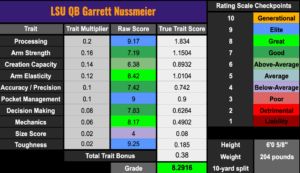
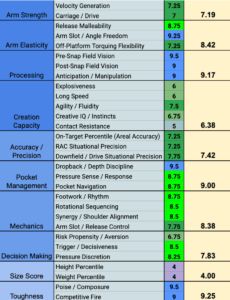
Nussmeier’s profile in particular will be polarizing, because the NFL-level operational traits are absolutely there. He can read pre-snap and command an offense, he can process fluctuating windows post-snap, he has exceptional pocket management skills, and he’s a tough, fearless competitor.
But he’s also below-average size, with durability concerns and a talent profile closer to average than elite. And even with his high-end processing, he’s prone to lapses in situational precision and poor decisions – his cross-body interception against Florida a prime example.
Below, you can see my composite grade for Nussmeier and his sub-trait framework. For context, an 8.5 is a first-round grade, and anything above an 8.00 is within the Top 100 range. Following this context, Nussmeier grades out as an early-to-mid Day 2 prospect at this stage. For me, he’s not quite a first-round prospect on his own, but if the class keeps its current scarcity, he’s the kind of high-floor operator NFL teams might elevate out of circumstance.
Behren Morton and John Mateer
In a class as open as this, there are other names to know. Sawyer Robertson has the athleticism, the arm, and the prototypical frame, and is putting up big numbers in a stacked Baylor offense. Robertson carried a mid-Day 3 grade from me entering the year, but if he can improve his accuracy and progression speed, he has good baseline traits to underlie an ascent.
Behren Morton is another QB in the Big 12 with big potential. The 6’2”, 220-pound senior QB has gotten off to an exceptional start in 2025, with 11 touchdowns to just one interception. He’s a gamer who’s rarely met a throw he doesn’t like. He hasn’t been tested much yet this year, but his functional mobility, arm strength, accuracy, and mental game all stand out as at least baseline strengths. If he can stay healthy, he could make noise.
There’s also John Mateer and Taylen Green, who’ve combined for 22 touchdowns. Both presently have Day 3 grades on my board as well, for similar reasons between them: Both are high-level physical talents with varying degrees of size, athleticism, and arm talent, but both also have limited processing profiles that hamstring their NFL projections. Mateer is graded a bit higher within the Day 3 window, but both QBs have more to prove in conference play.
In short, there are a lot of QBs. There’s a lot of time left. There are no guarantees. In a scarce QB class, it’s easy to prematurely elevate certain prospects to fill the void. We have to maintain discipline and avoid doing that. But if we are projecting off early-season returns and diagnostic traits, the most potential for first-round capital likely rests in the Big Ten.
The Big Ten: House of (Wild) Card QBs
Canvas the potential early-round signal callers in the 2026 NFL Draft, and you’ll see that many of them reside in the Big Ten. The conference has become the House of Wild Card QBs this year, and in a best-case outcome, at least 3-4 Big Ten QB prospects could become first-round picks. Part of it depends on who declares and who doesn’t, but the potential energy is there.
In limited action against subpar competition, Mendoza has been excellent, and Allar has been acceptable. But two other prospects adjacent to these preseason favorites are embarking on their own ascents: Dante Moore of Oregon, and Aidan Chiles of Michigan State.
A better term for Moore’s 2025 campaign thus far might be a “resurgence”. He saw action as a true freshman at UCLA, but was inconsistent and flamed out in Southern California. He then transferred to Oregon in 2024 and sat behind eventual third-round pick Dillon Gabriel. Now the decision to patiently wait his turn has seemingly paid off, as he’s been one of the best QBs in college football through September.
Through three games, Moore has completed almost 80% of his passes for 657 yards, seven TDs, and just one INT. He diced up an Oklahoma State defense in disarray and was similarly efficient against Northwestern.
Moore, like most, hasn’t been tested much yet this year – but from a diagnostic standpoint, he bears some similarity to first-round pick and Pro Bowl passer CJ Stroud. At 6’3”, 206 pounds, their size profiles are similar. Like Stroud, Moore has good functional mobility but doesn’t rely on it. Both QBs have easy, effortless velocity generation and layering ability, and Moore’s accuracy has been his calling card three games in.
Moore also knows how to get through his progressions, and flashes legitimate anticipation over the middle of the field – though he still needs to strive for more consistency in this area. There were times against Northwestern where he missed open vertical reads on posts or seam routes, and he got tied up between routes at times, sailing anticipatory crossers high.
Nevertheless, Moore is on a steep upward trajectory, in an Oregon offense that has an elite blocking front, dynamic weapons, and a structure conducive to NFL QB development. His clash against Penn State on September 27th is a game to circle.
If Moore acquits himself in that game, and helps Oregon compete or even come out on top, his stock could experience another exponential gain. The initial assumption was that Moore would be a 2027 prospect and not a 2026 prospect – but in an open class, he might be accelerating his timeline with his play.
That final statement could also be true for Chiles in East Lansing. A former four-star recruit who followed head coach Jonathan Smith from Oregon State to Michigan State, Chiles took his lumps as a first-year starter in 2024. At times, it was unclear whether he’d keep the job long-term. Instead, that early experience has helped catalyze a visible step forward in 2025.
There were glimpses of NFL-level traits and throws from Chiles in 2024 – taking reps under center and moving play-action mesh points, as well as firing outside-the-numbers drive balls into tight windows against Cover 2 looks – but he’s taken those flashes and built around them with added maturity and readiness in 2025.
Chiles’ comeback victory against Boston College was perhaps the best example yet, and one of the few times so far this year where a 2026 QB prospect has been truly tested by their game situation. Michigan State was down at the half to the Eagles, and Chiles would go on to throw for four TDs and rush for a fifth, steering the Spartans to an overtime triumph with his arms, his legs, and his mind – earning a strong 82.8 PFSN QBi score in the process.
Diving into the film, Chiles’ performance against Boston College was even more impressive. You saw a QB going through his reads quickly and playing patiently against coverage defenders in conflict. You saw a QB quickly discerning null reads, stepping up into the pocket, and fearlessly testing tight-window seams. You saw a QB stretching the field, creating on the ground – all working with a deficit in a must-win game for a Spartans team trying to return to bowl contention.
One of Chiles’ most impressive reps wasn’t even a completion. It was a play in the second half where Chiles – a true junior – experimented with a hard count to identify a blitzing LB. Upon identifying the blitzer, he took the snap, rolled away from the blitzer off a play-action exchange, and threw a high-percentage 1-on-1 pass to Nick Marsh, drawing a defensive pass interference penalty.
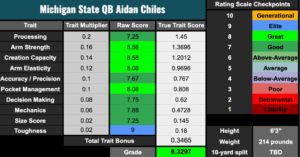
Chiles already looks like one of the more well-rounded QBs in the 2026 NFL Draft class, and if he’s able to hold and improve on his early grades through Big Ten play, Round 1 is in the realm of possibilities for him. He might not have a quantifiably elite trait outside of his toughness and poise, but his arm and creation capacity are both exceptional, and he’s a burgeoning operator behind the line with a well-rounded intangible pallet.
You’ll hear the words “potential” and “possibility” a lot when sitting in on conversations about the 2026 NFL Draft QB class, and that’s no accident. There’s no set pecking order right now, and any grades and rankings are very much in flux. The next two months of conference play will be crucial, and it’s up to each QB prospect to deliver when their name is called.
I won’t give a concrete ranking right now, but if I had 100 poker chips to bet on the current 2026 QBs to secure Round 1 capital? Here’s how I’d break it up:
- 20% – Fernando Mendoza
- 20% – Dante Moore
- 15% – Drew Allar
- 15% – Aidan Chiles
- 10% – Garrett Nussmeier
- 7% – LaNorris Sellers
- 5% – Carson Beck
- 5% – Behren Morton
- 1% – Taylen Green
- 1% – John Mateer
- 0.33% – Cade Klubnik, Sawyer Robertson, The Field