
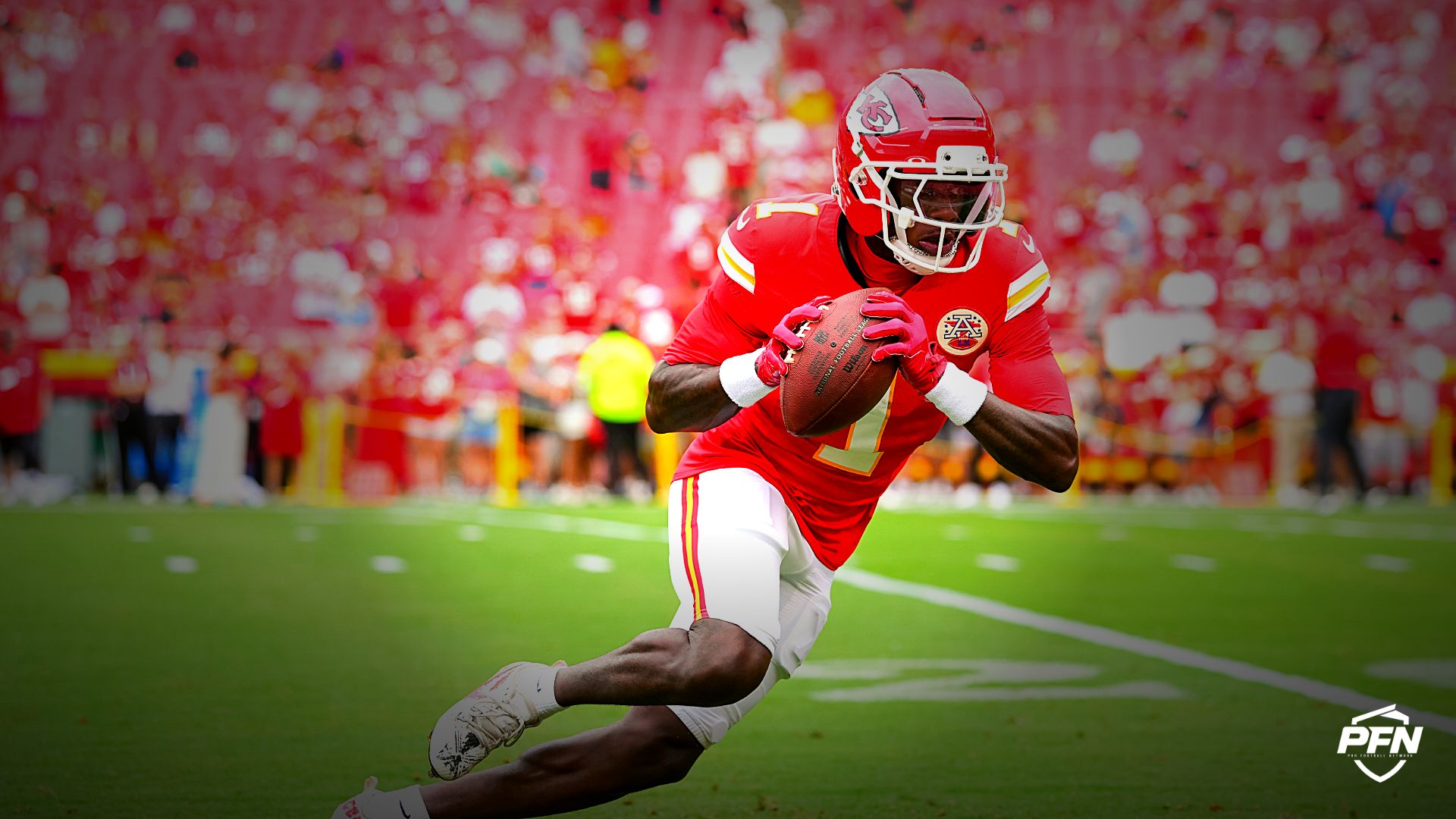
Every year, without fail, scouting analysts salivate over the raw speed of the new crop of prospects. This is especially true at the two most important positions for fantasy football, running back and wide receiver. Conventional wisdom would suggest faster = better. But is there such a thing as too fast? For wide receivers, history tells us the answer may be yes.

The Importance of Wide Receiver 40-Times
Let’s get one thing established out of the gate: speed does matter. If a player is not fast enough to play at the NFL level, he’s probably not going to be a productive wide receiver. Of course, there are always exceptions. But the general rule of thumb is a wide receiver must run at least 4.65 40-time to be an NFL-caliber player.
We do not have 40-times for every wide receiver in recent history. Some players choose not to run. Others only run at their Pro Days. So take these numbers with a grain of salt.
Per TruMedia, since 2000, there have been 37 tracked wide receivers to run slower than a 4.65 40-time. Of those 37, Anquan Boldin and Jarvis Landry are the only two to become long-term high-end fantasy producers. Keenan Allen ran a sub 4.7 40-time at his Pro Day. Obviously, he worked out quite well. But overall, sub-4.65 means too slow to play in the NFL.
START PREPARING: PFN’s FREE Fantasy Draft Simulator
Where scouts and fantasy managers go wrong is thinking that being really fast improves a wide receiver’s outlook.
The reality is being good at playing wide receiver (i.e. running routes and getting open) matters far more. There is not a meaningful difference between running a 4.55 or a 4.45.
Think of 40-times as more of a threshold. A prospect has to hit that threshold, but how far he exceeds is doesn’t really matter…until it does.
The Curse of 4.31
We know being too slow is a thing. But did you know that being too fast is also a thing? It surprised me, too.
Since 2000, 20 wide receivers have run a 4.31 40-time or faster. Across all of their careers, they have combined for two seasons of WR1 production (16+ PPG). The most successful WR of that group is, by far, Santana Moss, who ran exactly a 4.31.
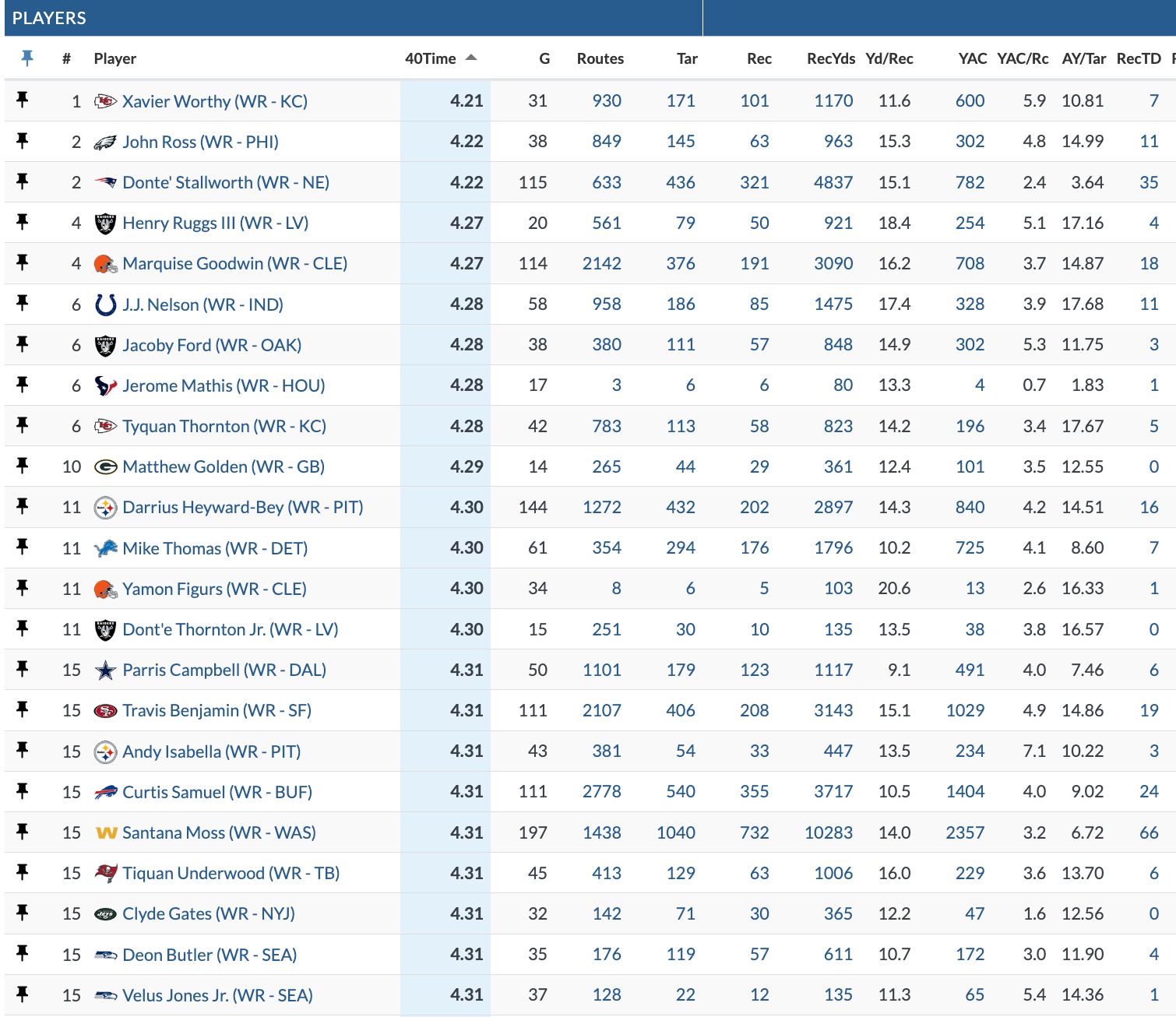
Intuitively, this doesn’t make much sense. However, when you think about how NFL teams operate, suddenly all becomes clear.
How often have we seen analysts fawn over how fast a wide receiver is? Then, we see that player’s draft stock rise.
The reason these players fail almost universally is that they never possessed the skills that warrant being taken where they end up going in the NFL Draft. Instead, they are pushed up the board due to something that doesn’t actually indicate an ability to play the position at a high level.
We didn’t have an example of this with the 2026 class. Brenen Thompson ran a 4.26 40-time, but he went in the fourth round. History suggests he won’t be anything more than a situational deep threat, but it’s not as if he was steamed up draft boards because of his speed.
DIVE IN: PFN’s Free Fantasy Football HQ
We did see a prime example of this in 2025, though. Matthew Golden wasn’t even considered a possible first-rounder until his 4.29 40-time. The Packers then reached for him in the first round, and he went on to post one of the worst rookie seasons of all time for a Round 1 WR.
The year before, we had Xavier Worthy. He certainly showed flashes late in his rookie season. Injuries to the Chiefs WR corps forced him into a role where the team was manufacturing touches for him. But in 2025, with everyone mostly healthy, Worthy averaged 7.9 PPG.
Some of the biggest Round 1 busts of all time were players who got overdrafted because of their speed. Worthy is trending that way. John Ross, Henry Ruggs, and Darrius Heyward-Bey are already there.
Before you get excited about a future wide receiver who ran a 4.3 40-time or faster, remember this study and proceed with caution.
