
Is it possible that both Jordan Love and C.J. Stroud are franchise quarterbacks poised to keep their respective teams in contention for the next five to seven years at a minimum?
Possible, if not very likely. That said, fantasy football managers in standard leagues who opt to draft a signal-caller in the middle rounds will be forced to pit these two against one another and choose who gets the call. You could flip a coin and let fate take care of itself, or you could put in the work, leveraging past data to make a statistically sound decision.

Who Should I Draft? C.J. Stroud or Jordan Love?
They say that the most important decision you’ll make in life is your spouse. It’s a single person you’re counting on to build you up when you’re down, celebrate the good times with you, and be a rock who’s always there.
Sure, that’s the cliché. But couldn’t that same sentiment be transferred to the quarterback position?
At least in 1QB formats, where, on a weekly basis, you get one crack at the highest-scoring position in the game. Most leagues afford you the option to start two (if not three or four) running backs and receivers, and if you reach whatever quota of fantasy points you’ve set for the position in a given week, you’re happy.
Of course, you’d love for your WR1 to shine or your RB1 to rack up valuable touches, but if you hit your target point total from the position as a whole, you don’t really care how the points are distributed.
There’s no backup plan once lineups lock at quarterback. For that given week, you need to feel comfortable with this player and, ultimately, like a spouse, choose correctly in order to have an enjoyable season.
The case for Love over Stroud is strong. He has a 12–7 lead over the Houston Texans’ main man in career 20-point games and has posted two very similar seasons (a 0.6% rise in passer rating), while Stroud ran into some bumps during his second year at the helm (13.7% dip in passer rating).
Love’s Green Bay Packers also invested first-round draft capital into their receiving room and play in a high-scoring NFC North that will demand that he put up numbers better than last season just to compete.
But, like choosing a spouse, the QB position on your fantasy roster isn’t “what have you done for me lately” as much as it is “how will we do together moving forward.” For starters, Stroud has access to a bona fide star wide receiver, something the Packers continue to search for.
C.J. Stroud finds Nico Collins for 6️⃣ to cap off a 99-yd Texans’ drive❗️ (via @NFL)pic.twitter.com/XWMLc1zJUZ
— NFL on ESPN (@ESPNNFL) January 11, 2025
That may sound overly simple, but find me the QB last year who was good for 18 points a week who wasn’t either an elite athlete (a box neither Love nor Stroud checks) or playing alongside a difference-making receiver.
- Lamar Jackson: Led quarterbacks with 915 rushing yards
- Josh Allen: 1,055 rushing yards and 27 rushing TDs over the past two seasons
- Joe Burrow: Ja’Marr Chase won the triple crown
- Baker Mayfield: Mike Evans has a historic run of 1,000-yard seasons and 10+ TD catches in four of the past five seasons
- Jalen Hurts: Led the position with 14 rushing TDs
- Jayden Daniels: Top five at the position in rushing yards (891) and rushing TDs (6)
- Jared Goff: Amon-Ra St. Brown is the only player to clear 105 receptions in each of the past three seasons
- Bo Nix: Nearly 4.0 fantasy ppg on the ground as a rookie
- Sam Darnold: Justin Jefferson cleared 1,500 receiving yards for the third time in four seasons
The odds of Nico Collins putting together a season like the receivers mentioned above are far greater than any Packers wideout doing so. I’m all-in on Collins as a triple-crown threat this season, but even if you aren’t, the fact that we’re not confident in who will lead the cheesehead receivers in fantasy points this season is concerning for both Love’s ceiling and floor in 2025.
Although Green Bay added a first-round receiver this season (Matthew Golden), the Texans looked to add around the edges at the position. Jayden Higgins (second round) and Jaylin Noel (third) may not be game breakers, but with Collins healthy, they just need to be complementary — which they should be able to do given their profiles.
If they can be additive this season, I think there’s much more room for Stroud’s profile to improve than Love’s. Heck, a healthy Collins and a little more creativity in play-calling might take care of that regardless of what the rookie receivers do.
Houston’s star receiver gives Stroud potential that I don’t think Love has access to. And it wouldn’t surprise me at all if the Texans’ QB held the advantage in all of these categories in 2025.
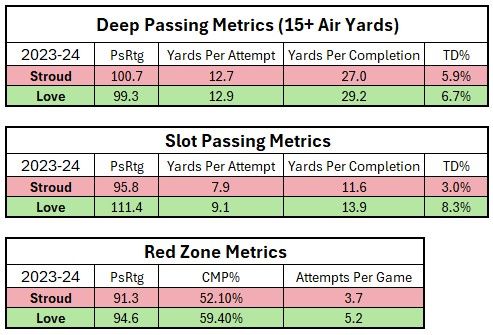
Honestly, the fact that those splits are as close as they are should be encouraging for Stroud supporters. That sample includes his introduction to the NFL and a season in which Collins missed five games and left another one early. The fact that, in total, he’s largely been able to keep pace in these specific areas is a plus, as it suggests he has the potential to gain ground on Love this year.
Collins’ ability to take over a game in a variety of ways can’t be overstated. Not only does it directly impact Stroud’s production, but it opens up paths for the rookies to land in favorable coverage spots. It’s a trickle-down effect that Love simply doesn’t benefit from when projecting his 2025 season.
Also of interest is the team buy-in. It’s true both Green Bay and Houston appear to be convinced they have “their guy” for years to come, but in the scope of 2025, that commitment looks different for our purposes.
Over the past two seasons (the sample we’ve been focused on), the Texans have ranked 12th in dropback rate in one-score games (60.1%; higher than the Tampa Bay Buccaneers and Buffalo Bills), while Green Bay ranks 30th (54.5%; ahead of only the Indianapolis Colts and Pittsburgh Steelers, not exactly breeding grounds in recent years for fantasy QB production).
Even with Love being the more productive of these two, Green Bay has been less likely to put the game on his shoulders. And in our volume-based game, that’s huge.
Imagine if Stroud returns to his rookie-season levels of efficiency. His star could ascend in a way that makes him the most productive pocket passer in our game — an outcome I don’t see in Love’s profile.
I’ve used this many words to sell Stroud in this 1-on-1 because, heading into picking apart these two, I wasn’t sold on one over the other. No analysis would be complete without a brief look at the schedule, understanding that this is the part of the breakdown most likely to change as the season progresses.
Not only do the Texans get three good-weather spots during your playoffs (two home games and a date with the Chargers in Los Angeles), but the quality of defenses they face looks favorable if we carry over strengths and weaknesses from 2024.
Weeks 15–17, Pressure Rates When Not Blitzing
Packers’ Opponents:
- at Broncos: 39.8% (second)
- at Bears: 34% (seventh)
- vs. Ravens: 31.9% (17th)
Texans’ Opponents:
- vs. Cardinals: 28.3% (26th)
- vs. Raiders: 29% (25th)
- at Chargers: 29.8% (23rd)
Intuitively, the inability to create pressure without bringing the heat is a problem. This leads to a breakdown of the defensive foundation and pokes holes across the board.
We, however, don’t deal with strict intuition, so here’s a look at the impact last season.
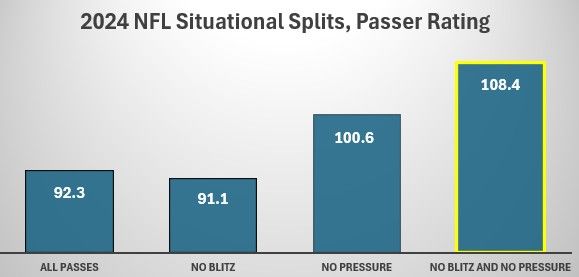
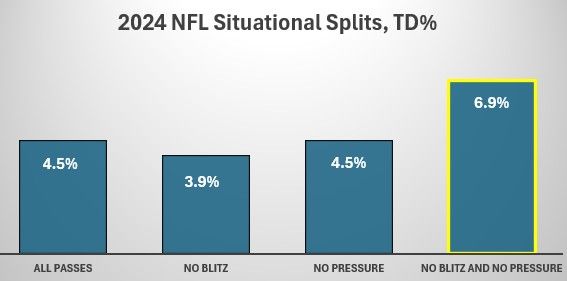
It’s no lock that either of these quarterbacks is selected in the top 100 of your draft, and that creates a situation where the risk/reward analysis works in their favor, no matter who you pick. That said, if we are chasing love in the form of a quarterback that we want to spend the season with, through the ups and downs, it’s Stroud for me.