
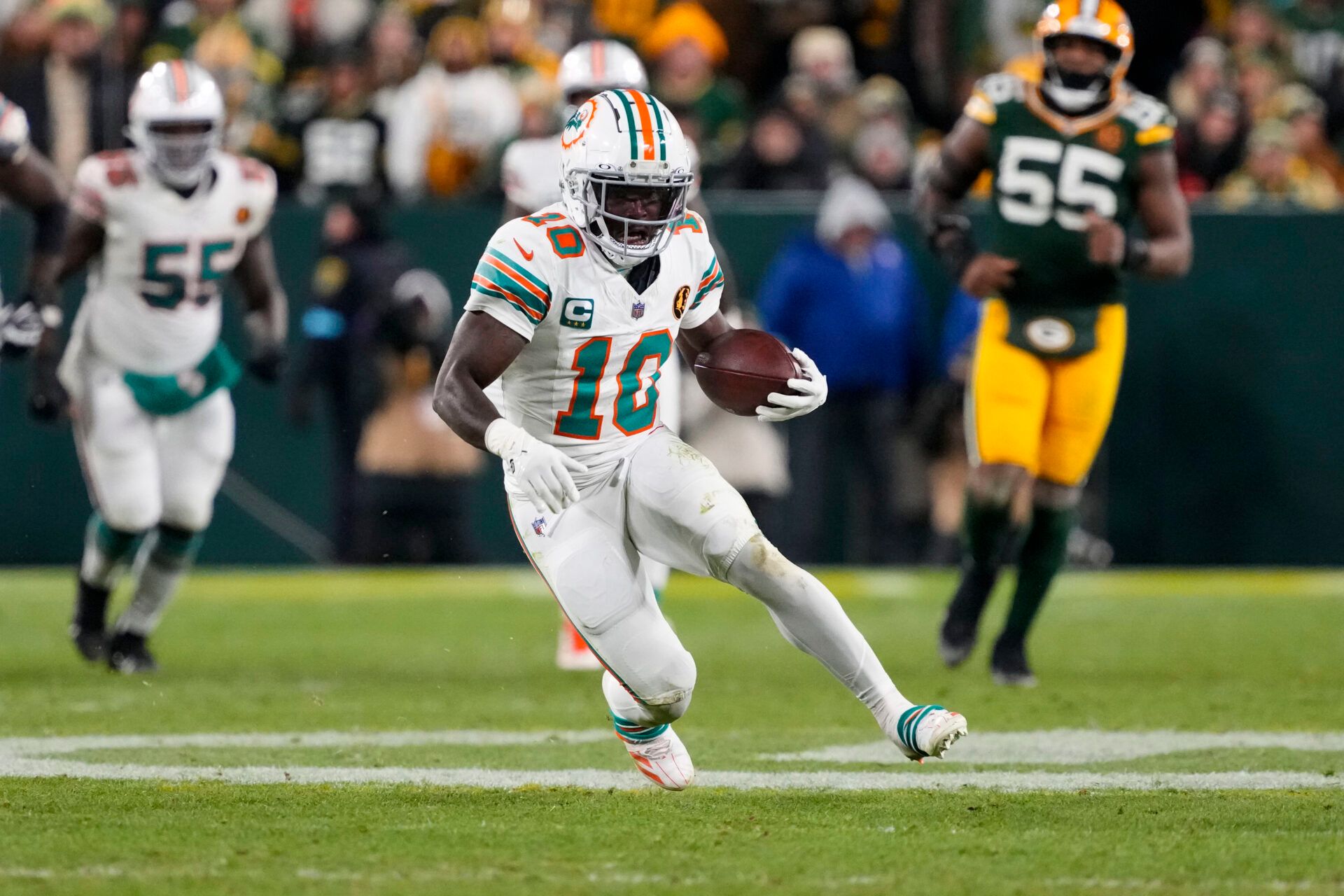
Miami Dolphins receiver Tyreek Hill has become fantasy football’s most controversial star, with traders increasingly backing away from the speedster as draft season heats up.
The numbers tell a concerning story that goes far deeper than simple target counts.

The Great Hill Exodus
PFSN users have spoken with their trades, and the message is crystal clear. Throughout August, 66.6% of deals involving Hill have seen fantasy managers move on from the former Chiefs star, according to PFSN’s Fantasy Football Trade Analyzer. This mass exodus reflects growing concerns about his evolving role in Miami’s offense and his ability to deliver on his lofty draft position.
The underlying metrics paint an even starker picture. For the first time in Hill’s career, he failed to meet the production baseline that any average NFL receiver would have achieved given his specific usage patterns. This represents a fundamental shift for a player who built his reputation on maximizing every opportunity.
TYREEK HILL. HUGE TOUCHDOWN.
📺: #CARvsMIA on CBS
📱: Stream on #NFLPlus https://t.co/B4mQvLOt8O pic.twitter.com/Uis2fkF3el— NFL (@NFL) October 15, 2023
Hill’s target distribution reveals the root of the problem. Modern NFL defenses have adapted to limit explosive plays by encouraging shorter passing attacks, making deep throws increasingly unreliable. Yet Miami has pushed Hill in the opposite direction, asking him to become more of a deep threat when the league is moving away from that approach.
The progression is striking. During his final season with Kansas City in 2021, just 23.3% of Hill’s targets came on deep routes. That figure jumped to 34.1% in his first Miami campaign, then climbed to 36.3% in 2023. Last season saw the most dramatic spike, with 40.7% of his looks coming downfield.
This shift creates a volatile fantasy asset. Deep targets produce feast-or-famine results, leading to inconsistent weekly performances that can derail championship runs. While Hill’s ceiling remains sky-high, his floor has dropped considerably, making him a riskier proposition than his early-round draft cost suggests.
The timing compounds these concerns. As Hill enters his age-31 season, speed-dependent receivers typically begin showing decline. Combining natural aging with an offense that increasingly relies on his diminishing deep-ball reliability creates legitimate questions about sustained elite production.
Smart fantasy managers recognize that paying premium prices for declining efficiency represents poor roster construction. Hill’s talent remains undeniable, but his current trajectory suggests the glory days of consistent WR1 production may be behind him. The mass trader exodus reflects this harsh reality, with savvy players pivoting to more reliable options at similar draft costs.
Sometimes the hardest fantasy decisions involve walking away from former superstars before the decline becomes obvious to everyone else.
