
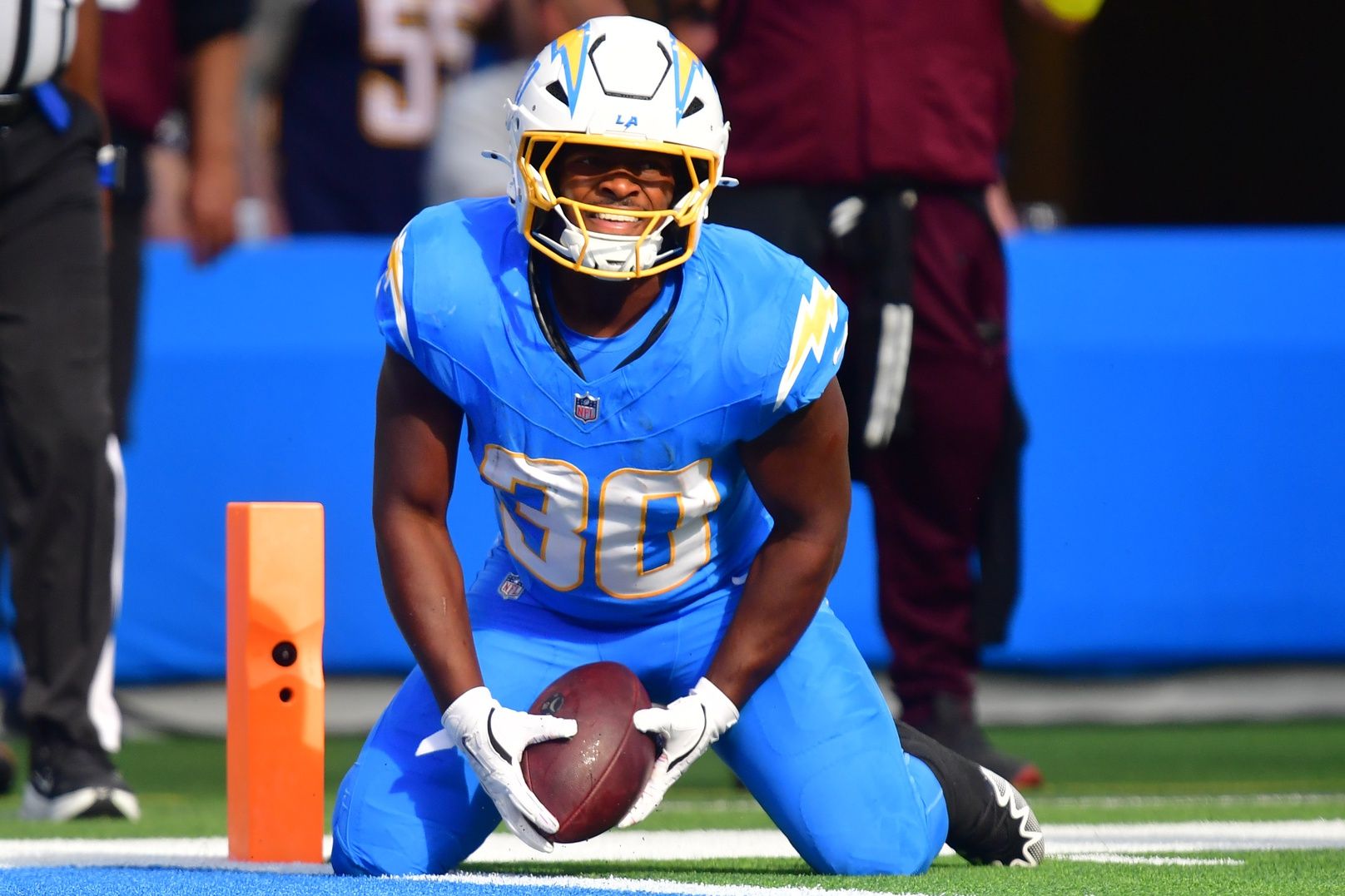
The Los Angeles Chargers’ backfield presents unprecedented uncertainty following Omarion Hampton’s ankle injury that landed him on injured reserve. Hassan Haskins and Kimani Vidal now split backfield duties in an offense that has dramatically shifted from its expected ground-heavy approach under Jim Harbaugh. Can fantasy football managers trust either Chargers runner against Miami’s struggling defense?
Hassan Haskins Fantasy Outlook
Haskins enters this opportunity with a nearly even workload split following Hampton’s injury, managing six touches compared to Vidal’s five after the starter departed. This balanced distribution reflects the coaching staff’s uncertainty about which player offers superior capabilities in an expanded role.
The connection between Haskins and head coach Jim Harbaugh extends beyond their current professional relationship. Haskins starred for Harbaugh at Michigan, where he rushed for 1,327 yards and 20 touchdowns in his final collegiate season. This established trust could prove valuable as the coaching staff evaluates backfield options moving forward.
Haskins brings a physical 6’1″, 220-pound frame that provides the prototypical early-down profile many coaches prefer for between-the-tackles situations. His willingness to embrace contact and secure positive yardage aligns with Harbaugh’s traditional ground-and-pound philosophy, despite the Chargers having moved away from that approach this season.
MORE: Free Fantasy Football Start/Sit Optimizer
However, his NFL production has been limited throughout his career. His 3.0 yards per carry average on 64 career attempts suggests efficiency concerns that could limit his effectiveness even with increased opportunities. The veteran’s primary value has come through special teams contributions rather than offensive production during his time with both Tennessee and Los Angeles.
The coaching staff’s decision to utilize both backs equally after Hampton’s departure indicates neither player has established clear separation in their evaluation process. Haskins’ experience and familiarity with Harbaugh’s system provide potential advantages, but his track record suggests modest expectations for explosive production.
Kimani Vidal Fantasy Outlook
Vidal brings a contrasting skill set that emphasizes explosiveness and versatility in both rushing and receiving situations. His college production at Troy showcased the big-play ability that creates fantasy-winning performances when game scripts cooperate favorably.
After Hampton’s departure, Vidal managed four carries for 18 yards while adding one reception, demonstrating his involvement in both phases of the ground game. His 3.25 yards after contact per attempt, despite limited opportunities, suggest the vision and cutting ability necessary to maximize blocking schemes effectively.
His receiving capabilities provide additional value in an offense that leads the NFL with a 65% neutral game script pass rate. Rather than embracing their traditional run-heavy identity, the Chargers have prioritized developing their passing attack around Justin Herbert and their receiving corps. This approach could significantly benefit Vidal’s pass-catching strengths.
The coaching staff’s decision to utilize both backs equally following Hampton’s injury suggests neither player has established clear separation in their evaluation process. Vidal’s youth and athletic upside may eventually win out if the committee approach continues throughout Hampton’s recovery period.
Should You Start Haskins or Vidal This Week?
Miami’s defense presents excellent conditions for whichever Chargers back receives primary duties. The Dolphins allow the seventh-most schedule-adjusted fantasy points per game to running backs. They surrendered over 200 rushing yards to Rico Dowdle in their most recent contest. Their defensive struggles create realistic expectations for meaningful production.
The Chargers carry a 24-point implied team total, suggesting they should score three to four touchdowns against Miami’s vulnerable defense. Herbert likely won’t account for every scoring opportunity, creating touchdown equity for both running backs that elevates their fantasy ceilings.
Haskins emerges as the safer choice based on his established relationship with Harbaugh and early-down profile. Sportsbooks project slightly higher yardage totals for the veteran, though these projections carry minimal predictive value given the limited sample sizes available. His experience and familiarity with Harbaugh’s system provide marginal advantages.
However, the reality involves significant uncertainty regarding touch distribution and role definition. Offensive coordinator Greg Roman confirmed both players will factor significantly without establishing a clear lead back, creating weekly volatility that makes confident projections impossible.
Both backs function as serviceable RB3/flex plays rather than reliable weekly starters. Fantasy managers facing roster construction challenges should lean toward Haskins for his slightly higher floor, while those seeking upside potential may prefer Vidal’s explosive capabilities.
