
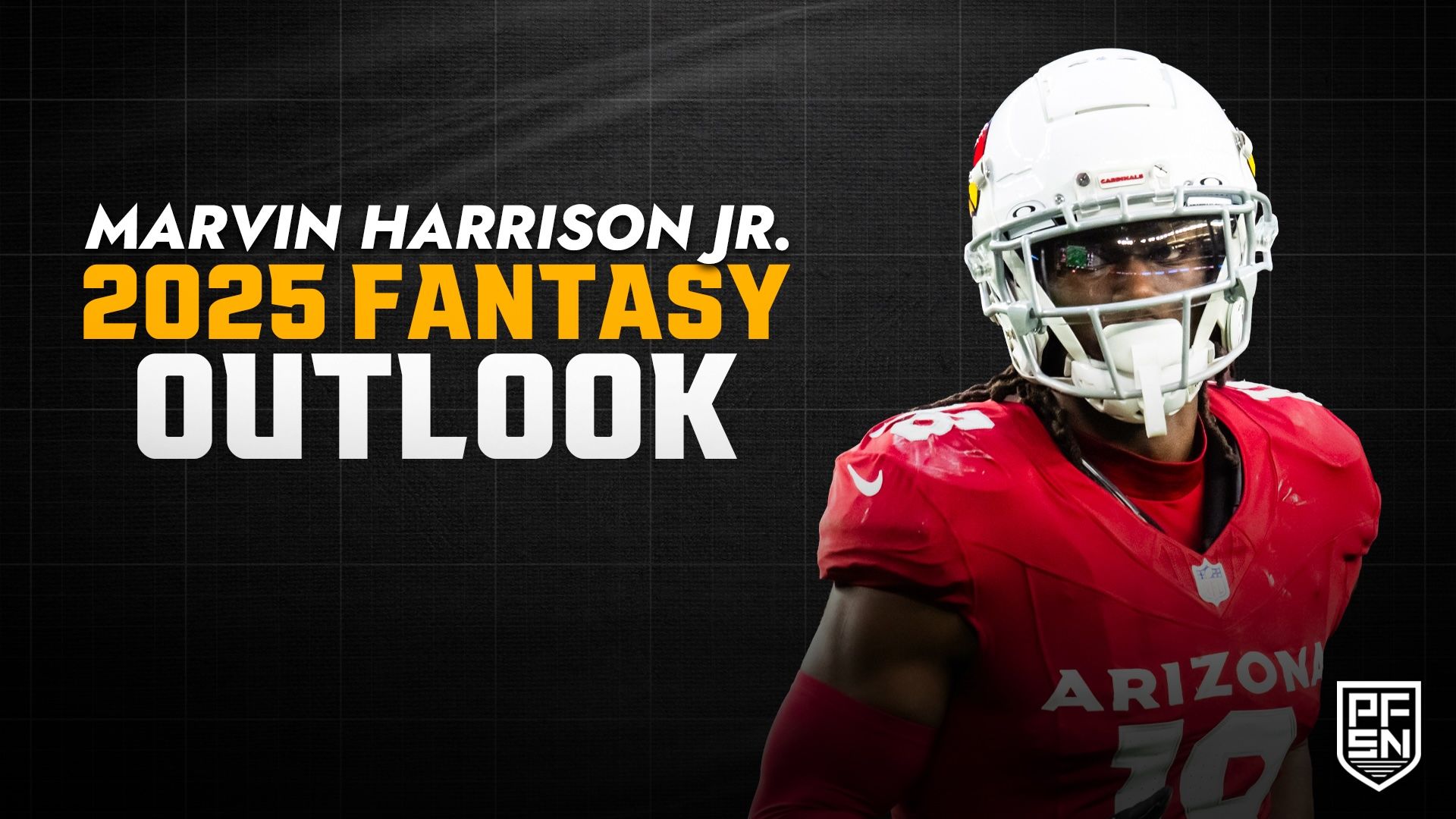
Last year, the Arizona Cardinals’ Marvin Harrison Jr. set what is likely an unbreakable record for the highest rookie wide receiver average draft position (ADP) in fantasy football history. He was the surest of sure things for rookie WRs…until he wasn’t. A major disappointment from a fantasy perspective, the question is now, are the Cardinals prepared to make Harrison a focal point of their passing attack in year two, allowing him to truly break out?
Marvin Harrison Jr. Fantasy Outlook
Whether Harrison lives up to the hype remains to be seen. But he was objectively one of the greatest WR prospects of all time. So much so that his redraft ADP as a rookie was in the early second round. We have never and likely will never see that again.
Harrison’s high ADP made him quite the polarizing player. Those who argued that it didn’t matter how talented he was, they’re not taking a guy who never played an NFL snap in the early second round, wound up being proven correct.
In retrospect, it looks so obvious. After all, where was the upside? The reason rookies are such good investments is because of their price. Guys like Malik Nabers, Ladd McConkey, and Brian Thomas Jr. were mega smashes because they put up the season Harrison was priced at, but didn’t cost anywhere near as much.
At best, Harrison was likely to return to par value. It was just an impossible ask. Even the three superstar rookies I mentioned above would have only been fine picks at best at Harrison’s ADP. Lesson learned.
With that said, it’s not as if Harrison was bad. He caught 62 passes for 885 yards and eight touchdowns. That’s a damn good rookie season. Sure, he only averaged 11.6 fantasy points per game. But plenty of future stud receivers had good real-life rookie seasons that weren’t good fantasy seasons.
Be careful fading Marvin Harrison Jr. after just one year…
Here’s how some other dynasty WR1s started their careers:
• Amon-Ra St. Brown: 912 yds | 5 TDs
• CeeDee Lamb: 935 yds | 5 TDs
• Nico Collins: 446 yds | 1 TD
• Drake London: 866 yds | 4 TDsI’m not saying it’s… pic.twitter.com/6f1KDxwdOH
— Andrew Mott (@Andrew2True) May 23, 2025
The sentiment surrounding Harrison is so negative because of how far he fell short of reaching expectations. If Harrison had been a fourth-rounder, he would’ve still been a massive disappointment, but it wouldn’t have been nearly as detrimental to fantasy managers.
In modern fantasy football, discounts based on underperformance are rare. Gone are the years when rookies were slept on, and sophomores coming off underwhelming rookie years were undervalued. We’re being charged for breakouts in advance.
Ten years ago, a guy like Harrison would be a fifth or sixth-round pick based on his rookie performance. Instead, his ADP sits at WR19, going around the 3/4 turn. He’s being priced lower than he was as a rookie, but about 25 spots ahead of where he finished.
If we’re being asked to pay for a breakout ahead of time, that breakout needs to be likely to occur.
The good news is that with this price, there’s also room for Harrison to exceed expectations. He has the talent to be a fantasy WR1. If he gets to 18 PPG, he will be one of the better picks in 2025 fantasy drafts. But can he?
Harrison Needs Better Usage To Return Value
It’s hard to find many positives from Harrison’s rookie season. He was the clear WR1 for the Cardinals, yet he only saw a 22.2% target share. Kyler Murray should’ve been hyper-focused on getting his top playmaker the ball. Instead, he threw to Harrison on just 22.1% of his routes run, 50th in the league. Harrison averaged 1.68 yards per route run, 58th in the league.
Harrison’s problem was twofold. First, he ran a lot of slow-developing routes, particularly over the middle. He won those routes at a 72.4% clip, tied for fourth best in the league. He was good! The problem was that they took too long to develop, and very often, Murray had to bail on the play before the window to throw the ball to Harrison was open.
The second problem was the complete lack of layup targets. If you watch any of the top pass-catchers, you will see their offensive coordinators design plays to just get the ball in their hands.
DJ Moore led the league with 47 screen routes last season. Some other notable screen route numbers were Garrett Wilson (32), CeeDee Lamb (26), Nico Collins (26), Jaxon Smith-Njigba (23), and Ja’Marr Chase (22). Care to guess how many Harrison had? I’ll give you a second. Got your answer?
The answer was three. Yes. Three. The WR1 for the Cardinals ran just three screen routes all season. He did not see a single screen target.
Just 5.6% of Harrison’s routes ran were slants. That was 41st in the league among players with at least 60 targets.
Downfield targets are necessary for high-end fantasy production. We want chances at splash plays that generate fantasy points in bunches. But the top players need easy points. Those come from easy targets. For reasons unknown, the Cardinals did not think it was important to scheme the ball to their top receiver.
MORE: Free Fantasy Football Mock Draft Simulator
I am very confident that Harrison is a talented football player. Long term, he will be fine. I expect multiple future WR1 seasons. But in 2025, Harrison has the same quarterback and the same offensive coordinator. I’m just not sure what’s going to change.
I have Harrison ranked as my WR17. I expect a jump, but the market is more bullish than I am. Given the part of drafts Harrison typically goes, I don’t expect to draft much Harrison, if any, this season.
Frank Ammirante’s Marvin Harrison Jr. Fantasy Projection
Marvin Harrison Jr. was one of the most hyped wide receiver prospects in recent memory, getting steamed to the early second round of fantasy football drafts last year. After a disappointing season that saw him put up 62 catches, 885 yards, and eight touchdowns, you can get Harrison in the mid-third round.
The question you have to ask is, is this enough of a discount after such a disappointing rookie season?
The positive for Harrison is the touchdown upside after putting up eight scores in his first year. Double-digit touchdowns are firmly in reach for the primary red zone target in Arizona. You also like to see the spike weeks he had in Year 1, including four catches for 130 yards and two touchdowns against the Rams.
The downside for Harrison is that this is still the same playcaller with Drew Petzing as offensive coordinator. We saw him use Harrison mostly on the perimeter running downfield, when his skillset involves so much more than that. This role can result in a boom-or-bust profile because so many targets are harder to haul in.
With that in mind, I would exercise caution in taking Harrison. It’s best if you get him as your WR2 instead of your top wideout.
