
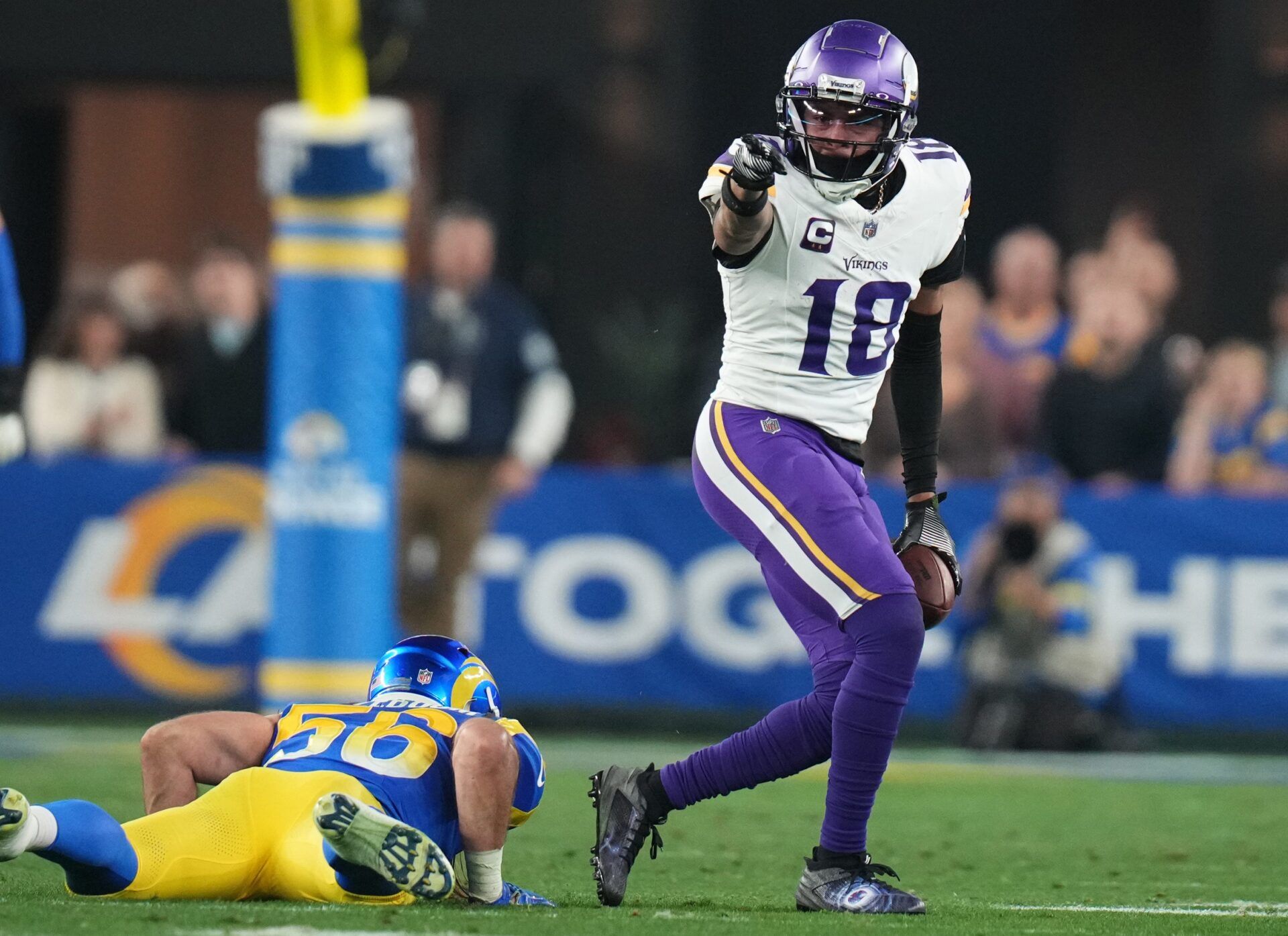
The fantasy football community has spoken, and their message is crystal clear: Justin Jefferson remains the most coveted asset in dynasty leagues despite entering uncharted territory with an unproven quarterback.
Trade activity tells the story better than any expert ranking, with Jefferson involved in 16.5% more PFSN Trade Analyzer trades than any other player since May 1st. This surge in movement reflects both his elite production history and the uncertainty surrounding his 2025 outlook.

The Rookie Quarterback Paradox
Jefferson’s current average draft position of No. 2 overall presents a fascinating contradiction in fantasy football logic. Last season, when paired with a quarterback who had at least thrown professional passes, his ADP sat at No. 8 overall. Now, entering a campaign where his signal-caller has never taken a snap in the NFL, fantasy managers are drafting him six spots higher.
This dramatic shift defies conventional wisdom about receiver-quarterback chemistry and the typical learning curve associated with rookie quarterbacks.
Note: Technically, JJ McCarthy is not a rookie, as he was drafted in 2024. However, McCarthy missed his entire rookie season with an offseason meniscus tear. Therefore, he is essentially as green as a rookie, making the comparison work.
Historical data suggests that elite receivers often experience statistical dips when paired with first-year quarterbacks, as timing routes and red zone efficiency typically suffer during the adjustment period.
Yet Jefferson’s track record has fantasy managers betting against this trend.
The elevated draft position reflects more than blind faith in Jefferson’s abilities. His consistent production regardless of quarterback play has established him as a matchup-proof asset. Over his NFL career, he has worked with multiple signal-callers and maintained elite-level performance through various offensive schemes and coordinator changes.
Justin Jefferson is so dang smooth 😮💨 pic.twitter.com/Ot61wG37w5
— Football’s Greatest Moments (@FBGreatMoments) July 5, 2025
Consistency Beyond Compare
Jefferson’s statistical dominance becomes even more impressive when examined through the lens of expectation management. He has exceeded expectations by 13% or more in every single season of his professional career. This level of sustained overperformance is virtually unmatched among current receivers.
The comparison to CeeDee Lamb provides crucial context for understanding Jefferson’s elite tier status. While Lamb has emerged as a top-tier receiver, he has achieved the 13% threshold only once in his career. This stark difference highlights Jefferson’s ability to consistently outproduce even the most optimistic projections, a trait that separates true fantasy superstars from merely excellent players.
This consistency extends beyond raw statistics to include his ability to maintain production despite defensive attention and game script variations. Jefferson has proven capable of producing elite numbers in blowout wins, close losses, and everything in between.
His route-running precision and ability to create separation have made him quarterback-agnostic in ways that few receivers achieve.
Market Dynamics and Trade Value
The trading frenzy surrounding Jefferson reveals the complex calculus fantasy managers face when evaluating risk versus reward. His status as the most traded player indicates that some owners view the rookie quarterback situation as a selling opportunity, while others see it as a chance to acquire a proven commodity at a potentially discounted rate.
Dynasty league managers particularly value Jefferson’s age profile and contract situation.
At 25, he represents the perfect blend of proven production and remaining prime years. His recent contract extension with Minnesota provides stability and ensures he’ll remain the focal point of the offense regardless of quarterback changes.
The trading activity also reflects broader market inefficiencies in how fantasy managers evaluate quarterback-receiver relationships. While conventional wisdom suggests caution when elite receivers pair with rookie quarterbacks, Jefferson’s unique skill set and the modern NFL’s emphasis on quick-hitting passing attacks may minimize traditional concerns about timing and chemistry.
Furthermore, Minnesota’s offensive infrastructure remains largely intact despite the quarterback change. The coaching staff, offensive line, and supporting cast provide continuity that should ease the transition period.
Jefferson’s ability to win at all three levels of the field gives any quarterback multiple options for getting him the ball in advantageous situations.
The combination of elite talent, proven consistency, and market volatility creates a unique opportunity for savvy fantasy managers.
Whether buying or selling, Jefferson’s current situation represents one of the most intriguing decision points in dynasty football, with his historical performance suggesting that betting against his continued excellence remains a dangerous proposition.
