If you want the biggest bang for your buck, targeting rookies in your fantasy drafts is your best bet. Fantasy football is full of risk, even from proven performers. So while others hesitate because “they haven’t done it in the league yet,” take advantage and find value where others are shying away.
The 2025 class featured a ridiculously deep, top-heavy running back group, meaning there’s ample opportunity to find value in the middle and late rounds. Meanwhile, a wide receiver you hadn’t heard of could quickly establish himself as a mainstay in his offense early in the season.
Here’s a rundown of the most relevant rookies and whether you should consider drafting them at their current cost.
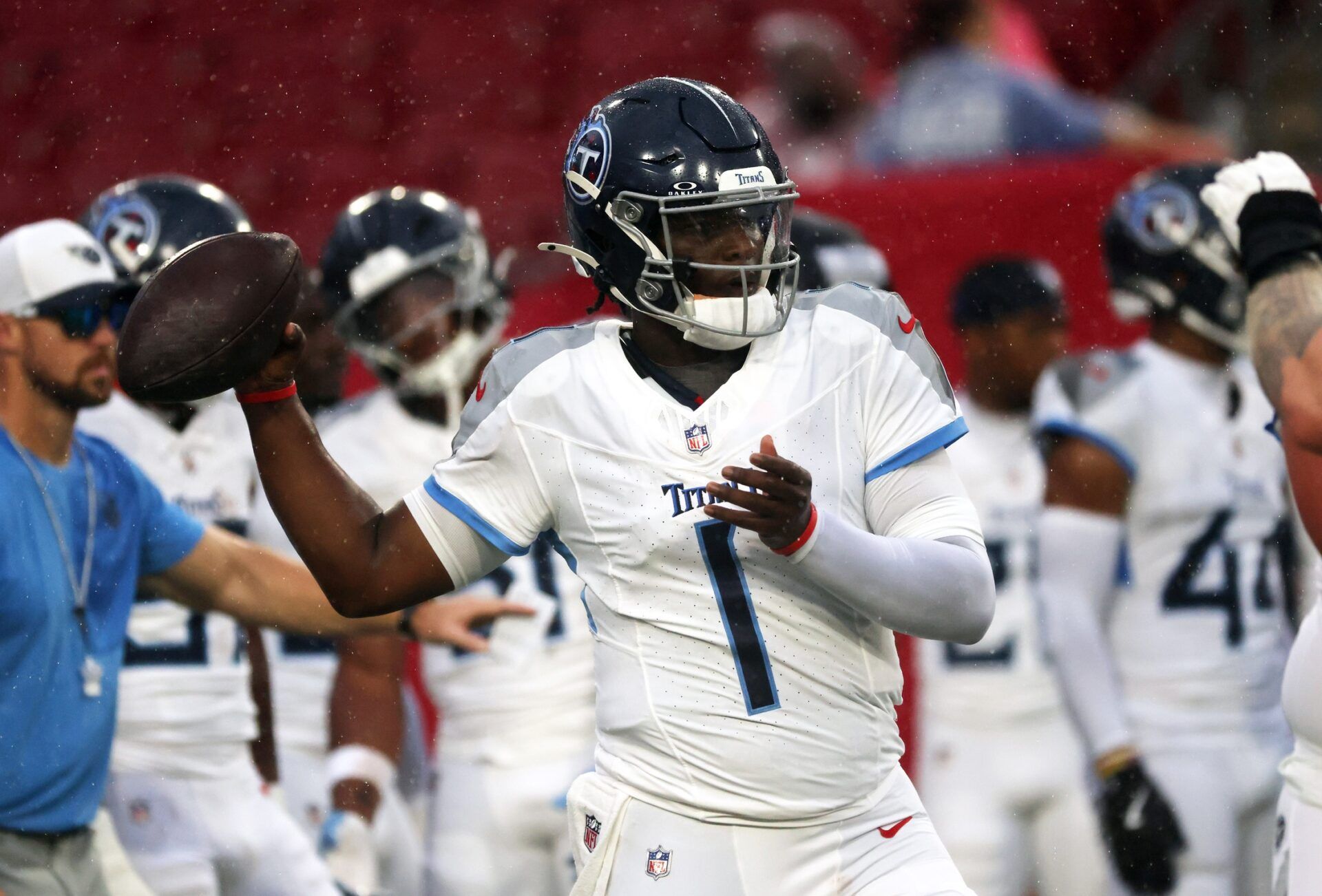
Cam Ward, QB, Tennessee Titans (ADP: QB24)
The only quarterback worth considering from this year’s rookie group. While he doesn’t carry the same hype as much of last year’s class, neither did Bo Nix and his discouraging cast of weapons. Yet Nix played a crucial part in getting his team back into the playoffs, surpassing expectations in both real life and fantasy.
Hell of a throw by Cam Ward. Catch the ball pic.twitter.com/kOm4oggjj3
— Billy M (@BillyM_91) August 15, 2025
Cam Ward has the chance to do the same thing. The Titans have a long way to go — the supporting cast is questionable, the coaching staff is unproven, and Ward has to prove himself. However, that uncertainty has kept his cost quite low, even in superflex formats. For the chance at an exciting young quarterback at minimal cost, he’s worth a shot.
Ashton Jeanty, RB, Las Vegas Raiders (ADP: RB4)
You will not get Ashton Jeanty at a discount. Instead, you have to decide whether he can hit his upside as a fantasy prospect in Year 1. The Raiders were not the most exciting landing spot, but they’ve overhauled their leadership and now look capable of supporting a true RB1. At the end of the first round, his questions don’t exceed the injury risk of Christian McCaffrey or the age of Derrick Henry.
Crucially, Pete Carroll should allow him to be the workhorse in this offense, and the depth chart behind him supports that. A rookie of this caliber is worth the investment.
Omarion Hampton, RB, Los Angeles Chargers (ADP: RB15)
In most years, Hampton would be the clear RB1 of his class, but he declared the same year as Jeanty. That may have been a blessing, allowing him to land on a more talented team. Now, in Greg Roman’s run-heavy offense, Hampton is set up for plenty of work.
He may split time with Najee Harris, but this offense should support both players. Last year, JK Dobbins found plenty of success without breakaway speed or big-play ability. Harris won’t offer that either, so Hampton should see a steady uptick in touches throughout the year, paving the way for a potential top-10 finish.
TreVeyon Henderson, RB, New England Patriots (ADP: RB20)
One of my favorite fantasy prospects this year, Henderson’s ADP dipped after he joined the Patriots but rose again following highlight-reel preseason performances. While others see the Patriots’ offense as a problem, I think his skill set was exactly what they needed, setting him up for a solid workload.
TreVeyon Henderson with a 3rd and 10 carry to convert and then a 3rd and 4 inside the 10 for a touchdown.
One of the only rookies we don’t have to worry about in pass pro
The Patriots cannot keep this guy off the field.pic.twitter.com/5tka8MLLOj
— Al Calo (@Calo_Football) August 16, 2025
Henderson has never held a backfield by himself, so the biggest question is whether he’ll see 250-plus touches as a rookie. Rhamondre Stevenson doesn’t worry me much, but don’t panic if Stevenson handles a chunk of the early work. Between the big plays and receiving upside, Henderson should be efficient with what he’s given.
RJ Harvey, RB Denver Broncos (ADP: RB21)
Harvey was one of my favorite draft targets in a loaded running back class. A former quarterback, he has only played running back for a few years and now must learn Sean Payton’s intricate offense.
Keep an eye on Dobbins early, but don’t forget about Harvey. The Broncos’ offensive line is built to support its backs, and Payton will find creative ways to involve them in the passing game. Don’t panic if Harvey isn’t a PPR monster by Week 3 or 4, or buy low if another manager gives up. He has the tools to be a late-season league-winner.
Kaleb Johnson, RB, Pittsburgh Steelers (ADP: RB28)
Johnson is one of the most frustrating rookie prospects. He excels in the wide-zone scheme and was drafted by a team that runs it, but the Steelers’ offense remains boom-or-bust with Aaron Rodgers, DK Metcalf, and a young offensive line.
Does that mean Johnson is built to thrive if everything clicks? Maybe. But Rodgers isn’t likely to trust a rookie in pass protection or the receiving game, and Jaylen Warren and Kenneth Gainwell are better suited for that role. Can Johnson be valuable enough as a runner alone? I’d lean no.
Quinshon Judkins, RB, Cleveland Browns (ADP: RB32)
An uncomfortable offseason due to off-field issues seems to be resolving, putting Judkins back on the field. He was built to be a workhorse with upside from Day 1, and with Cleveland reverting to Kevin Stefanski’s scheme, plus questions at quarterback, the Browns will likely run a lot in 2025.
It may not be the healthiest offense to invest in, but at this ADP, you want upside and workload. Rookie Dylan Sampson may have earned some trust while Judkins was away, but he projects more as a change-of-pace option. A slightly riskier pick, Judkins is still worth it at a discounted price.
Cam Skattebo, RB, New York Giants (ADP: RB37)
Skattebo quickly won fans over with his bruising style during Arizona State’s playoff run, but his draft stock dipped due to questions about speed and durability. His profile as a power back with receiving ability still has appeal.
That said, his ADP feels inflated. Reports out of camp suggest he hasn’t beaten out Tyrone Tracy, who may hold the starting role. Skattebo should find some work, but without consistent touches or scoring upside, he’s not worth considering at cost.
Jaydon Blue, RB, Dallas Cowboys (ADP: RB43)
The Cowboys continue to miss out on adding an RB to their offense, something that’s been desperately missing since Ezekiel Elliott lost his touch. They brought in a pair of unexciting vets, Javonte Williams and Miles Sanders, and drafted Jaydon Blue in the fifth round. Blue, a speedster from Texas, is the only upside option of this bunch.
There hasn’t been a lot of hype around him out of camp, and an injury slowed him down further. As such, Blue’s value is very low. However, once the season is in full swing and Dallas gets frustrated with its first options, Blue is going to get a real look and playing time. This is an offense and role I’d like to invest in, so grab Blue late or keep a close eye on him on waivers, and hope for the best.
Bhayshul Tuten, RB, Jacksonville Jaguars (ADP: RB51)
One of the lessons managers should have learned from last year was to take shots on ambiguous backfields. That’s how you end up with Chase Brown, J.K. Dobbins, and Bucky Irving at tremendous values.
Much like those scenarios, I have no idea who’ll win the RB job in Jacksonville as all three backs have rotated at the starter throughout camp. Could Tuten be the next Chase Brown? Probably not, but it costs close to nothing to find out.
Tetairoa McMillan, WR, Carolina Panthers (ADP: WR25)
The hype around rookie receivers has died down significantly. Around this time last year, Marvin Harrison Jr. and Malik Nabers were not attainable at a reasonable cost, but this year, McMillan and Travis Hunter are. Just a fifth-round pick, McMillan enters the alpha role in the Carolina offense almost unquestioned.
It requires some projecting forward for young QB Bryce Young, but if you can buy into what he did at the end of last season, then you can draft McMillan with confidence. A top-10 pick, WR1, and a fifth-round price is worth the shot, regardless of how you feel about this team. But a weak defense and susceptible division line up nicely for early success.
Travis Hunter, WR, Jacksonville Jaguars (ADP: WR31)
Hunter is the only true unicorn to come out of the draft in recent history, showing off a skill set that was common in the 1950s but not so much in the modern era. Joining Trevor Lawrence and Liam Coen in Jacksonville, the new regime was willing to trade a future first-round pick just to move up a few spots to grab him. Shouldn’t you be willing to draft him in the fifth round?
There’s valid hesitation. You’d hate to lose your WR2/flex because he plays defense for a week. While he’s currently slated to be a full-time receiver and backup corner, that worry could persist throughout the season. You shouldn’t be so scared as to avoid him completely, but caution in this situation is valid.
Matthew Golden, WR, Green Bay Packers (ADP: WR42)
An ambiguous Packers receiving corps should be far more straightforward now, barring a breakout from someone else. The first first-round receiver for Green Bay in two decades, there was clearly a lot of belief in Golden from the Packers. If nothing else, he should settle the roles that were up for grabs previously in this offense.
His cost is a tad high for the uncertainty, but that’s the chance you have to be willing to take on an upside option tied to a good offense. Golden may take some time to assert himself as the No. 1, but if he gets to that role by season’s end, he could be a difference-maker for the fantasy playoffs.
Emeka Egbuka, WR, Tampa Bay Buccaneers (ADP: WR47)
Ohio State’s all-time receiving leader went ahead of Golden in the draft, yet goes a round and a half lower in fantasy. Golden may step into WR1 duties earlier, whereas Egbuka may not at all, but the latter is the more proven prospect in a more lucrative passing offense.
Baker Mayfield calls Emeka Egbuka “the real deal” 📈
Egbuka’s ADP is currently 127 on Yahoo 👀
(via @newheightshow) pic.twitter.com/9Q6YWC7Grc
— Yahoo Fantasy Sports (@YahooFantasy) July 24, 2025
Should Chris Godwin return sooner rather than later, that could obviously kill Egbuka’s value. However, it seems more likely that Godwin won’t return soon and will need plenty of ramp-up time before he’s an established threat again. Tampa took Egbuka for a reason; he’s been on fire all camp, and his teammates and coaches can’t stop raving about him. Don’t hesitate, especially at his current cost.
Jayden Higgins, WR, Houston Texans (ADP: WR53)
The NFL was a big fan of Higgins in the draft, and the Texans were even more so, taking him high in the second round and guaranteeing his full contract, an unprecedented move at the time. Another ball-winner across from Nico Collins and catching passes from C.J. Stroud, there isn’t much not to like.
His lower price comes from a crowded receiving corps. Collins will be the alpha in this offense, and they added Christian Kirk to replace Tank Dell. However, some of that should be offset by a lack of a running game due to Joe Mixon’s injury and an ugly offensive line. If Higgins can work into a clear No. 2 option by the end of the season, this offense may become pass-heavy enough to support it for fantasy.
Tre Harris, WR, Los Angeles Chargers (ADP: WR57)
Harris going at this cost makes Jayden Higgins look like an excellent value. The Chargers did invest a high pick into Harris, but unless he has a 180 from his camp reports, he’ll still be a second or third option on a run-heavy offense.
This offense is set up to run a lot and then run some more. Ladd McConkey is a target sponge and reliable threat. They even brought back Keenan Allen, who at his age still caught 121 passes between a first-round rookie and proven D.J. Moore last season. It doesn’t feel like Harris’s role is set up for volume or valuable targets.
Tyler Warren, TE, Indianapolis Colts (ADP: TE10)
Just for comparison, Warren going at TE10 is about the same value as Cam Skattebo going as RB37. For a thin position, Warren is going quite low in drafts despite an influx of rookies at the position producing early. The Colts aren’t exactly a bastion of fantasy production, but they do need someone to be the go-to target in the passing game.
Warren is one of my favorite targets if you punt on the position through the early and mid rounds. He has the floor and scoring potential to survive early if Anthony Richardson is the starter, but once Daniel Jones enters the lineup, Warren should quickly see a rise in targets. Once again, the risk at his cost seems too appealing to pass up.
Colston Loveland, TE, Chicago Bears (ADP: TE11)
Loveland may be the superior pass catcher to Tyler Warren, with a better supporting cast, and was a higher draft pick. Yet he goes a full round after Warren. Why? Because, despite his talent, the Bears have a far more ambiguous receiving corps.
It’s easy to envision Warren leading the Colts in targets as a rookie, but Loveland may not be the starting TE in Chicago if Cole Kmet can hang on to his role. The Bears, under new offensive play-caller and head coach Ben Johnson, have to work in fellow rookie Luther Burden, last year’s top-10 pick Rome Odunze and their true WR1, D.J. Moore. That’s a lot of mouths to feed for a young QB-HC duo. Keep an eye on Loveland on the wire for a late-season breakout, but I wouldn’t look this way for an early-season fill-in at the position.
