
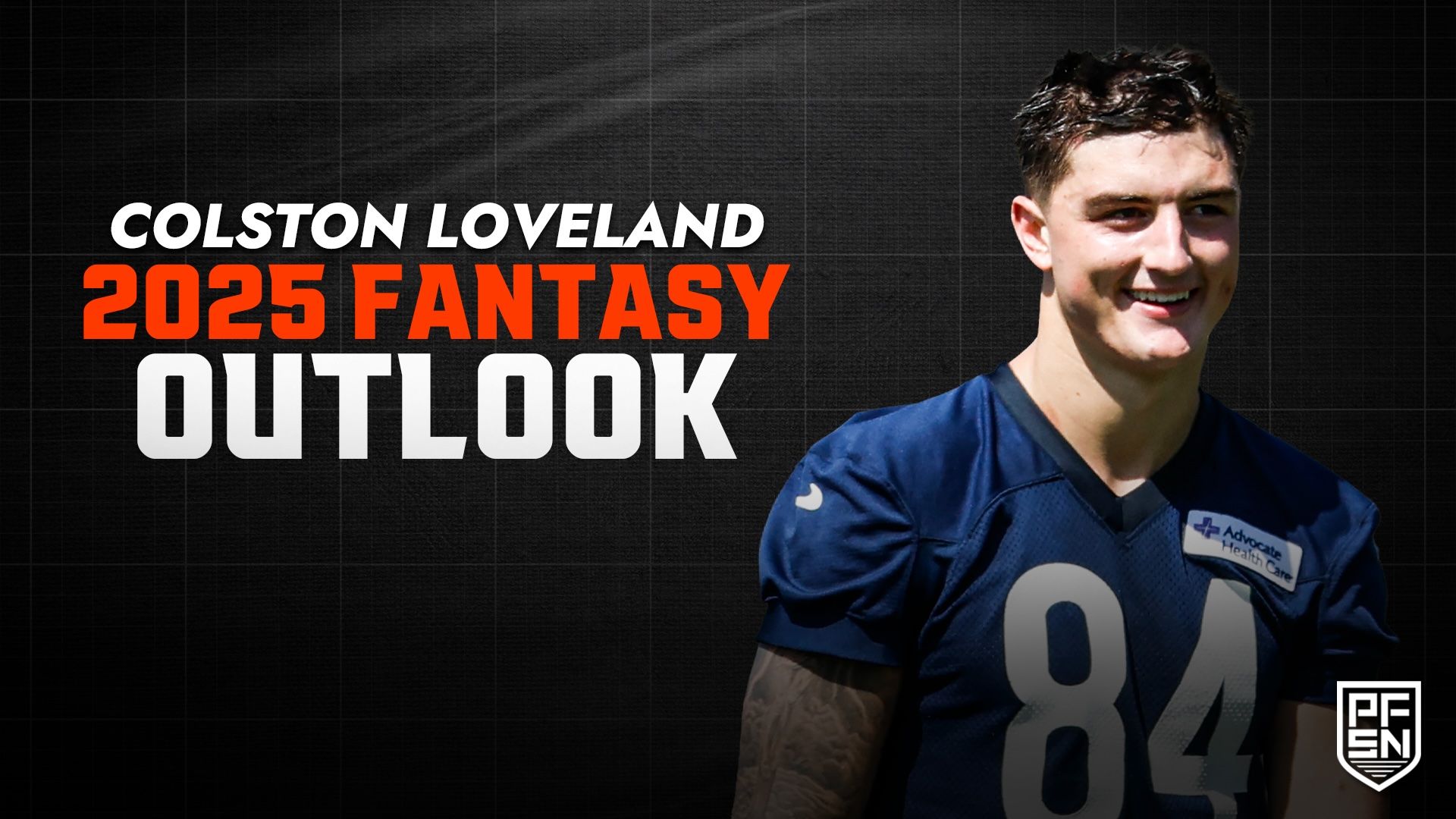
Rookie tight ends used to be an auto-fade in fantasy football redraft settings, but we’ve seen that belief be busted in recent years. Look at the top of the 2025 TE rankings, and you’ll see youth well-represented, and the Chicago Bears are hoping that Colston Loveland can be next in line.
Should you leave your draft counting on the 10th overall pick in April as a weekly asset?
Should You Draft Colston Loveland in Fantasy?
Last season, it took roughly 10 PPR points to be a top-12 performer at tight end. Some weeks, it was higher than that, and others lower, but on a per-game basis, that was the minimum you hoped to get from your tight end throughout the 2024 fantasy season.
I cannot wait to see what Colston Loveland can do in the Bears offense.
TE size but plays like a WR. This offense is going to be a lot of fun pic.twitter.com/TWgPEE93SH— Just Another Year Chicago: Bears (@JAYChi_Bears) June 17, 2025
As I’m sure you’re aware, that’s been a tough number for rookies at the position to get. Over the past decade, only four of 20 qualified tight ends have gotten there, with the majority checking in well under 8.0 points per game.
That said, the three most recent Round 1 tight ends have done enough to make them plausible fantasy options, if not substantial profits given where they were drafted.
- 2021 Kyle Pitts: 10.4 PPG (TE11, 0.7 PPG away from TE8)
- 2023 Dalton Kincaid: 9.4 PPG (TE14, 13 PPG away from TE8)
- 2024 Brock Bowers: 15.5 PPG (TE3)
We are slowly dismissing the idea that rookies can’t come in and impact the fantasy game at this position. I think that’s likely to continue for as long as defenses insist on taking away the big play, thus surrendering the space in which these prospects can thrive.
MORE: Free Fantasy Football Mock Draft Simulator
That’s even more true when a team identifies a tight end as a chain-moving option and invests heavily. Loveland stands 6’6” and weighs in at 248 pounds, which is a nice frame for a player with the type of varied route tree he enters the league with.
Last season, Caleb Williams ranked 13th in passer rating on passes thrown less than 10 yards down field (ahead of Kyler Murray, Bo Nix, Jordan Love and others) and 33rd on all other passes (behind Kirk Cousins and Daniel Jones to name a few).
I fully expect him to develop a more well-rounded pass diet in his second season, but the underneath game is going to be featured in this Ben Johnson offense (his Lions ranked 31st in average depth of throw a season ago). With a pair of field-stretching receivers (Rome Odunze and Luther Burden III) slated to be on the field with regularity, there is going to be room for Loveland to operate.
I’m not anticipating a Brock Bowers-type year because I don’t think that role will be available. But why can’t he be what Zach Ertz was for Jayden Daniels a season ago? Ertz finished as fantasy’s TE9 and was even better once a solid connection was developed (7.0 through Week 5, 11.9 after that).
As long as you are committing to the pick in the later rounds and not pivoting at the first sight of a learning curve, I think Loveland is a great wait-on-TE option in all formats, as he is cheap exposure to an impressive skill set in an offense with plenty of potential.
Frank Ammirante’s Colston Loveland Fantasy Projection
Colston Loveland is a rookie tight end whom the Bears selected 10th overall. He is an elite prospect whose college production was suppressed due to a run-heavy offense. He can win downfield and generate big plays, which is rare for a tight end.
The problem is that it’s a crowded offense with the Bears, featuring other viable pass-catchers like DJ Moore, Rome Odunze, and Luther Burden. There’s also a risk that Loveland has to share some snaps with Cole Kmet, who is a starting-caliber tight end in his own right.
MORE: Fantasy Football Trade Analyzer
Considering these factors, Loveland looks like a bit of a risk at his current ADP. However, this is the type of game-breaking talent that you want to swing for the fences on with your tight end selection.
If he is as good as advertised, there’s upside that he can emerge as the second or third target in a much–improved offense. Still, I prefer to go with fellow rookie Tyler Warren, who has a clearer path to targets with the Colts.