
Alvin Kamara earned our trust through the first four years of his career. He was the perfect piece in the perfect situation and racked up fantasy points in a very sustainable way.
He was great. Was. Those glory days are behind us now, and this New Orleans Saints offensive situation is as bleak as any in the NFL. Should fantasy football managers feel comfortable in taking Kamara at a bit of a discount, or are there too many red flags to justify counting on the veteran as a weekly starter?

Should You Draft Alvin Kamara in Fantasy Football?
I was wrong. I was wrong last season in fading Kamara. He averaged over 100 scrimmage yards per game, averaged over four catches for the seventh time in eight seasons, and even had three games where he cleared 110 rushing yards (entering the season, he was doing that once every 20.2 games played).
Results-wise, very wrong. Process-wise? I’m not sure it was that bad, and that’s why I’m back for more, as I would continue to be a year early than a year late on a profile like this.
Let’s start with the macro before drilling down a bit. You don’t expect the Saints to be all that competitive. I don’t either, and if you asked that cute dog on Instagram that hits a ball down the stairs into buckets with sporting outcomes labeled on them, I think even he’d agree.
Last season, nine teams failed to lead for 40% of their defensive snaps. These, in large part, are the teams where you start to worry about running backs getting scripted out of the plan and leaving fantasy managers out in the cold (46 qualified running backs).
- New England Patriots: 38.4% lead, Rhamondre Stevenson ranked 39th in fantasy production over expectation
- Tennessee Titans: 37% lead, Tony Pollard (41st)
- Jacksonville Jaguars: 35.2% lead, Tank Bigsby (26th) and Travis Etienne (45th)
- Los Angeles Rams: 35.1% lead, Kyren Williams (25th)
- Carolina Panthers: 31.3% lead, Chubba Hubbard (29th)
- Las Vegas Raiders: 26.2% lead, Alexander Mattison (42nd)
- Cleveland Browns: 20.8% lead, Jerome Ford (11th) and Nick Chubb (46th)
- Chicago Bears: 20.2% lead, D’Andre Swift (31st)
- New York Giants: 19.6% lead, Tyrone Tracy Jr. (28th) and Devin Singletary (30th)
We are obviously dealing with a variety of skill levels on that chart. Still, the fantasy points against expectation is a measure against league average, so the fact that strong fantasy options like Williams and Hubbard were relegated to below-average producers is terrifying.
New Orleans was a five-win team last year with a -60 point differential, and that seems like a best-case scenario for 2025 (they currently have the second-shortest odds to hold the top overall pick in April).
I maintain that Kamara is on the back nine of his career and is more likely than not to experience decline, but there is no denying that I have one more out this year than last, largely due to the team’s lack of expectations around him.
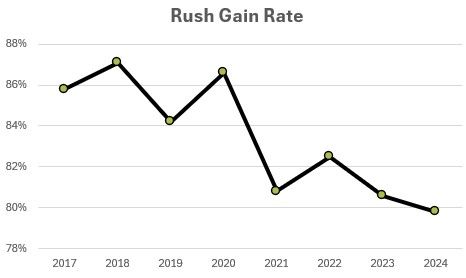
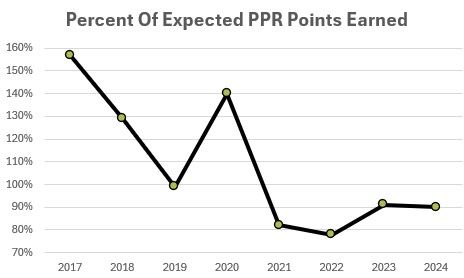
As for the per game fantasy football efficiency that once made Kamara a dominant asset, the graphs above show a decline. This list does more than hint at that: 43 running backs had 400+ carries over the past four seasons, and here’s the bottom end of that leaderboard in terms of fantasy efficiency when handed the rock.
Fantasy Points Per Rush
- 39. Antonio Gibson: 0.51
- 40. Alvin Kamara: 0.51
- 41. Javonte Williams: 05.0
- 42. Alexander Mattison: 0.49
- 43. Rachaad White: 0.48
The other four running backs on that list have been actively deprioritized in favored of unproven youth in some fashion over the past two seasons. You could argue that the aging risk of Kamara was at least on the minds of the Saints in 2023 (third-round pick spent on Kendre Miller), they just drafted a player their coaching staff would grow to despise.
That allowed Kamara to stay at the tippy top of this depth chart despite underwhelming rushing numbers. His unique skill set was a perfect fit for this Derek Carr/Pete Carmichael Jr. orchestrated offense for years. Well, Carr has hung up his cleats, and the Saints are welcoming in a third OC in as many years (current: Doug Nussmeier, a coach with no NFL playcalling experience).
2024 RB Leaders in Designed Targets per Game@FantasyPtsData
1. De’Von Achane, 2.1
2. Alvin Kamara, 1.8
3. Rachaad White, 1.6 (1.1 from Week 12-on)
4. Aaron Jones, 1.5
5. Bucky Irving, 1.4 (1.9 from Week 12-on)
6. Kenneth Walker, 1.4 pic.twitter.com/kfF08QgkCn— Fantasy Points Data (@FantasyPtsData) June 24, 2025
What if some of those drawn up looks evaporate? It’s certainly possible given the changes in personnel and what if things look as bad as they very well could through the first month of the season (opponents: Cardinals, 49ers, Seahawks, and Bills)? Kamara has said that he wants to retire a Saint, and they rewarded him with a two-year extension last October, but that doesn’t lock in his role should this season get away from them.
New Orleans bought in Cam Akers (laugh if you want, but he is four years younger than Kamara at a position that cycles through players rapidly) and drafted Devin Neal in the sixth round this April (last two years at Kansas: 3,017 scrimmage yards and 34 touchdowns).
I’m not suggesting that Kamara loses his role outright, but I do think there is some adjustment possibility and I’m not worried about that for the likes of Joe Mixon, RJ Harvey (the role change here would be in the positive direction as the season wears), James Conner, David Montgomery, or D’Andre Swift, all of whom our FREE Fantasy Football Mock Draft Simulator have as players being selected in the same general tier as the aging Saint.
When drafting running backs in the Round 4-7 range, I want stability. I want to know exactly what I’m getting, and that is usually tied to a reasonably successful offense. All of those names I just mentioned have a level of promise on that side of the ball this season that could fuel overachieving in terms of boxscore production, and I simply am having a hard time seeing that being the case for the 2025 Saints, a team that could be more focused on 2026 by the time Halloween comes around.
Dan Fornek’s Alvin Kamara Fantasy Projection
Alvin Kamara continues to churn out RB1 seasons regardless of the offensive environment surrounding him in New Orleans. Kamara finished as the RB5 in points per game (18.9). The veteran running back had modest rushing production (228 carries for 950 yards and six touchdowns), but led all running backs in targets (89) and produced a strong 68 receptions for 543 yards and two receiving touchdowns.
Kamara has scored at least 17.0 fantasy points in seven of his eight seasons. Since 2021, he averaged 217.8 carries and 79.8 targets per season. He finished third among running backs in yards per route run (1.6) and still posted respectable elusiveness metrics (18.0% avoided tackle rate and 2.6% juke rate) despite his age.
New Orleans spent the offseason trying to upgrade their offense for new head coach Kellen Moore. The Saints used the draft to add another first-round offensive tackle (Kelvin Banks Jr.) and their quarterback of the future (second-round pick Tyler Shough). Banks will help improve the run game (especially if Trevor Penning can win a starting guard spot), and Shough was no stranger to utilizing his running backs in the passing game during his final season with Louisville.