
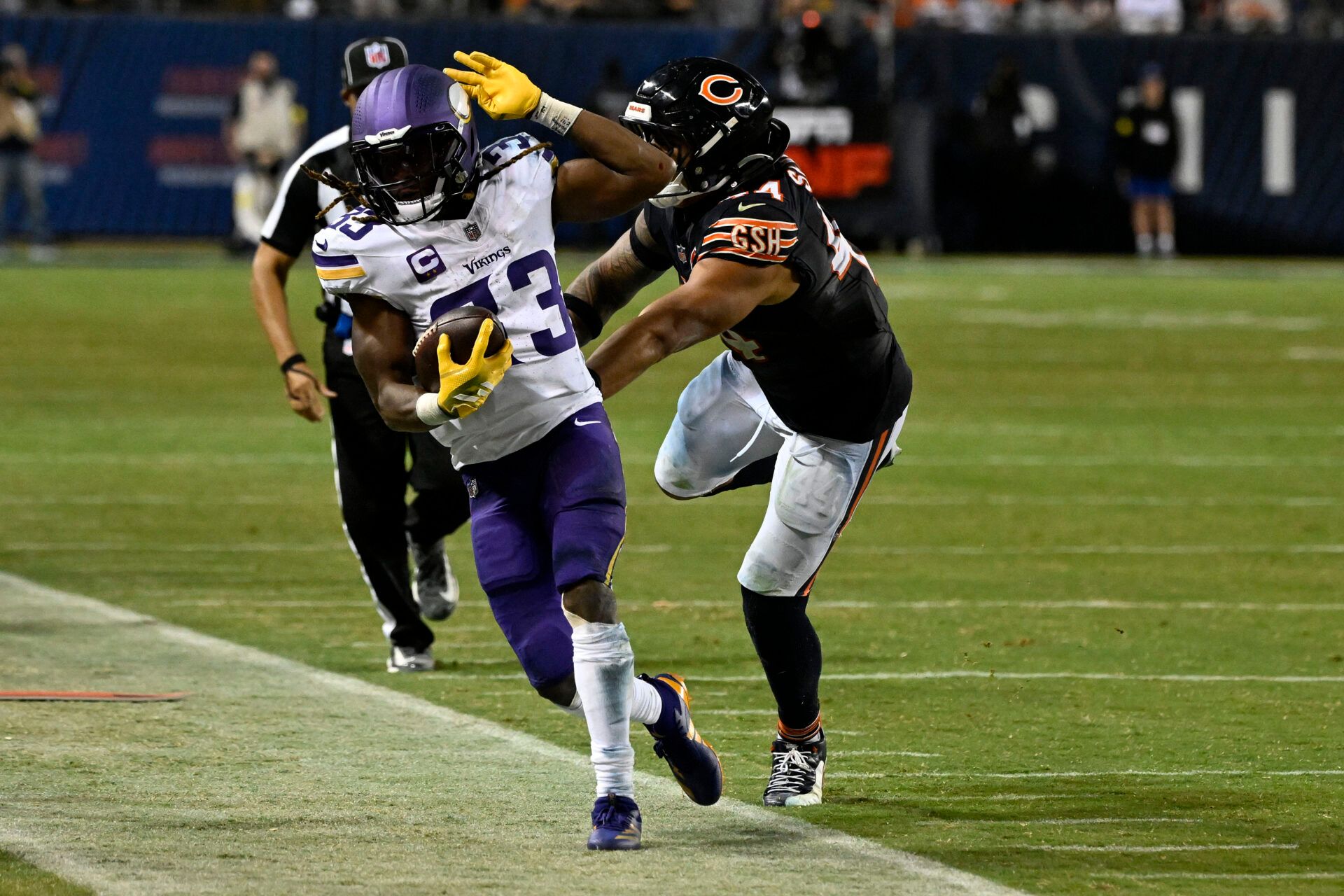
The Minnesota Vikings’ backfield situation became muddier after Monday night’s game against the Chicago Bears, where Jordan Mason narrowly outpaced Aaron Jones Sr. in snaps despite concerns about the team’s overall offensive struggles.
While Jones delivered fantasy production when it mattered most as a receiver, the underlying metrics reveal a more complex picture for managers moving forward.
Are Aaron Jones Sr. and Jordan Mason Now Splitting Carries?
Mason out-snapped Jones 30-28 in what many expected to be a clear showcase game for the veteran back.
That slim two-snap margin tells a different story than the 15.7 PPR points Jones ultimately produced. Mason’s involvement wasn’t merely situational either, as he commanded all seven red-zone opportunities for the backfield while Jones held only a marginal 13-9 edge in routes run.
The snap distribution suggests Minnesota views this as more of a committee than initially anticipated. Jones entered the season as the presumed lead back. Still, Monday’s usage patterns indicate the coaching staff values Mason’s skill set in specific situations, particularly near the goal line, where fantasy points are most valuable.
Production Dependent on Big Plays
Jones’ fantasy output relied heavily on one significant moment. His fourth-quarter touchdown reception accounted for 61.8% of his total production for the evening, transforming what could have been a disappointing performance into a respectable fantasy showing.
This touchdown dependency raises questions about his weekly floor, especially given the Vikings’ broader offensive challenges.
TOUCHDOWN AARON JONES
JJ McCarthy has turned it around in the second half 👀 pic.twitter.com/DijrTAVhvL
— Bussin’ With The Boys (@BussinWTB) September 9, 2025
Mason’s 8.5 PPR points came without any explosive plays, suggesting his role might provide more consistent weekly production even if his ceiling remains lower. Fantasy managers banking on Jones as a reliable RB2 option should consider how dependent his scoring potential is on finding the end zone or breaking off chunk plays.
Offensive Environment Concerns
Minnesota finished the week ranked in the bottom 10 for plays, yards, and time of possession, creating an unfavorable environment for sustained running back production.
While one game represents a small sample size, these metrics indicate the Vikings may struggle to generate enough offensive volume, especially early on in QB J.J. McCarthy’s first on-field season, to consistently support two fantasy-relevant backs.
RELATED: Vikings RB Depth Chart: Aaron Jones and Jordan Mason Battling For Minnesota’s RB1 Role
The limited offensive output puts additional pressure on both Jones and Mason to maximize their opportunities. In low-volume offenses, running backs typically need either goal-line work or passing game involvement to maintain fantasy relevance.
Monday’s game showed Mason monopolizing red-zone carries while Jones provided more value as a receiver, suggesting their roles might complement rather than compete with each other.
Fantasy managers should approach both backs with tempered expectations until Minnesota’s offense demonstrates more consistency. The committee approach, combined with limited offensive volume, creates uncertainty that makes both players risky weekly starts despite Jones’ Monday night success.
