
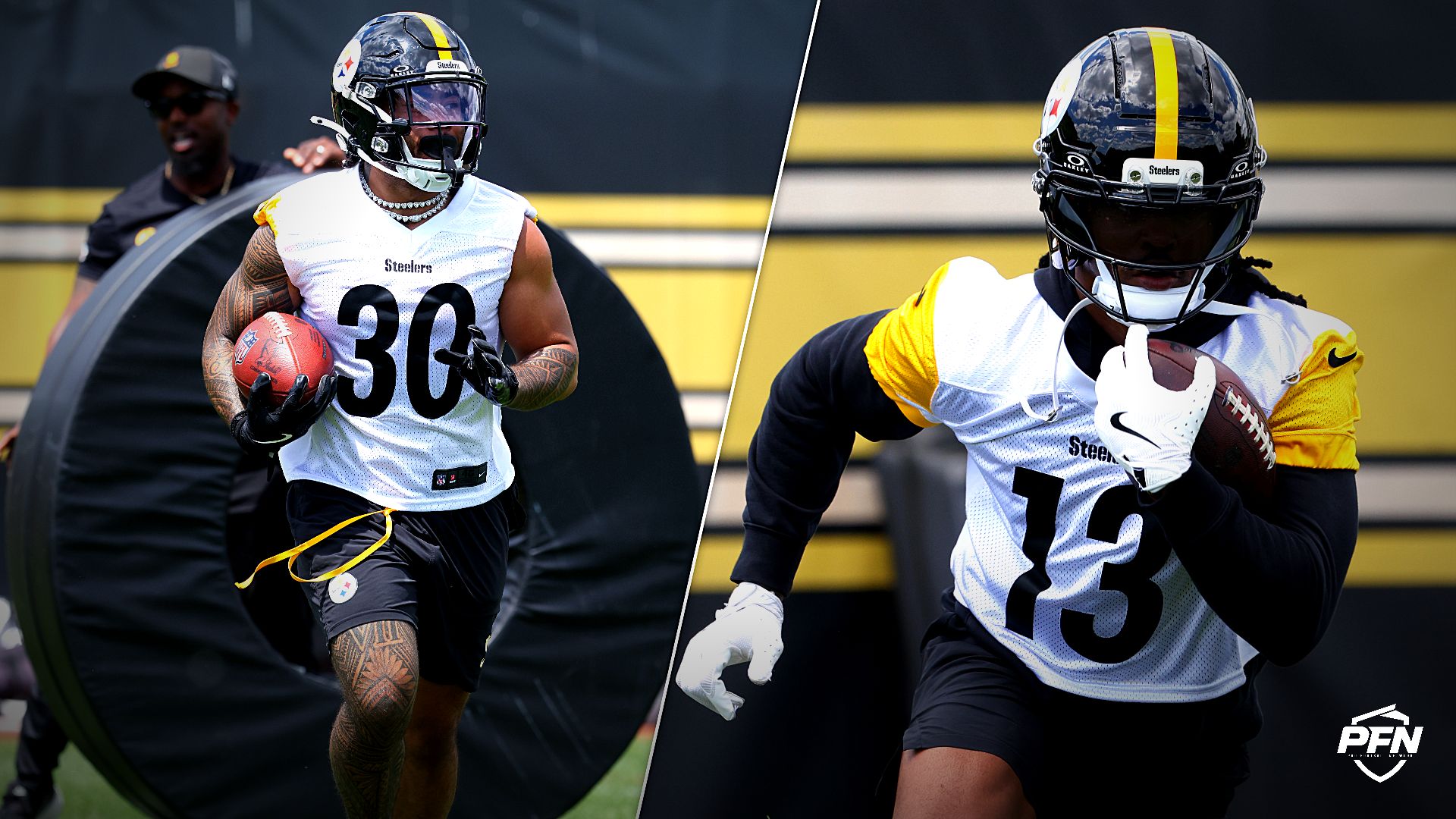
The modern NFL has fully embraced the running back committee. Gone are the days when you could pencil in a bell cow and forget about it. More and more backfields now split the work two or three ways, leaving fantasy football managers guessing about who actually holds value. This is my attempt to cut through the fog and give you my best read on every ambiguous backfield.
Los Angeles Rams: Kyren Williams and Blake Corum
Let’s start with a backfield that looks ambiguous but really is not. The Los Angeles Rams run a full committee, and that usually sends fantasy managers into a panic. This one is different. The roles here are about as well-defined as any split in the league.
Kyren Williams starts every single week. He gets the entire first drive. Blake Corum then takes the entire second drive, outside of obvious passing situations. From there, the two simply alternate drives for the rest of the game. The one wrinkle is that Williams keeps the passing-down role. He stays on the field on third downs even during Corum’s drives.
This structure has a real fantasy football consequence. Neither back is the designated goal-line runner. When the Rams punch one in on the ground, which of the two scores largely comes down to whose drive it happens to be. That makes the touchdown production essentially luck-based between them. It is also worth remembering that the Rams’ true “goal line back” is actually Davante Adams.
On draft day, it makes sense that Williams goes earlier. He is the starter, and he owns the passing-down work. At cost, though, I actually prefer Corum.
Williams has a real ceiling problem because Corum’s presence caps his production Corum, on the other hand, offers standalone Flex value plus the injury-contingent upside that kicks in if Williams ever goes down.
Jacksonville Jaguars: Bhayshul Tuten and Chris Rodriguez
This is a genuinely ambiguous backfield. Travis Etienne is gone to the New Orleans Saints. He left behind a lead role that just produced an overall RB13 finish in this offense.
Bhayshul Tuten is the presumed heir. He was the first running back this regime drafted, and the team has cleared the path for him. The runway is legitimate, as Jacksonville ranked as the No. 6 scoring offense last season. Tuten steps into a Trevor Lawrence and Liam Coen attack with every chance to run with the job.
The physical tools jump off the page. Tuten ran a 4.32 40-yard dash, which puts his speed score in the 98th percentile. His burst grades out in the 97th percentile.
START PREPARING: PFN’s Fantasy Mock Draft Simulator
Coen has shown no real allegiance to any of these backs. The one who plays the best plays the most. In theory, that is supposed to be Tuten. There is even a path to him out-touching Chris Rodriguez at the goal line. Coen values unpredictability, and, given his seven career targets, a defense knows Rodriguez is almost certainly running whenever he is on the field.
Here is my hesitation. I am not at all sure Tuten is good enough to seize this job. As a rookie, he did next to nothing, posting just 5.9 fantasy points per game on 93 touches at 3.7 yards per carry. He could not carve out a meaningful role alongside Etienne. On top of that, the passing-down job went to seventh-round rookie LeQuint Allen. The athletic profile is real, but one year of production this thin makes it fair to ask whether the player matches the workout numbers.
This is where Rodriguez becomes a real problem. Coen hand-picked him after getting the best out of him back at Kentucky. He views Rodriguez as a power back who grinds out the tough yardage.
Rodriguez earned it on the field last year, running for 4.5 yards per carry with six touchdowns after taking the starting job from Jacory Croskey-Merritt in Washington. That last detail matters more than it looks. The Commanders handed Croskey-Merritt every chance to lock down the lead role. He could not do it. Rodriguez wound up carrying the load for much of the second half. The exact same setup is in play here, with Tuten cast as the young back being handed the opportunity.
One wrinkle works in Tuten’s favor. Rodriguez has been dealing with a foot injury and missed most of Jacksonville’s offseason program. He is not building the same runway a healthy camp would have given him.
Even so, I do not expect this to stay a comfortable Tuten runaway. Either Tuten proves he is the guy inside the first month, or we see far more Rodriguez than the distance between an RB22 ADP and an RB42 ADP would suggest. The path for Tuten to smash his price is absolutely there. I am just skeptical the player is good enough to walk it.
Pittsburgh Steelers: Jaylen Warren and Rico Dowdle
This one has a fun quirk to it. The Pittsburgh Steelers are running a backfield led by two former undrafted free agents. Jaylen Warren and Rico Dowdle both went undrafted and clawed their way into real NFL roles. This split is a true toss-up.
The most likely outcome is a clean division of labor. Dowdle handles early downs, stepping into the bruiser role that Warren himself surprisingly filled last season after the team moved on from Najee Harris. Warren then slides back into the receiving role that always fit him better. That is the genuine split I expect. Both backs have a defined job in it.
DIVE IN: PFN’s Fantasy Football HQ
The goal line is where I would pump the brakes on any clean narrative. Dowdle profiles as the favorite for that work, but I do not see him monopolizing it. Warren should keep a piece of the touches inside the five.
Aaron Rodgers factors in as well. His penchant for checking the ball down keeps the passing-down back busy and prevents Dowdle from vanishing as a receiver entirely.
Both of these backs are solid picks at their cost. Each one carries standalone value in his role, plus the contingent upside that kicks in if the other goes down. Warren has the slightly more predictable job of the two. Dowdle brings the proven ability to handle a full three-down workload if he is ever asked to. You are not making a mistake with either.
New England Patriots: Rhamondre Stevenson and TreVeyon Henderson
The hype machine has made this backfield feel murkier than it actually is. TreVeyon Henderson is the exciting young name, and the fantasy world has talked itself into a changing of the guard. Reality is stranger than that. Rhamondre Stevenson is the starting running back on a team that just went to the Super Bowl, and he is somehow being drafted behind his own backup.
This will not be a committee. Stevenson is the clear RB1, and Henderson will mix in sparingly, at least to start the year. If you want the proof, look at how New England used them when it mattered most.
Across their four playoff games, Stevenson played 65%, 59%, 93%, and 63% of the snaps. Henderson sat at 38%, 40%, 7%, and 40%. Training camp reports this summer point in the same direction, with Stevenson entrenched as the starter.
STAY UPDATED: PFN’s Fantasy News Tracker
None of this means Henderson is nothing. He clearly owns the higher ceiling of the two. There is a chance he improves as the season goes on and pries away more work. Plus, if Stevenson were to get hurt, Henderson can handle a three-down role, which we saw firsthand in the two games Stevenson missed last year when he totaled 243 yards and five touchdowns. The whole question with Henderson is how likely he is to reach that ceiling. That answer determines whether he is worth targeting at his price.
Where I land is simple. I would draft Stevenson ahead of Henderson. You are getting the trusted starter on a strong rushing team at a discount, while the name going ahead of him is a backup betting entirely on a leap.
Normally, I would chase upside. But I believe chasing the Henderson upside is purely a bet on a Stevenson injury. I can make similar bets at much lower costs with pure handcuffs. Henderson is too expensive, given there is no real difference between him and Tank Bigsby, for example. Take the sure role over the shiny upside here.
Carolina Panthers: Chuba Hubbard and Jonathon Brooks
Chuba Hubbard will open the season as the clear starter, but do not mistake that for security. It is abundantly clear the Panthers want Jonathon Brooks to be the guy.
Brooks was the organization’s hand-picked back of the future, a second-round pick and the best running back prospect in the 2024 class. Then his knee betrayed him. He tore his ACL in college, re-tore it late in 2024, and lost all of 2025. The entire question here is whether he is still the guy we remember from Texas. If that ability is intact and the knee holds up, Brooks has real juice to take this backfield over.
The Panthers have already shown they will hand the keys to whoever plays best. That is exactly what happened last season with Rico Dowdle, and Dowdle was nothing more than a free-agent signing.
MORE: Fantasy Football Draft Strategy: How to Win Your League After Selecting Bijan Robinson First Overall
Brooks is the guy this front office actually drafted to lead the room. Give him the ability and the health, and his upside matches what we watched from Dowdle a year ago, if not more.
Now for the reason to be skeptical. We have seen this exact movie before. Two years ago, Hubbard was the afterthought in drafts, penciled in to hold the job for a few weeks before Brooks inevitably took it. A few weeks became a couple of months. Those months became the entire season. Anyone who bet on the rookie taking over got burned. Hubbard turned into one of the best values in fantasy that year, averaging 16.1 PPG.
So where does that leave us? As the training camp buzz around Brooks keeps building, I expect him to pass Hubbard in ADP before long. What that overlooks is Hubbard’s proven ceiling. He already posted genuine RB1 numbers in this offense back in 2024. If his price keeps sliding while the hype chases Brooks, Hubbard turns into a real target. I think both are worth a look at cost, which is exactly what you would expect from a backfield this unsettled.
Tampa Bay Buccaneers: Bucky Irving and Kenny Gainwell
This backfield is going to look exactly like it did over the back half of last season, once Bucky Irving returned from his injury. That means Irving grinding out empty early-down carries between the 20s. It means Kenny Gainwell owning the receiving work that previously belonged to Rachaad White. And it means Sean Tucker vulturing the short-yardage and goal-line touches. This may be ambiguous to some, but not to me. I am full-on fading Irving and all the way in on Gainwell.
The fade is not complicated. Irving has been stripped of everything that makes a running back matter in fantasy. His receiving role evaporated over the second half of last season, and his catch totals cratered along with it. Worse, he lost the goal line entirely.
Irving ran the ball 13 times inside the five-yard line as a rookie. As a sophomore, that number was zero. He has become the exact archetype you never want to draft: a two-down back who does not catch passes and does not get goal-line carries.
This is the part that trips people up. None of this is a health concern. I am not the least bit worried about Irving’s shoulder. In fact, I am rooting for him to get a glowing report out of training camp. A clean bill of health would push his price back up and pull Gainwell’s down. That only sharpens the exact bet I want to make.
The Bucs themselves have told us how this plays out. They let White walk to Washington, brought Tucker back, and paid real money for Gainwell, one of the best pass-catching backs in the league coming off a season where he saw a 16.3% target share. Teams do not spend like that on a receiving back unless they plan to feed him.
Gainwell is the guy I am targeting in this backfield. And if Irving does end up getting hurt, Gainwell could legitimately be a league winner as a three down back. Plus, Tucker becomes a worthwhile pickup in his own right.
Washington Commanders: Jacory Croskey-Merritt and Rachaad White
Jacory Croskey-Merritt is going to get every chance to run away with this job. The lead-back role and the goal-line work are his to lose heading into the season. He has even spent training camp working to round out his pass catching. That is the role the Commanders hope he can have. “Hope” being the operative word here.
I just do not buy it. The opportunity will be there. Holding onto it is the part I question.
Look under the hood of Bill’s rookie season and the profile thins out fast. He barely existed in the passing game, posting a 3.0% target share that is about as close to zero as it gets for a lead back. Even his rushing was more flash than substance, with plenty of evaded tackles but middling yards created once he broke free. He also could not hold the job when he had it, losing the lead role to Chris Rodriguez before a fluky Week 17 illness handed it back. The most telling number is this: JCM broke out for 27 points in Week 5, then delivered just two usable fantasy weeks the rest of the way. Two.
TRADE NOW: PFN’s Dynasty Trade Calculator
This is a coaching staff that has shown zero allegiance to any back. When Croskey-Merritt hits the kind of cold stretch that defined his rookie year, they will turn to the back they trust. This year, that back is Rachaad White.
He is the reliable veteran in this room, and the one I want out of this backfield. White is the primary receiving option already, and I expect him to siphon off more early-down and goal-line work than most people are projecting.
One more name lurks behind the two of them. Washington used a sixth-round pick on rookie Kaytron Allen. He is not a factor in the projected pecking order right now, but that could change if JCM gets hurt or gets phased out of the offense entirely. Do not dismiss that second scenario. A total washout is well within the range of outcomes for a former seventh round pick. If it happens, Allen could suddenly become interesting, but the rookie is not someone fantasy managers should be selecting in drafts.
Denver Broncos: J.K. Dobbins, RJ Harvey, and Jonah Coleman
Sean Payton loves a committee. This one at least opens with a fairly clear pecking order. J.K. Dobbins is the lead runner. His role should look a lot like it did before a foot injury wiped out his second half last season. Picture 15 to 18 carries a game.
RJ Harvey works behind him as the passing-down back who mixes in for a handful of carries. Jonah Coleman is the rookie sitting third on the depth chart. I do not expect him to see the field much at all.
Here is the case for Dobbins. He ran the ball extremely well last season, averaging 5.1 yards per carry and ripping off the 11th-most runs of 15-plus yards in the league. The problem, of course, is his health.
Dobbins has pledged to play all 17 games this year. I will believe it when I see it. He has not made it through a single full season since entering the league in 2020. If he somehow stays upright, he is a genuine value at his cost. I just refuse to bet on it.
Harvey is where I get off the ride. His rookie production flashed, headlined by a stretch of RB1 scoring from Weeks 11 through 17 once Dobbins was hurt. That output leaned almost entirely on scoring, though. He found the end zone 12 times on fewer than 200 touches. That is not a rate that survives Dobbins being healthy.
The real problem, though, is the missing path to more work. If Dobbins goes down again, Harvey still does not inherit the backfield. Coleman is the one who slides into the early-down and goal-line duties, which keeps Harvey pinned in the same satellite role that gave us just three usable weeks over the first half last year.
The rookie is the interesting name here, even if he barely touches the ball early on. At 220 pounds, Coleman has the size for the dirty work inside and profiles as a goal-line option. He was also a sneaky-good pass catcher at Washington, hauling in 31 balls in his final collegiate season.
That blend is the entire point. Coleman is a jack of all trades and a master of none, which is what makes him such a rare double handcuff. If Harvey gets hurt, Coleman can slide into the passing-down role. A Dobbins injury would hand Coleman the early-down and goal-line work instead.
The bottom line is simple. This is mostly a backfield to avoid. Dobbins carries too much injury risk for me to trust, even at his depressed price. Harvey has no route to the volume he would need to be a true impact player. Coleman has no standalone value as a team’s RB3, which makes him a pass in most redraft leagues. The moment either back goes down, though, Coleman rockets to the top of the waiver wire columns. That is the only version of this Denver backfield I actually want.
Minnesota Vikings: Aaron Jones and Jordan Mason
Both of these backs are Day 3 success stories. Aaron Jones went in the fifth round. Jordan Mason was a UDFA who clawed his way into a real role. Last season the two shared the load in a fairly even committee. This year I am not sure we get a repeat of that exact split.
What I could see instead is a cleaner divide between early-down and passing-down work. Mason would handle the early downs and the goal line as the lead runner. Jones would slide into more of a pure satellite role as he ages. That kind of transition fits him well, as receiving skills tend to age better than rushing. Jones can still be effective catching the ball out of the backfield even as the rest of his game slips.
Mason’s case is straightforward. He averaged 4.8 yards per carry last season playing in an offense featuring JJ McCarthy, Carson Wentz, and Max Brosmer at quarterback. That is real efficiency behind brutal quarterback play.
When Jones missed five games, Mason stepped in and posted 12.6 PPG as a starter against just 5.6 alongside a healthy Jones. The ceiling comes with one glaring hole. Mason does next to nothing in the passing game, with 30 total targets over his last 28 games. That makes him touchdown-or-bust. He averaged 13.9 PPG in games he found the end zone last year and 4.9 PPG when he did not.
Jones is clearly in decline, and that is the concern. His 4.2 yards per carry and three touchdowns last season were both career lows. He turns 32 before the year is out. Injuries have piled up as well, with five-plus games missed in two of the last three seasons.
The flip side is that his best remaining skill is the one that holds up longest. Jones still ranked 17th in yards per route run last year. A satellite role lets him lean on that receiving ability rather than the burst that has faded. His upside is capped by his age and by Mason’s presence. Mason’s upside is capped by his lack of receiving chops.
The backdrop for both is a Vikings offense that should be better. Kyler Murray takes over at quarterback. He may not be a great quarterback, but he is a sizable upgrade on McCarthy. Kevin O’Connell has coaxed production out of far worse quarterbacks than Murray.
If the offense climbs back up from its 26th-place scoring finish to merely middle of the pack, both backs come along for the ride. Neither one is expensive. I cannot fault targeting either at cost. If I am picking one, though, I want the younger back.
