
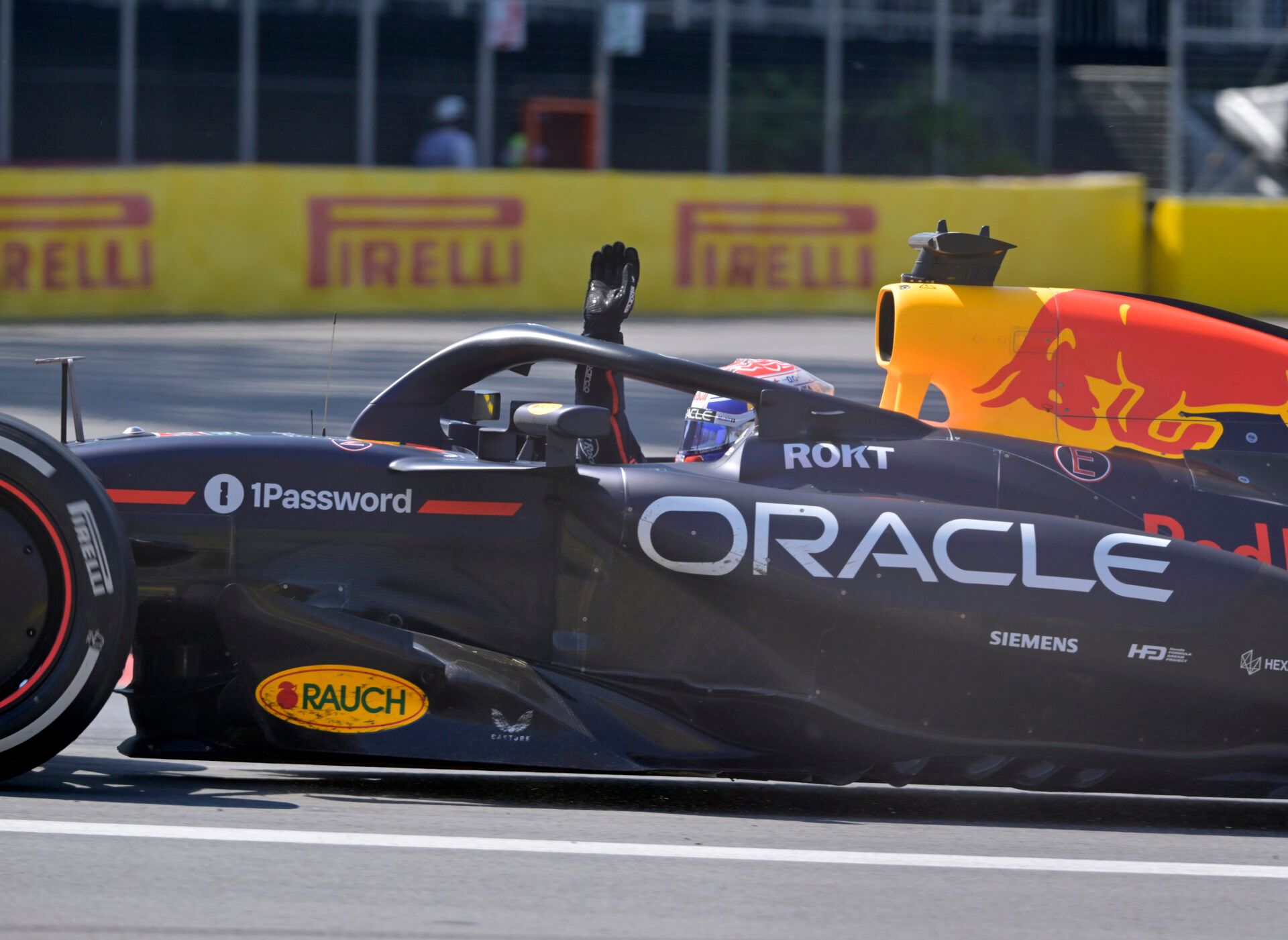
While encouraging cautious optimism, Ford delivered a solid first impression with its new Red Bull F1 machine. Red Bull kicked off Formula 1’s new era in impressive fashion on Monday, setting the fastest time during the opening day of pre-season testing at Barcelona’s Circuit de Catalunya.
The team’s new partnership with Ford showed early promise as rookie driver Isack Hadjar posted the quickest lap of the morning session.
Red Bull Hits the Ground Running in Barcelona With New Ford Power
The test, which runs from Monday through Friday, marks the first time teams have run their brand-new 2026 regulation cars.
The session is closed to both media and fans, with teams choosing to participate in any three of the five available days. Red Bull, Mercedes, Racing Bulls, Alpine, Haas, Audi, and newcomer Cadillac all hit the track on the opening day.
Hadjar, who recently joined Red Bull’s main team, clocked a best time of 1 minute 20.3 seconds.
While this was roughly seven seconds slower than last year’s grand prix practice times at the same circuit, it represented solid progress for the first day of testing with entirely new machinery.
The young driver’s performance followed Mercedes, setting the early pace through Kimi Antonelli.
The German team showed excellent preparation, completing more than 20 laps in the first two hours of running. Antonelli’s early benchmark gave Mercedes fans reason for optimism about their 2026 campaign.
However, as track conditions improved throughout the morning, Hadjar capitalized on the faster surface to jump ahead of Antonelli’s time.
He eventually built a two-second gap over the Mercedes driver, though such margins mean little at this early stage of testing when teams are running different programs and fuel loads.
The session wasn’t without its challenges. Three red flags disrupted the running, causing several interruptions to what teams had hoped would be productive mileage-gathering exercises.
Franco Colapinto brought out the first stoppage when his Mercedes-powered Alpine came to a halt on track. The car was quickly recovered, allowing the session to resume with minimal delay.
The second red flag proved more time-consuming. Gabriel Bortoleto’s Audi stopped on the circuit, resulting in approximately 15 minutes of lost track time as marshals worked to clear the stricken car.
A third interruption occurred around 1 p.m. local time when Liam Lawson’s Racing Bulls required recovery.
Despite these setbacks, all participating teams completed well into double digits. This marked a significant improvement over the last major regulation change in 2014, when only four teams achieved similar mileage on the opening day of testing.
The timesheet showed nearly seven seconds separating the fastest and slowest teams, but such gaps are expected and essentially meaningless at this point.
Teams are running vastly different programs, with some focusing on reliability, others on systems checks, and some on aerodynamic evaluation.
New entry Cadillac posted the slowest times of the day but still managed respectable mileage as the American manufacturer begins its Formula 1 journey.
The team’s ability to get the car running and complete multiple sessions represents a solid foundation to build upon.
Notably absent from Monday’s action were McLaren and Ferrari, both of which had previously announced plans to begin testing no earlier than Tuesday.
Aston Martin’s participation remains unclear amid reports suggesting their car may be behind schedule. Most concerning is Williams’ complete absence from the first test, raising questions about their preparation for the upcoming season.
As testing continues through the week, teams will gradually reveal more about their 2026 packages.
