
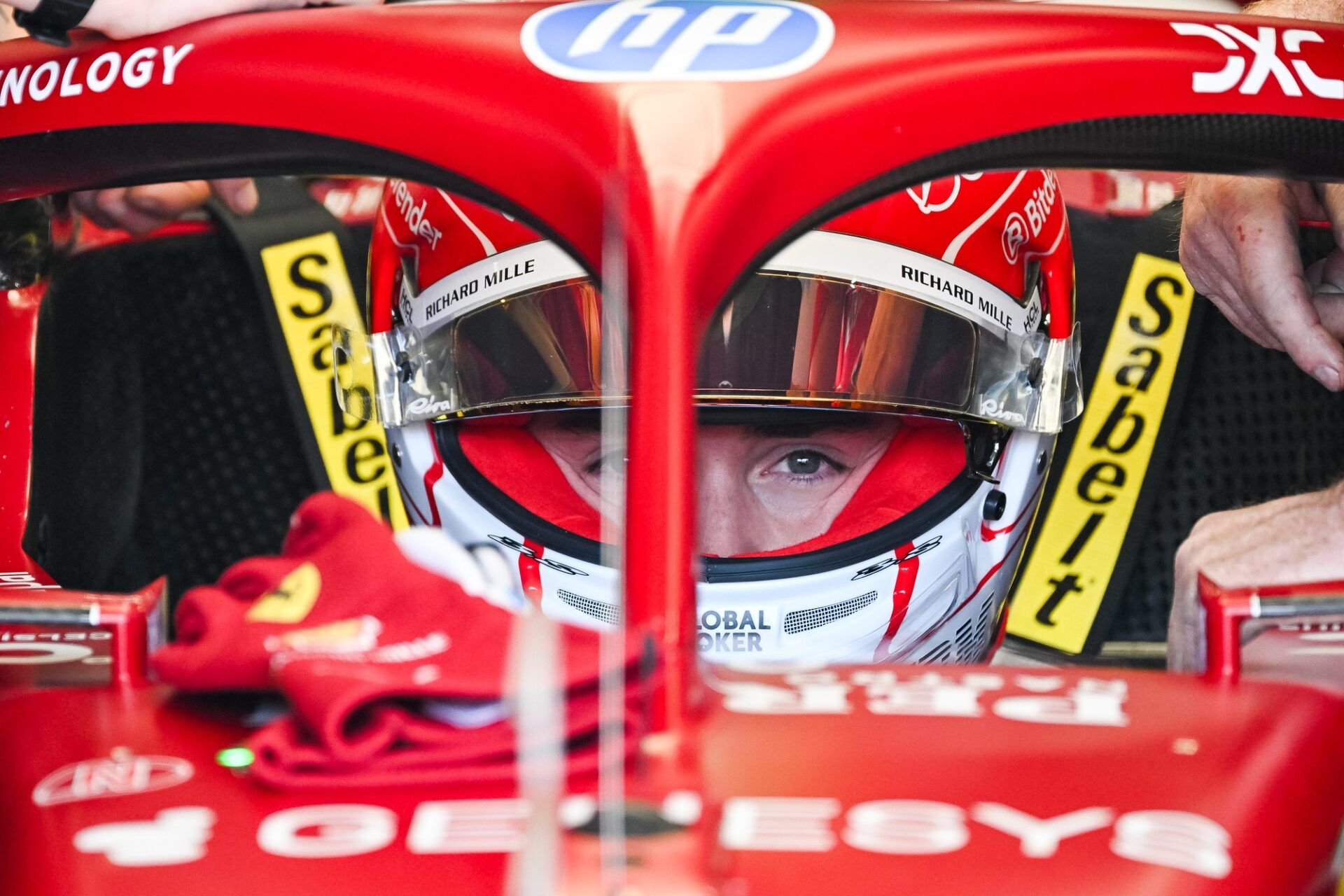
As the 2025 F1 season hurtles toward its grand finale in Abu Dhabi, all eyes first turn to Las Vegas, where dark storm clouds threaten to rewrite the script. With forecasts hinting at torrential rain over the Strip Circuit, the glitz and neon of Sin City may soon give way to one of racing’s greatest equalizers: chaos on a soaked tarmac.
Usually, when the rain gods descend, not every star shines. As the grid braces for a potentially treacherous weekend, it raises an uncomfortable question: Who will rise, and who will fall?
With the stage set, here’s a look at Charles Leclerc and four other F1 heavyweights who have historically faltered when the weather throws its biggest curveball.
Before F1’s Vegas Deluge – Charles Leclerc and Four More Wet-Weather Strugglers
When the conversation shifts to racing in the rain, no discussion feels complete without invoking the legendary quartet of Michael Schumacher, Sebastian Vettel, Ayrton Senna, and reigning champion Max Verstappen. These four have long turned storm-soaked circuits into their own personal playgrounds, dancing on the edge of control with unbelievable grace.
But for every rain master, there are others on the grid who haven’t been as blessed by the downpour. While the icons rise when the heavens open, a handful of drivers have repeatedly found themselves fighting the spray. First on the list is Ferrari’s No. 16 speedster, Leclerc.
“Wet weather, we were speaking about it in the last race weekend, I don’t think it’s a strength for our car at the moment.” This was the 28-year-old’s open admission after qualifying for the Belgian GP this year.
“We are really struggling. But having said that, every weekend is different. We’ll learn from the past and see what’s possible tomorrow.” But the past the Monacan referred to here wasn’t too bright, particularly under dark, ominous clouds.
Time and again, wet conditions have exposed both Leclerc’s limits and Ferrari’s shortcomings. Even in moments of brilliance, like his impressive P2 in a chaotic, storm-hit Sao Paulo qualifying (2023), those flashes have been overshadowed by repeated difficulties elsewhere.
In Turkey during the 2020 season, he openly admitted he had “no explanation” for his team’s lack of pace in the rain, conceding they were “struggling more than the others” on a track that offered almost no grip. Jump forward to 2023, and he described visibility as virtually nonexistent at Spa: “We don’t see anything when it’s raining,” a reality that turns even minor errors into potential disasters.
Mixed conditions at Silverstone this year gave him one of the “most difficult races” of his career, leaving him limping home with a P14. Moreover, Leclerc himself has been blunt, admitting that despite rain once being a strength, Ferrari’s car has made wet-weather driving “extremely difficult,” with its characteristics amplifying every treacherous element of a soaked circuit.
Carlos Sainz – Vulnerable in the Wet
Next up on the list is Leclerc’s former Prancing Horse teammate, Carlos Sainz. The 31-year-old from Spain has shown excellence in wet qualifying, the Styrian GP (2020) being a perfect example. The following year, he navigated the changing conditions during the Russian GP to secure a podium for Ferrari.
However, Sainz’s relationship with the rain hasn’t always been smooth sailing. In Singapore (2022), the Spaniard admitted he “never really got into a rhythm” once the track became slick, struggling especially with the rear of the car as grip began to fade.
He later told The Independent that damp conditions often chip away at his confidence, forcing him to leave extra margin to avoid costly mistakes. Those vulnerabilities resurfaced dramatically at the 2024 Brazilian GP, where two separate incidents in the wet left him visibly frustrated.
Sainz didn’t mince words afterward, calling this then-SF-24 equipment “very unpredictable and very difficult to drive” whenever the heavens opened, a sharp contrast to the calm control he’s shown on his better days in the rain.
Furthermore, his more recent Williams machinery isn’t the best on the grid and tends to amplify his wet vulnerabilities. While the four-time Grand Prix winner can be very good in the rain, he’s not immune to the chaos of the damp conditions, especially when the car doesn’t seem to help.
Oliver Bearman – Young and Fiery but Still Inexperienced
The 20-year-old Briton’s first true exposure to F1-grade rain arrived at Sao Paulo in 2024, when he stepped in as Haas’s super-sub. But the storm wasted no time reminding him of the gulf between junior formulas and the big leagues. Oliver Bearman later admitted he had over-pushed, lost control, and made several unforced errors in treacherously low-grip conditions.
With a modest car beneath him and almost no F1 wet-weather mileage to fall back on, his inexperience was laid bare for the world to see. These struggles weren’t entirely new; even during his F3 days, damp conditions sometimes caught him out. Yet he learned early to embrace the challenge.
In a fully soaked 2022 test at Jerez with PREMA Racing, Bearman experienced everything from aquaplaning to the damp patches, describing it as a rare chance to feel the entire spectrum of wet behavior in a single day.
And the lessons paid off. In F2 at Spa, a circuit where rain lurks like a permanent character, the youngster snatched pole in a qualifying session clouded by the threat of a downpour. When heavy rain suddenly drenched one sector, he had already delivered a lap that others couldn’t match.
Even through the mistakes, the Briton has been clear about the value of every slippery lap. His wet-weather tests and willingness to confront the chaos head-on reveal a young driver forging himself through the very conditions that expose him the most.
Yuki Tsunoda’s Turbulent Dance With the Rain
The Red Bull Racing driver’s introduction to the damp conditions was anything but gentle. In his rookie season, his first true rain-soaked Grand Prix (2021 Imola) turned into a bruising lesson as he spun after the red-flag restart.
He later reflected on the incident and took the fall, deeming he was “too aggressive on the throttle” when the grip vanished beneath him, costing him a potential top-10. Fast forward to 2025, his struggles resurfaced again at Silverstone, where the shifting conditions left him adrift; he described his pace as “outstandingly slow” and admitted he felt completely “lost” throughout the race.
To add insult to injury. Even when the weather didn’t turn, the anticipation of rain hurt him. During a home race, Yuki Tsunoda gambled on a full wet-leaning setup, but the downpour never arrived, leaving him compromised and unable to extract performance from a car tuned for conditions that never materialized. The mismatch wrecked his rhythm and eventually his race.
Yet through all of it, Tsunoda has tried to treat every slippery weekend as homework rather than humiliation.
Valtteri Bottas – Strong but Inconsistent
Finnish ace and Mercedes’ third pilot, Bottas, has demonstrated real pace in the rain: not just in races but also in practice sessions when conditions are poor. However, mechanical issues (such as glazed brakes) and tyre warm-up troubles have undermined his performance in wet qualifying sessions.
Some of his worst moments stem from the combination of overcommitment and low grip, especially when setup or tyre temperature isn’t optimal.
Pirelli once hailed Valtteri Bottas for his “sheer bravery” after he blasted down the straight at 316 km/h on intermediates during a marginally wet qualifying session during the Chinese GP in 2014. What made the moment even more impressive was the near-zero visibility created by the spray.
But while flashes of bold, wet-weather brilliance have defined parts of his career, the Finn has also faced the other side of the storm.
In one rain-soaked qualifying session in Austria (2020), the 36-year-old struggled with a glazing front-right brake, a problem that robbed him of confidence under braking. He later admitted that he couldn’t generate enough tyre temperature either, a combination that made the session “quite tricky” as grip slipped away.
Two years later, things worsened in a dramatic wet qualifying at Spa, where the driver revealed he lost crucial front-tyre heat due to a slow out-lap and a low-downforce setup that simply wasn’t built for the damp conditions.
The mismatch left him fighting in a car that refused to respond. In a separate incident during the Australian GP, the same season, Bottas found himself skating onto still-wet grass, losing the rear, and crashing out when he pushed the limit again in another damp session.
The Finn later admitted he had been “pushing too hard,” unaware that the grass held more moisture than expected, a minor misjudgment that turned into a costly spin. Note that Bottas is currently not fully committed this season but is expected to return next season with the new Cadillac Team.
Now, as the Vegas storm creeps closer, the Strip Circuit is poised to become the great equalizer once again. For Leclerc, Sainz, Bearman, and Tsunoda, the rain will not only test their skills but also expose their weaknesses.
