
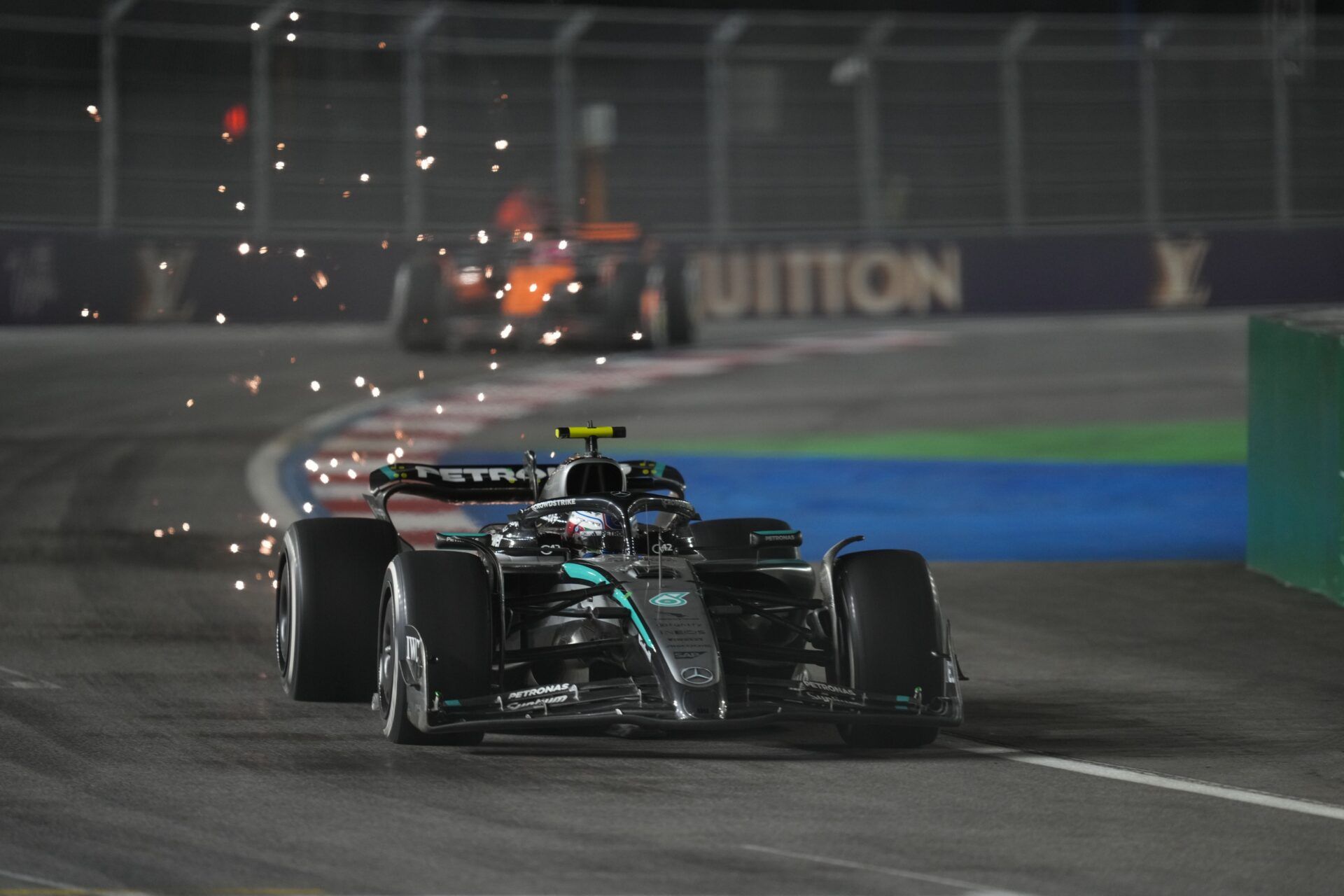
The Abu Dhabi post-season test usually brings long hours of boring simulations of the F1 car on track, but this year, something instantly caught the eye. Mercedes rolled out a mule car that looked a little different at the front, which gave the paddock its first look at F1’s next aero era.
The moment Andrea Kimi Antonelli pulled out of the garage in the Mercedes mule car, photographers scrambled to get pictures of the very first look at where F1 is soon headed.
Mercedes Gives a Glimpse of 2026’s Active Aero Setup
For 2026, F1 cars are undergoing a major aerodynamic shake-up as the sport transitions away from the heavy ground-effect era and enters a new era of active aerodynamics. DRS will be gone as both rear wings and front wings will instead open on the straights to help cars run with less drag.
That means the front wing is about to become a much bigger piece of the puzzle, especially for the top-speed battles on the straights, and Mercedes has taken the first visible step in that direction.
During the post-season test at Yas Marina Circuit, Antonelli hit the track in a Mercedes’ mule car fitted with a prototype active front wing. It included a chunky actuation system that connected the upper wing flaps to the nose through large tubing which is a working sample of what the ‘Straight Line Mode’ system will look like when drivers switch into low-drag settings on the straights.
Ferrari has also been experimenting with its own prototype by conducting private tests before Abu Dhabi, and it brought its updated version to the same test. As a result, the two biggest teams now have early hands-on experience with active aero.
This is not just about the teams, as Pirelli is watching closely too and has nine hours in this test to gather data for its 2026 tyre range. Mule cars run Monza-style wings with reduced downforce levels to simulate how next-generation cars will behave.
The comparison between the two different setups will give Pirelli valuable information about tyre load and temperature. Mario Isola from Pirelli explained that seeing both setups makes their analysis much easier, especially since mule cars are capped to speeds of roughly 300 km/h to avoid stressing the tyres too much.
An Important Step Towards F1’s 2026 Season
Teams are not just trialing moveable front wings, but some are also testing hybrid wheel rims that sit somewhere between the current designs and those expected in 2026. The FIA approved a small number of runs, even if the results are not perfect yet, because the current brakes are still fitted and brake heat affects tyre temperatures massively.
Every team in Abu Dhabi is running two cars, with one being in the 2025 spec, driven by a young driver, while the second is modified to feel like a 2026 machine. These tests give engineers a chance to understand lower downforce levels, lighter chassis targets, and how active aero might eventually shape performance.
The general public does not often get a look behind the curtains when F1 transitions to a new rulebook, but this test has given fans a preview of what the sport will look like in just about two months’ time.
There is still a long journey before next season, but if Mercedes’ wing is anything to go by, the aero revolution is already looking very aggressive, and the sport is excited to welcome it soon.
