
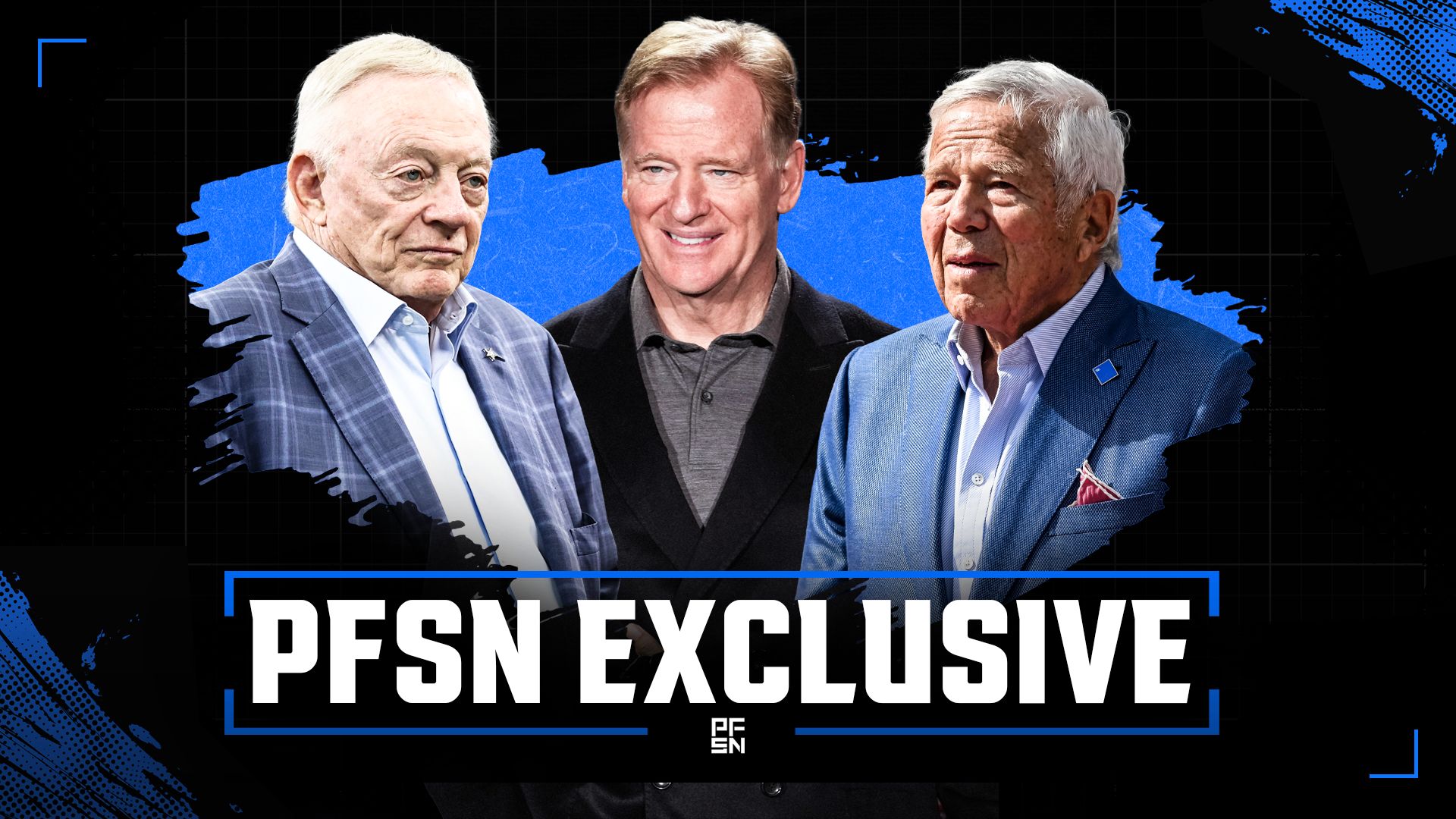
The NFL didn’t stumble into becoming America’s biggest show. It was aggressively built by a commissioner who counts votes better than anyone in sports and two owners who marry outsized ambition to relentless dealmaking.
In a conversation with PFSN about his new book, “Every Day Is Sunday: How Jerry Jones, Robert Kraft, and Roger Goodell Turned the NFL into a Cultural & Economic Juggernaut” (out Oct. 14), New York Times reporter Ken Belson mapped out how the league’s modern era took shape, why its center of gravity still runs through Dallas and Foxborough, and what the next decade could look like.
How Jerry Jones and Robert Kraft Redefined Power in the NFL
Ask Belson who truly runs the NFL, and he didn’t hesitate — it’s not the commissioner’s office or the players, but a small circle of billionaires who’ve turned the league into America’s most dominant entertainment business. “The league is much more of an owner-driven league than, say, Major League Baseball or even the NBA,” he said. “Roger Goodell is not really a CEO. He’s more of a Senate majority leader. He’s constantly corralling owners.”
That distinction matters. In Belson’s telling, Goodell’s power comes not from absolute authority but from political skill — the ability to broker consensus among a room of titans who are used to getting their own way. And within that room, two voices rise above the rest: Jerry Jones and Robert Kraft.
“Jerry Jones and Robert Kraft are clearly the two most powerful owners,” Belson explained. “They’ve got nine Super Bowls between them. They’ve both been very influential on media negotiations, labor negotiations, and they’re also sort of the ideas people.”
It’s not just their trophies or their teams’ valuations that set them apart. Jones and Kraft helped design the financial structure of the modern NFL — the one that turned television contracts into billion-dollar jackpots and reshaped the calendar into a year-round spectacle. Belson describes them as twin forces driving the league’s ambitions: Jones, the dealmaker who never stops pushing; Kraft, the statesman who keeps it from veering off a cliff.
“Roger Goodell takes his cue from all the owners,” Belson added, “but particularly those two. Robert Kraft has been called the shadow commissioner, but frankly, so is Jerry. They’re constantly calling the commissioner and other owners, trying to get their ideas put forward.”
The result is an unofficial power triangle — one that has defined every major decision in the league for nearly two decades.
Contrasting Styles, Shared Power: How Jones and Kraft Keep the NFL on Top
Behind that alliance, though, are two radically different philosophies. Jones and Kraft may be partners in progress, but their methods reflect opposite instincts — one guided by gut, the other by calculation.
“Robert’s much more of a relationship guy,” Belson said. “He’s very smart numbers-wise, but approaches things differently. He’s a smoother, while Jonathan [Kraft] is more technocratic, numbers-driven.”
Where Kraft is measured and methodical, Jones thrives in chaos. He’s impulsive, charismatic, and unfiltered — a showman as much as a strategist. “Jerry has the right idea but the wrong instinct — or maybe the right instinct but the wrong follow-through,” said Belson. “He gets ahead of himself. If you’ve ever watched him speak, he’s throwing out words hoping they stick.”
RELATED: EXCLUSIVE: How Tom Brady and Bill Belichick Built — and Broke — the Patriots Dynasty
That creative restlessness often leaves others to clean up the fallout. Kraft’s talent, Belson noted, is turning Jones’s energy into workable policy. “He’s not necessarily an ideas guy,” Belson said, “but he’s very good at synthesizing ideas and coming out with a solution or a palatable compromise. So in that way, they complement each other.”
It’s an odd couple dynamic that has served the league well. Jones dreams up the future; Kraft figures out how to sell it to everyone else. Together, they’ve become the yin and yang of NFL power — the visionary and the validator.
Power and Profit Collide: Inside the Boardroom Battles That Redefined the League
But creative tension cuts both ways. The same ambition that built the league’s golden era has also produced some of its most volatile boardroom battles.
Belson traces their first major clash back to the 1990s, when Jones — still a relative newcomer — challenged the league’s business model. “Jerry wanted to maximize the revenue of the Cowboys,” said Belson. “He wanted to strike his own deals with Pepsi instead of Coke and with American Express instead of Visa. That went against the NFL rules — ‘all for one, one for all.’ It led to a back-and-forth set of lawsuits.”
Jones’s rebellion forced the NFL to rethink how it handled local revenue and sponsorship rights. But it also earned him a reputation as the league’s disruptor-in-chief. “I think Robert understood where Jerry was trying to go,” Belson noted, “but he was very much against how he did it. Anytime you’re suing your fellow owners, that’s a bad look all around.”
Years later, that friction resurfaced in a very different context — the fight over Goodell’s contract extension in 2017. Belson recounts how Jones objected to the size of Goodell’s pay package, only for the disagreement to explode into a personal feud after the commissioner suspended Ezekiel Elliott. “Jerry blew a gasket,” Belson said. “He threatened to sue the owners on the compensation committee by hiring a very well-known antitrust lawyer. At that point, the owners turned against Jerry, and Robert was one of them.”
Moments like that reveal both the fragility and resilience of the league’s inner circle. These men may battle publicly, but their financial interests always bring them back together. Conflict, Belson suggests, isn’t a weakness — it’s how the NFL evolves.
How Roger Goodell Keeps NFL Billionaires in Line and the League Profitable
At the center of it all stands Goodell, a commissioner whose genius isn’t charisma but calculation. He’s less a visionary than a vote counter — and in the NFL, that’s what keeps the machine running.
“About a third of the owners have their own opinions and are willing to stick their necks out,” Belson explained. “Another third don’t really care one way or the other. The rest go whichever way the wind blows. Roger’s job is to gently steer the room to wherever makes the most sense — not for him, but for whatever seems to be the emerging majority.”
That balancing act has made Goodell both indispensable and polarizing. His success is measured not in popularity but profitability. “He’s learned to manage crises differently,” Belson said. “Say what you will about him as a person, he’s made the owners richer, and that’s his main constituency.”
In Belson’s view, Goodell isn’t a moral compass or a visionary like Pete Rozelle. He’s a broker — the one man capable of keeping billionaires aligned long enough to keep the money flowing.
The Ray Rice Scandal That Nearly Ended Roger Goodell’s NFL Reign
Even the best operators stumble, and Goodell’s toughest test came during the Ray Rice scandal in 2014. Belson called it “the most disastrous part of his commissionership — and a moment that almost got him fired.”
“He suspended Rice for two games, not knowing there was more graphic video,” Belson recalled, “then turned around and suspended him indefinitely, which a federal judge overturned because it was double jeopardy. His whole handling afterwards — he was a deer in the headlights for several weeks. He gave a really bad press conference and looked way out of touch with both the sponsors and women fans. It was a national conversation in the worst way.”
The fallout was swift and punishing. For the first time, fans saw cracks in the league’s armor — a sign that the shield could bend under cultural pressure. Yet, in the long term, that embarrassment forced change. Goodell learned that survival required adaptation, not authority. It was the turning point that transformed him from an enforcer into a political survivor.
Goodell’s Ambitious Plan That Made the NFL a Cultural Powerhouse
If that moment humbled him, the decade that followed restored his power. “In 2010, he set a very ambitious target of $25 billion by 2027,” said Belson. “We’re very much on target to hit that. He said the previous commissioner doubled revenue; I’m going to triple it. And he has done it.”
Under Goodell, the NFL stopped being a seasonal sport and became a 365-day content machine. Every broadcast, every streaming deal, every international game became another way to grow the brand. “The valuations of all these owners’ teams have not just tripled — they’ve gone up five or six times,” Belson added.
In other words, Goodell turned the league into the kind of corporate empire Rozelle and Paul Tagliabue only imagined. “To Goodell, the NFL isn’t just a sports league,” Belson writes in his book. “It’s a cultural institution that gobbles mindshare and captures the national zeitgeist.”
That strategy worked. The NFL no longer competes with other sports — it competes with culture itself.
How Changing Demographics Are Forcing the NFL to Think Globally
Still, even juggernauts hit ceilings. For all its success, Belson warned that the league’s greatest threat might not come from lawsuits or politics, but from demographics. “There always have to be limits,” he said. “One reason you’re seeing growth overseas is because the demographics of America aren’t as favorable. We have a slowing birth rate, fewer children going into schools. The concussion crisis — although I wouldn’t call it a crisis anymore — is still real.”
The NFL’s response has been to export the brand and reimagine the game for new audiences. “They have to look elsewhere,” said Belson. “The NFL is countering with flag football, trying to make it more palatable to moms, trying to get girls involved. It’s easy to export overseas and teach people the game.”
That shift shows a league that never stops monetizing. “They’re going to create a flag football league where they’ll take an equity stake in it,” Belson added. “There’s no money they’re going to leave on the table.”
If football once symbolized American grit, its future may hinge on global reach — not toughness, but accessibility.
Moral Tradeoffs Behind the NFL’s Unstoppable Rise in Popularity
Even as the league expands, Belson questioned what it’s losing in the process. “Depending on who you ask, absolutely,” he said when asked if the NFL sacrificed anything for corporate dominance. “When you go all in on media, you lose something. You turn yourself into almost a caricature of a sport.”
That self-awareness is rare inside the league office, where growth often trumps reflection. Gambling, in particular, represents both opportunity and danger. “It’s distorting the motivations of fans and potentially the motivations of players themselves,” Belson said. “It’s fragmenting the game into little pieces that you can bet on. The way you watch is going to change.”
Even the concussion issue — once the existential crisis of the sport — has become something the NFL manages, not fears. “Ten years ago, I would have said the concussion issue was a major threat,” said Belson. “But a lot of Americans have moved on. The helmets have better technology. Coaches are better trained at spotting concussions. The protocols have improved. But it doesn’t change the fact that you’re still smacking your head into another kid’s head.”
The contradictions are apparent: a safer league that still sells violence, a moral brand that profits from gambling. Yet, somehow, fans keep coming back — proof that the NFL’s grip on American culture remains unshakable.
A New Era of NFL Ownership Emerges as Jones and Kraft Pass the Torch
Power, however, doesn’t last forever. Both Jones and Kraft are now in their eighties, and Belson said the next generation is already shaping the league’s future. “Their kids have been involved for years,” he noted. “Jonathan Kraft is very well respected and thought of in leadership circles. He’s different — more technocratic — but in many ways, Jonathan already runs the Patriots.”
In Dallas, the transition looks similarly seamless. “Stephen’s clearly the heir apparent,” Belson said. “Charlotte Jones has been handling marketing and philanthropy for years. I don’t know how they’ll divide up the roles, but Stephen, I assume, will be the principal owner.”
If their fathers built the NFL’s modern empire, the children will inherit a global brand. “Jerry and Robert changed what ownership means,” said Belson. “They made it about business empires, not just football teams.” The next generation’s challenge won’t be reinvention — it’ll be preservation.
Goodell’s Final Act Could Cement the NFL’s Next Great Era
At 66, Goodell isn’t ready to hand over the gavel. “I wouldn’t be surprised if he’s done the math,” Belson said. “Another labor deal is coming in 2030. He’d want to get that done and the media deals that follow. He’s complained he can’t find a successor, but someone told me he’s lying to himself — he just likes what he does.”
That labor deal may bring another seismic shift: the 18-game season. “The 18-game season was proposed by Jerry Jones in 2011,” Belson said. “Back then, it was a non-starter. They got 17 games in 2020. They’ll try for 18 in 2030 — 20 years after Jerry first brought it up. Today’s players grew up with concussion protocols; their priorities differ. The perceived risks of an 18th game are different now.”
It’s fitting that the NFL’s future — like its past — rests on a balance between profit, power, and personality. The league is no longer just a sports organization; it’s a cultural mirror reflecting America’s ambitions, contradictions, and obsessions.
And at the center of it all are three men who’ve mastered the art of keeping the machine running: Jones, the visionary; Kraft, the diplomat; and Goodell, the enforcer. Together, they’ve built a league so big, so profitable, and so embedded in American life that, as Belson’s title suggests, every day really is Sunday.
