
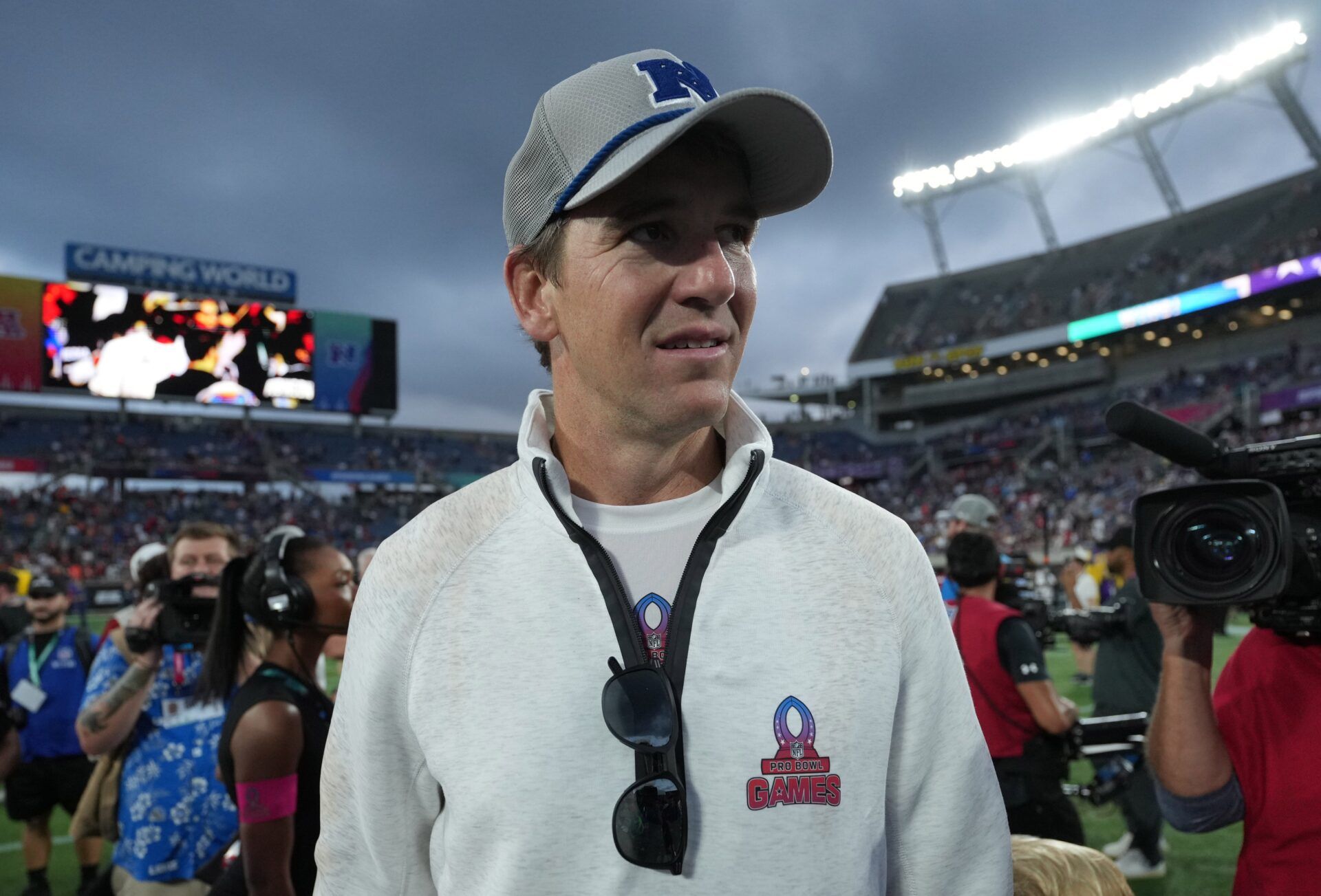
Eli Manning’s Hall of Fame case remains one of the most debated in modern NFL history, and his latest miss has only intensified the conversation. The former New York Giants quarterback was not elected in his second year of eligibility, even as the Hall of Fame selection process drew scrutiny for separate reasons involving Bill Belichick’s first-ballot snub.
While analysts continue to weigh Manning’s two Super Bowl MVPs against his career efficiency numbers, a former NFC East rival has now publicly questioned whether the Giants legend belongs in Canton at all.
Emmanuel Acho Questions If Giants Legend Eli Manning Is Hall Of Fame-Worthy
On a recent episode of the “Speakeasy” podcast, former Eagles linebacker and current analyst Emmanuel Acho gave a pointed assessment of Manning’s resume and how it stacks up against quarterbacks already enshrined.
Before delivering his critique, Acho drew a distinction between brief peaks and long-term dominance, framing the Hall as reserved for the latter.
He then argued that highlighting a handful of elite performances does not meet that standard in his view. “Eli Manning was GREAT for about six games, but it’s not the ‘Hall of Good’, ‘Hall of Great’, it’s the Hall of Fame,” Acho said.
“How can Eli Manning be in the same club as Peyton (Manning) as Tom (Brady). How can Eli be in the same club as Drew Brees? It just doesn’t look right, sound right, or smell right, ain’t nothing about that is right.”
READ MORE: Top 100 2026 NFL Free Agent Rankings
His comments reflect a sentiment shared by some evaluators who point to efficiency metrics and year‑to‑year rankings when judging quarterbacks for Canton.
Statistical context from Manning’s career underscores why opinions are so divided. Per CBS, Manning’s average season ranks well below that of recent Hall of Fame quarterbacks in key passing efficiency categories.
In expected points added (EPA) per play, he averaged 18th among qualified quarterbacks per year, with only three top‑10 finishes. A top 5 QB by EPA/play just ONCE in his career (and never higher than 5).
In Pro Football Reference’s era‑adjusted ANY/A+ metric, he averaged 17th, again trailing the typical Hall standard. His average rank in passer rating was 19th, with just one top‑10 finish, compared with an average of 10th for modern Hall of Fame passers and at least five top‑10 seasons for each of the 14 inductees studied.
Those numbers fuel the argument that while Manning delivered iconic postseason moments, he did not consistently perform at the level of his brother Peyton Manning, Tom Brady, or Drew Brees in the regular season.
Eli Manning Gets Snubbed by Hall Of Fame Following Bill Belichick Controversy
Manning’s latest Hall of Fame snub came in a year when the selection process was already under intense scrutiny for other reasons. ESPN reported that Bill Belichick, eligible for the first time, did not receive the 80 percent of votes required for induction, with deliberations reportedly including discussions of Spygate and Deflategate.
That outcome led the Hall of Fame to issue an unusual statement reminding the public that it reviews both its process and the selection committee annually, and that members could be removed if they violated the bylaws, for example, by sharing deliberation details.
The Hall said, “The integrity of this process must be beyond reproach,” a message interpreted as a response to reporting on Belichick’s case.
Against that backdrop, Manning’s case continues to be measured primarily on football merits. His .500 career record and lack of regular-season awards stand in contrast to two Super Bowl wins and game‑winning drives against the Patriots’ dynasty, which many see as defining his candidacy.
The longer he waits, the more his resume will be compared against a crowded group of “bubble” quarterbacks, including Matthew Stafford, Philip Rivers, Matt Ryan, and Russell Wilson, all of whom posted strong volume numbers in an era of inflated passing stats.
In that sense, Acho’s remarks capture one side of an evolving debate: whether two legendary postseason runs are enough to overcome average‑to‑below‑average efficiency in a Hall of Fame discussion designed for the very top tier of quarterbacks.
