
The 2026 NFL Draft running back class might not match 2025, but there’s another wave of high-level talent on the way. This article highlights some of the top RB prospects in the 2026 NFL Draft from an analytical perspective, using key correlative indicators.

Identifying Indicators and Assembling Model To Rank 2026 NFL Draft RBs
At the RB position, successful prospects often combine both quality analytics and quality film. As a result, identifying relevant analytical indicators can be invaluable in narrowing down the list. Before we get to that, it’s important to talk about the process that goes into it.
NFL Draft analysis and projection require constant improvement, and one way to improve is to take a blended approach between film and analytics. This would allow one to gain a more holistic view of a prospect and search for strong indicators of success in both mediums.
When you think of the words “strong indicator,” you should immediately ask: What are the “analytics” indicating strongly? How do you define success? Starting with these questions will steer you toward your goal, whether you prefer fantasy football analytics or film.
While some people use EPA (expected points added) as their definition of success, I try to steer away from it because of all the outside factors that influence it. Sean Clement from Sumer Sports does a great job explaining the issues in assigning EPA to individual players.
“There is simply too much uncertainty in the division of credit in public play-by-play data to make those metrics work well given publicly available data. Credit assignment in football at any level is difficult, but even more so when constrained by the limitations of public data and without integrating subject matter expertise.”
This is where fantasy football plays a role. While many outside factors influence fantasy points per game, this is a slightly more isolated way of tracking “player success” at the RB position.
In the exploratory data analysis phase, I like to use correlation to figure out which statistics are the best predictors of fantasy ppg. Correlation is a way to measure how two things move together. When a stat has a positive correlation, it coincides with an increase in fantasy points per game.
Correlations are expressed in percentages ranging from -100% to 100%. A -100% correlation means that when one goes up, the other always goes down. In football, you will almost never find -100% or 100% correlation, except for wins and losses or completions and incompletions.
Using TruMedia, I have a solid suite of statistics to search for correlations. The strongest predictors of NFL fantasy points per game for RBs all ranged from around 40% to 60% correlation.
The best predictors included scores from NextGenStats that take into account multiple variables like Combine Score, Production Score, and Athlete Score — all of which had a correlation just over 60%. The end goal of this article is to produce a similar “score” to these.
Standalone statistics or measurements like vertical jump, scrimmage yards per game, yards per rush after contact, missed tackles forced and avoided tackles, and explosive run percentage all had high correlations with fantasy ppg as well. After identifying stats that correlate, the next step is to assemble the model.
Carefully selecting variables based on mathematical concepts that affect a model’s predictive power, I was able to assemble a lasso regression model that effectively predicts a college running back’s fantasy points on average. Below, you’ll find the 2026 RB prospects who performed best within this model.
For additional context, I also included the scores of 2025 NFL Draft RB prospects in my analytical model. Last year’s prospects are rated higher than 2026’s in the model at this stage because they don’t have Combine numbers factored in yet.
2026 NFL Draft RB Prospects With Strong Analytical Indicators
1) Jeremiyah Love, Notre Dame
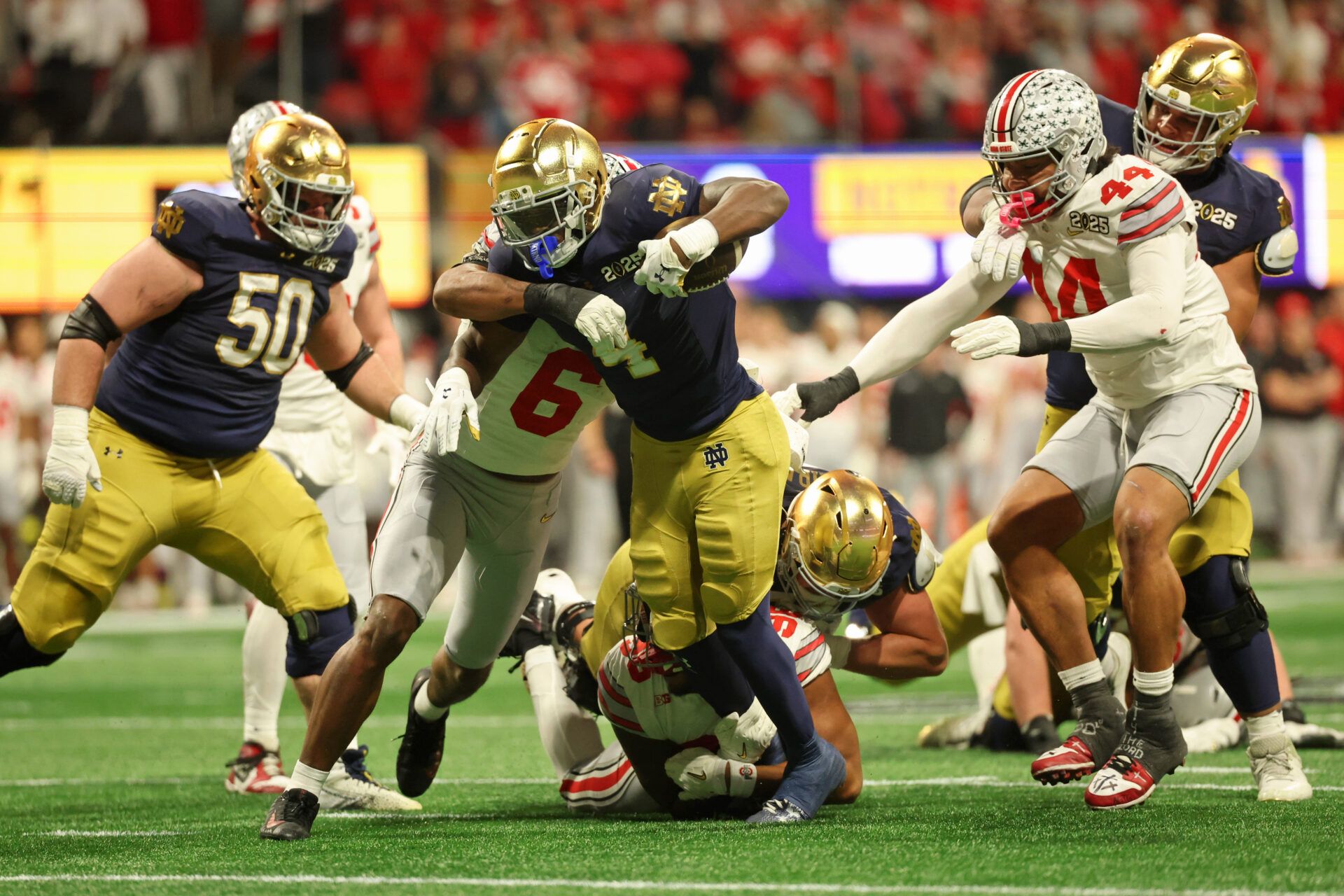
To absolutely no one’s surprise, the top analytical darling of the 2026 NFL Draft is Notre Dame Fighting Irish star Jeremiyah Love.
In two of Notre Dame’s four playoff games, Love showcased exactly what makes him special: a 98-yard breakaway TD against the Indiana Hoosiers and one monster “gotta have it” goal-line TD against the Penn State Nittany Lions.
Through 234 career carries, Love has zero fumbles and accounted for 21.3% of Notre Dame’s scrimmage yards in 2024. He also had a breakaway run percentage of 52.5%, good for 21st in the nation last year.
Love ranks fourth in the model among running backs this year and last, but is expected to pass both Cam Skattebo and Ahmad Hardy in 2025. If he does, he would rank behind only Ashton Jeanty over the past two seasons.
2) Jonah Coleman, Washington
Jonah Coleman is my ninth-ranked RB from the 2025 and 2026 classes, and No. 2 here. Similar to Love, Coleman hasn’t fumbled in 396 snaps and possesses an impressive ability to keep going despite contact. His 4.34 yards after contact per rush ranked 16th in the nation last season.
Jonah Coleman was quietly one of the most efficient RBs in CFB last year: 1,053 yards and 10 TDs, averaging 5.5 yards per attempt.
He’s compact, low-to-the-ground, and formidable through contact at 5’9″, 229 pounds, but also has eye-catching lateral mobility and gap pressing IQ. pic.twitter.com/WqscRd1aP8
— Ian Cummings (@IC_Draft) June 17, 2025
At 5’9″, 229 pounds, Coleman has the natural build to withstand and work through contact, and he combines that with impressive lateral quickness and pass-blocking chops. With an average breakaway percentage, Coleman’s top-end speed is the only thing stopping him from being in an elite analytical category alongside Skattebo, Jeanty, and Love.
3) Makhi Hughes, Oregon
After transferring to Oregon, Makhi Hughes has a chance to explode on the national stage in 2025. Posting over 1,350 rushing yards in both his redshirt freshman and sophomore seasons at Tulane, Hughes ranks 16th overall in predicted fantasy points per game and third in the 2026 class. The metrics make it easy to be bullish, and his film has the same effect.
I need to see Makhi Hughes prove it week in and week out against Big Ten competition, but I love what’s there on his Tulane tape.
A pure “energizer” runner at a listed 5’11”, 210 pounds, whose electrified stride frequency and contact balance can result in some exhilarating runs. pic.twitter.com/mAJtGZykUZ
— Ian Cummings (@IC_Draft) June 17, 2025
Hughes could stand to improve in both phases of the passing game, but he has a decent amount of explosive plays, yards after contact, and overall great production that makes him a top running back in this class.
4) Desmond Reid, Pittsburgh
Despite his small frame (5’8″, 175 pounds) and a limited number of carries, Desmond Reid graded out as the fourth-best 2026 RB in the analytical model — likely due to his impressive receiving grade (12th of 208) and career 11.4 yards per reception as a pass catcher.
While he struggles to gain yards after contact (171st of 208), Reid’s missed tackles forced per attempt rank 92nd, an above-average mark. He can’t take contact as well, but he’s a force in open space and one of the best receiving backs in the upcoming group.
5) Darius Taylor, Minnesota
Darius Taylor is the last of the 2026 running backs ranking in the top 25 across both the 2025 and 2026 classes.
Taylor’s strong analytical standing comes from the fact that he ranks above average in just about everything. He had a 40% breakaway percentage in 2024, 27 explosive runs, and finished with 3.91 yards per rush after contact. Pair this with just one career fumble and prototypical size at 6’0″, 215 pounds, and you have a very solid starting profile.
6) Nicholas Singleton, Penn State
Nicholas Singleton has the makings of an elite RB talent, but his analytical profile hasn’t matched that yet. On 174 attempts, he only forced 33 missed tackles, ranking 137th of 208 qualifying running backs. Even so, he still ranked 41st in percentage of breakaway runs, which shows his elite speed.
MORE: Nicholas Singleton 2026 NFL Draft Film Breakdown
That also shows up in his 32 explosive runs in 2024. What really bodes well for Singleton is his breakout age. He accounted for over 20% of Penn State’s scrimmage yards as a true freshman and has kept that pace each of the last two seasons.
7) Kaytron Allen, Penn State
To top off the list, we have the second Penn State RB, Kaytron Allen. Allen’s strongest analytical indicator is his 3.24 yards per rush after contact, which ranks 113th of 208. While not as productive as Singleton, he’s had significant playing time in all three years at Penn State.
Allen and Singleton are a great example of why it’s best to use a blended approach for scouting and predicting NFL success. Both are solid players on film, but they share the backfield and lack some of the top predictors that other running backs stand out in.
Honorable Mentions: Jahiem White, West Virginia; Quintrevion Wisner, Texas