
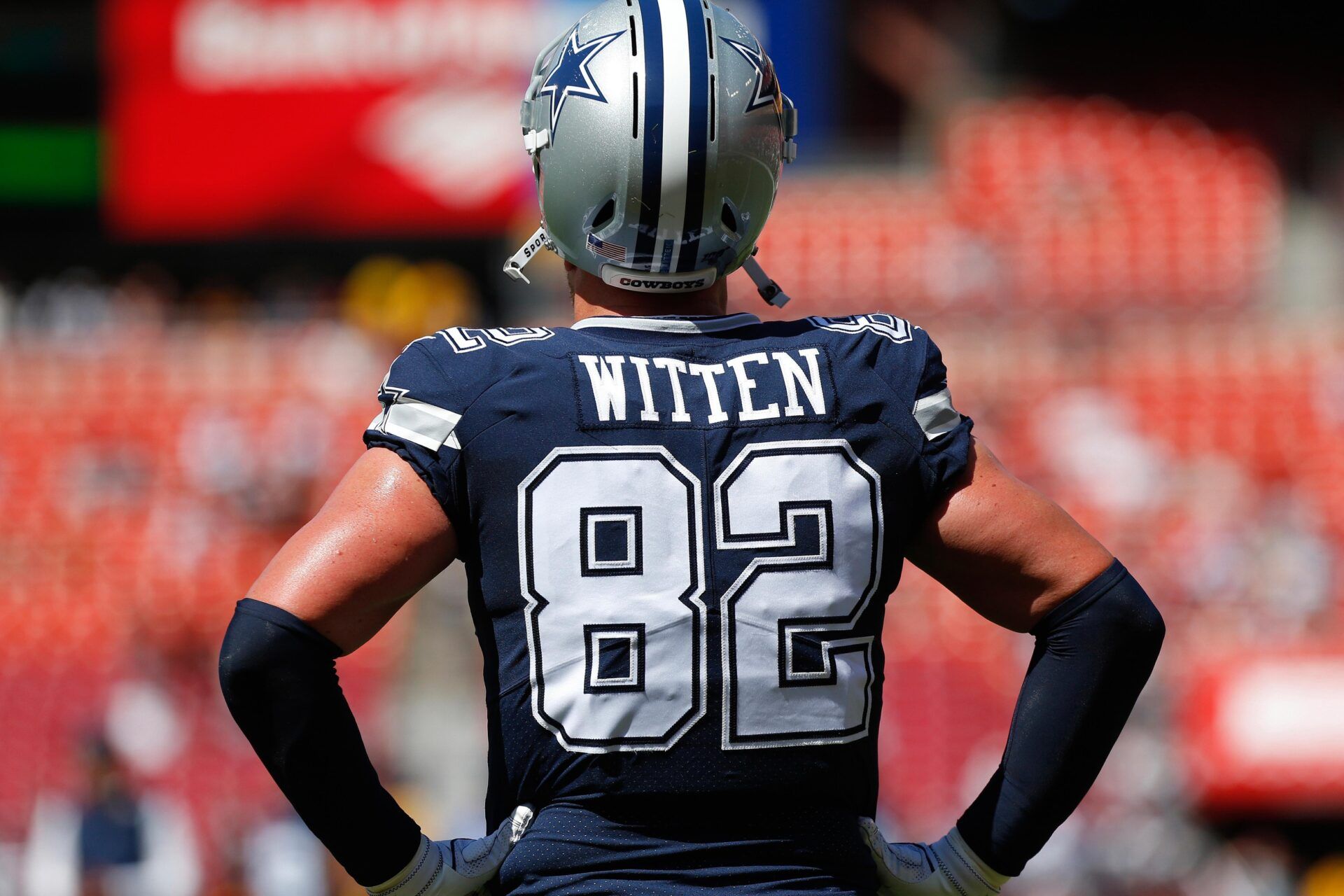
Longevity in the NFL rarely comes without sacrifice, and Jason Witten’s career is a clear example of that reality. Known for durability and dependability rather than flash, his financial outcome reflects years of steady contribution. A closer look at his earnings reveals how patience and persistence shaped both his legacy and net worth.

Tracking Jason Witten’s NFL Earnings Through 2 Decades of Reliability
According to Celebrity Net Worth, Witten has an estimated net worth of $12 million, built primarily through his long NFL career. Born May 6, 1982, in Elizabethton, Tennessee, Witten’s early life included hardship that ultimately shaped his discipline and direction.
Moving in with his grandparents at age 11 placed him under his grandfather’s guidance, a football coach, which accelerated his growth and helped him contribute to multiple state semifinal appearances.
His development continued at the University of Tennessee, where he played both defensive end and tight end while setting school records for receptions, receiving yards, and touchdowns. Those achievements led to his selection in the third round of the 2003 NFL Draft, which initiated a career defined by durability and steady financial growth.
READ MORE: Super Bowl 60 Predictions: Predicting the Winner, Final Score, MVP, and More
According to the Spotrac earnings breakdown, Witten earned $895,000 in 2003, followed by $305,000 in 2004 and $380,000 in 2005, bringing his cumulative total to $1.58 million.
His earnings rose sharply in 2006 to $6.5 million, then to $6.595 million in 2007, pushing his total past $14 million. Between 2008 and 2010, he consistently added between $1.905 million and $3.141 million per season, surpassing $22 million in career earnings.
His highest single-season total came in 2011 at $16.391 million, raising his cumulative earnings to $38.612 million. From 2012 through 2017, Witten maintained a steady annual income between $4.6 million and $7.4 million, eventually surpassing $72 million.
He later added $4.3 million in 2019 and $4.82 million in 2020, bringing his total career cash earnings to $81,879,722. The numbers illustrate a career built on long-term consistency rather than short financial peaks.
Witten’s legacy is still evolving through his place in the 2026 Pro Football Hall of Fame race. The modern-era candidate pool has narrowed from more than 100 names to 50 semifinalists, then 25, and finally 15 finalists, with Witten and Darren Woodson both still in contention.
For Witten, this marks his first year of eligibility, arriving at a time when first-ballot selections have become increasingly difficult. His candidacy is strengthened by his standing as the Dallas Cowboys’ all-time leader in receptions, receiving yards, and games played.
However, the waiting period endured by Woodson, who retired during Witten’s rookie season in 2003 and has been a finalist for four consecutive years, highlights the uncertainty of the process. Woodson’s patience after 23 seasons of retirement reflects how competitive Hall of Fame selection has become, even for elite players.
That context adds significance to Witten’s first appearance on the ballot. Whether his durability, records, and long-term consistency can overcome modern voting trends remains an open question, but it underscores his influence beyond his playing days.
