
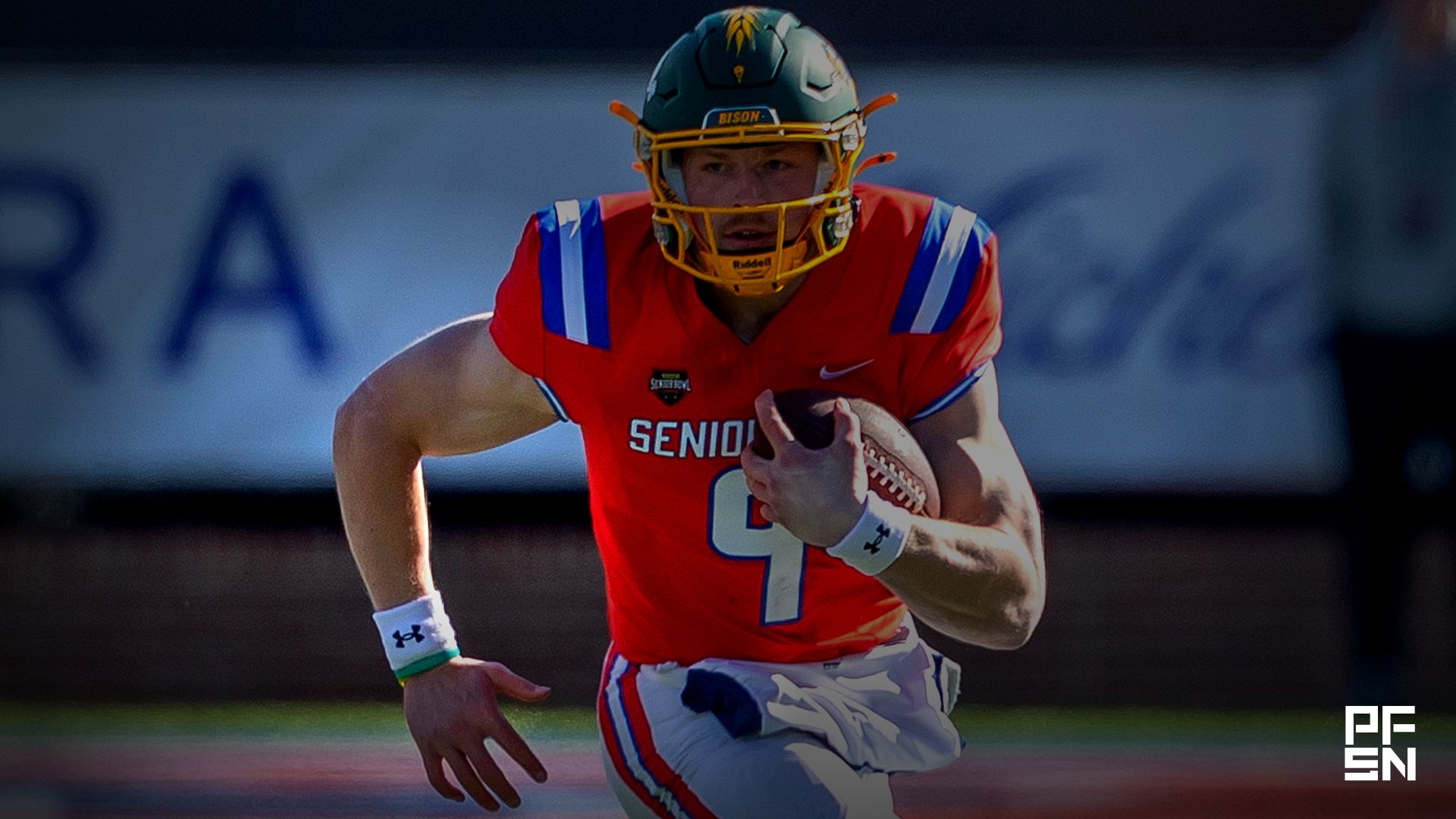
The Philadelphia Eagles made a surprising move late on Day 3 of the 2026 NFL Draft, selecting North Dakota State quarterback Cole Payton at No. 178 overall. It is not a pick that fills an obvious need, which is why it stands out. With Jalen Hurts locked in as the starter and veteran depth already in place, this decision feels more about long-term upside than anything immediate.
From a production standpoint, Payton brings an intriguing background. According to PFSN’s scouting profile, he spent multiple seasons as a backup before finally getting his shot as a full-time starter in 2025. He responded with 2,719 passing yards, 16 touchdowns, and just 4 interceptions while completing over 70% of his throws.
He also added 717 rushing yards and 13 touchdowns on the ground, finishing with an 89.7 PFSN QB Impact Grade, the second-highest mark in the FCS. The tools and flashes are there. The question is how quickly he can develop into a complete quarterback.
Why Cole Payton’s Developmental Traits Intrigue the Eagles Despite Concerns
The reaction from PFSN NFL draft analyst Ian Cummings on the “Football Debate Club” live draft show captured both the intrigue and the hesitation around this pick.
“This is an interesting pick, because I didn’t think the Eagles would go quarterback,” Cummings said. “Tanner McKee is showing some really encouraging flashes in spurts. That makes you think maybe they try to sell high, try to trade him.
“Andy Dalton, you have as a backup. You’re not going to get anything for him in the trade at the stage in his career. But he’s just a valuable guy, more of a mind type of guy to have, just as you’re paying him to be a player-coach, essentially.”
The Eagles were not lacking bodies at the position, so this feels like a bet on traits rather than necessity.
Payton certainly checks the physical boxes. At 6’3 and 233 pounds, he has the build teams look for, along with explosive athleticism and a strong arm that can generate velocity from different angles.
Still, the concerns show up quickly when you dig into the tape.
“But Cole Payton, I’m intrigued by the physical tools he brings to the table. So you’re looking at a one-year starter at the FCS level. That’s a pretty big concern. And you can see sometimes on tape, pretty, pretty raw.”
That lack of experience is hard to ignore. One full season as a starter leaves a lot of room for growth, especially when it comes to processing and decision-making.
Payton’s High Ceiling Comes with a Long Timeline
Cummings continued by pointing out where Payton still needs to improve before he can handle an NFL offense.
“I think you know, at his stage as a left-handed quarterback, there could be a slight adjustment with how the ball spins off his hands, compared to other quarterbacks that receivers catch passes from, the ability to go through his progressions, and to make full field reads a little inconsistent. I think generally at this stage, he’s best suited as a one-read quarterback. Don’t have them think too much.”
That lines up with his scouting profile, which highlights his slow processing speed and limited in-game reps as key areas to develop. Right now, he projects as a player who needs time before he is ready to take on a larger role.
“The internal clock is really slow, and that was the biggest takeaway at the Senior Bowl,” Cummings added. “I think you’re looking at him as a developmental guy for sure.”
Even with those concerns, the upside is what makes this pick worth taking late on Day 3.
“But the ceiling is really high. In terms of athleticism, raw athleticism, one of the best in the class.”
BE AN NFL GM: PFSN’s Ultimate GM Simulator
That is the gamble for Philadelphia. If Payton develops the mental side of his game to match his physical tools, there is real potential there. In the short term, his athleticism could even open the door for situational usage while he continues to grow. For now, this is a long-term play. One built on traits and projection, not immediate impact.
