
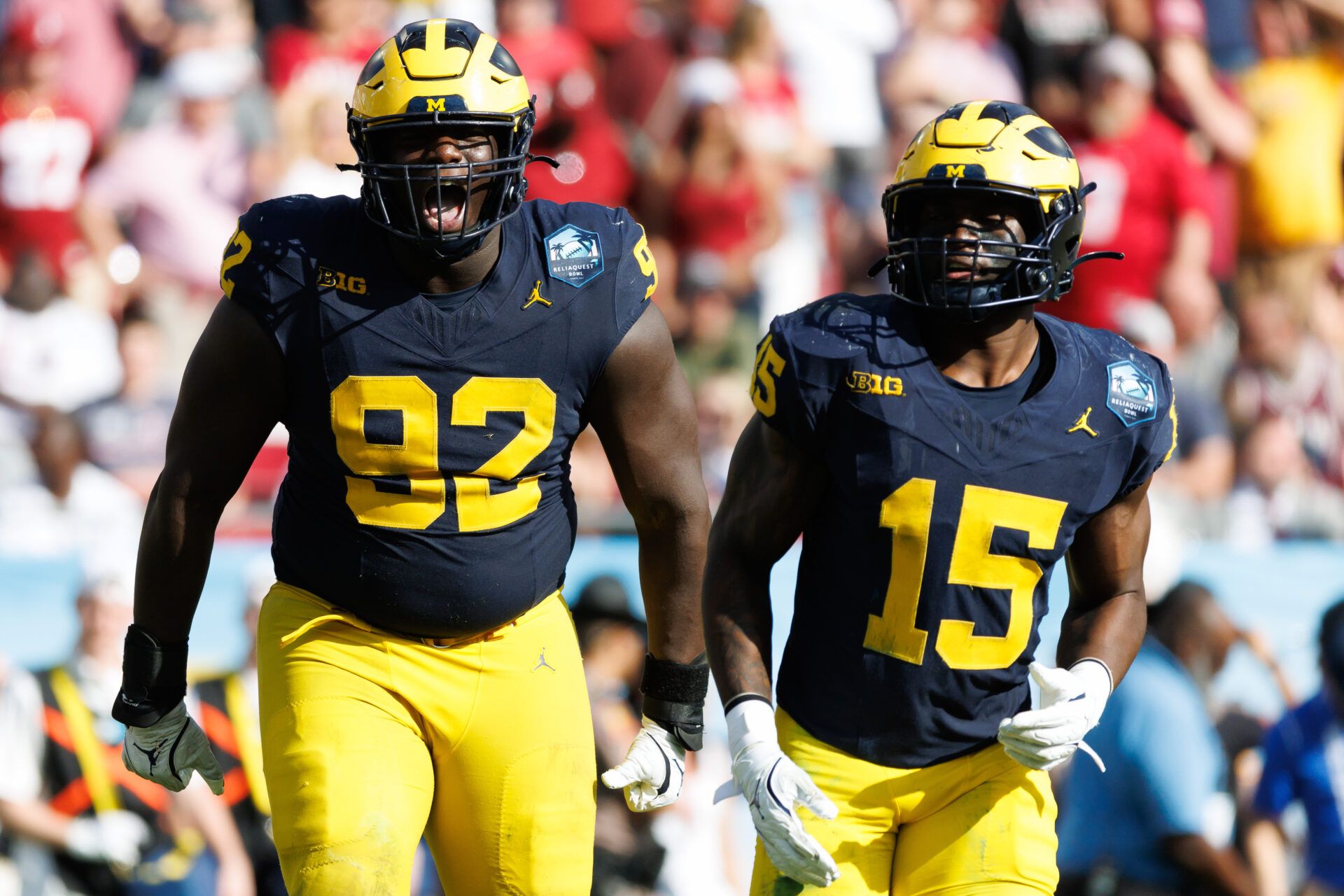
Connor Stalions thought he was building the perfect system — thousands of dollars in tickets, a network he called the “KGB,” and enough “dirty film” to decode any opponent.
What he actually built was the foundation for what could become the most expensive penalty in NCAA history. Michigan now faces financial consequences that even its legendary donor base might not rush to cover. How did we get here?
How Much Will Michigan’s Sign-Stealing Scandal Actually Cost the Wolverines?
Michigan’s football program is bracing for what analysts describe as unprecedented financial penalties tied to the sign-stealing scandal. The NCAA ruling includes fines and lost revenues that could climb as high as $35 million, a figure far surpassing the previous record of roughly $8-9 million assessed to Tennessee in 2023 following various recruiting violations.
Analyst Ross Dellenger outlined the projected totals: about $7.2 million for 10 percent of the football budget, nearly $27 million in lost College Football Playoff distributions over 2025 and 2026, and more than $700,000 in the value of reduced football scholarships.
“Michigan’s total cumulative fines from the NCAA decision are expected to reach as much as $35 million,” Dellenger said, noting the magnitude of the penalty.
Michigan’s total cumulative fines from the NCAA decision are expected to reach as much as $35 million – or roughly quadruple the previous historic high (Tenn $8-9M):
~$7.2M (10% of FB budget)
~$27M ($6M CFP in 2025 + $21M CFP in 2026)
~$700K+ (10% of all FB scholarships awarded)
— Ross Dellenger (@RossDellenger) August 15, 2025
Beyond the direct fines, the school is expected to forfeit more than $20 million in postseason football payouts over 2025 and 2026, with some projections pushing the total loss closer to $25 million.
The NCAA also imposed a $50,000 fine, docked 10 percent of the football budget, and required the forfeiture of the financial value of 10 percent of scholarships.
Why Won’t Michigan’s Wealthy Donors Simply Cover the Costs?
The question now is whether Michigan’s deep-pocketed alumni and boosters will step in. Reporter Matt Brown highlighted both the possibility and the hurdles.
“Okay, fine. But Michigan has a bunch of rich donors. Won’t they just fundraise this and get it paid off in a week? It’s possible. But recent history suggests that is probably going to [be] harder than just calling Larry Ellison,” Brown said.
After seeing the conversation over the last few days, I commissioned a special Extra Points Investigation to look into a critical issue in the college football community
Is 25 million bucks a lot of money? Even for a school like Michigan? What about 30?https://t.co/PYk4MJjUbP
— Matt Brown (@MattBrownEP) August 18, 2025
According to Michigan’s fiscal year 2024 report, the athletic department collected about $44 million in total donor and corporate contributions, with $33.6 million earmarked for football. To cover the NCAA penalty entirely through new donations, the department would need to raise more than 70 percent above its previous year’s total.
That challenge becomes even steeper when considering competing priorities. Michigan is already depending on donor dollars for athlete compensation beyond the House settlement cap, facilities projects, staff salaries, and other departmental needs.
“Possible? Yes. Easy? In my professional opinion… no, it wouldn’t be easy,” Brown added. He emphasized that diverting $25 million or more from donor funding to an NCAA fine means that money wouldn’t go to NIL, scholarships, or operations.
What Did the NCAA Investigation Reveal About Connor Stalions’ Operation?
The controversy dates back to early 2023, when reports revealed that Michigan had engaged in prohibited in-person scouting. Former staffer Connor Stalions was identified as the organizer of an elaborate scheme that went far beyond typical reconnaissance.
Evidence showed that Stalions, through a network of interns and acquaintances he called the “KGB,” purchased and transferred thousands of dollars in tickets so others could record future opponents’ sideline signals.
MORE READING: All Punishments Awaiting Sherrone Moore and Michigan in Sign-Stealing Case Explained
The scope was staggering. In 2022 alone, Stalions spent nearly $35,000 on tickets. The recordings, which Stalions labeled “dirty film,” were used to decode play calls, and the information was then shared with Michigan coaches.
According to the NCAA, receipts, digital transfers, and testimony confirmed the extent of the operation. The findings form the foundation of the penalties Michigan is now facing, penalties so steep that even one of the wealthiest donor bases in college athletics may hesitate to step in.
Despite Michigan’s affluent alumni base, the reality is that donors may be reluctant to cover costs for violations that tainted their 2023 national championship celebration. Still, as many fans around college football noted, no forfeiture of the ’23 championship was ordered, meaning that to many, the punishments weren’t harsh enough.
