
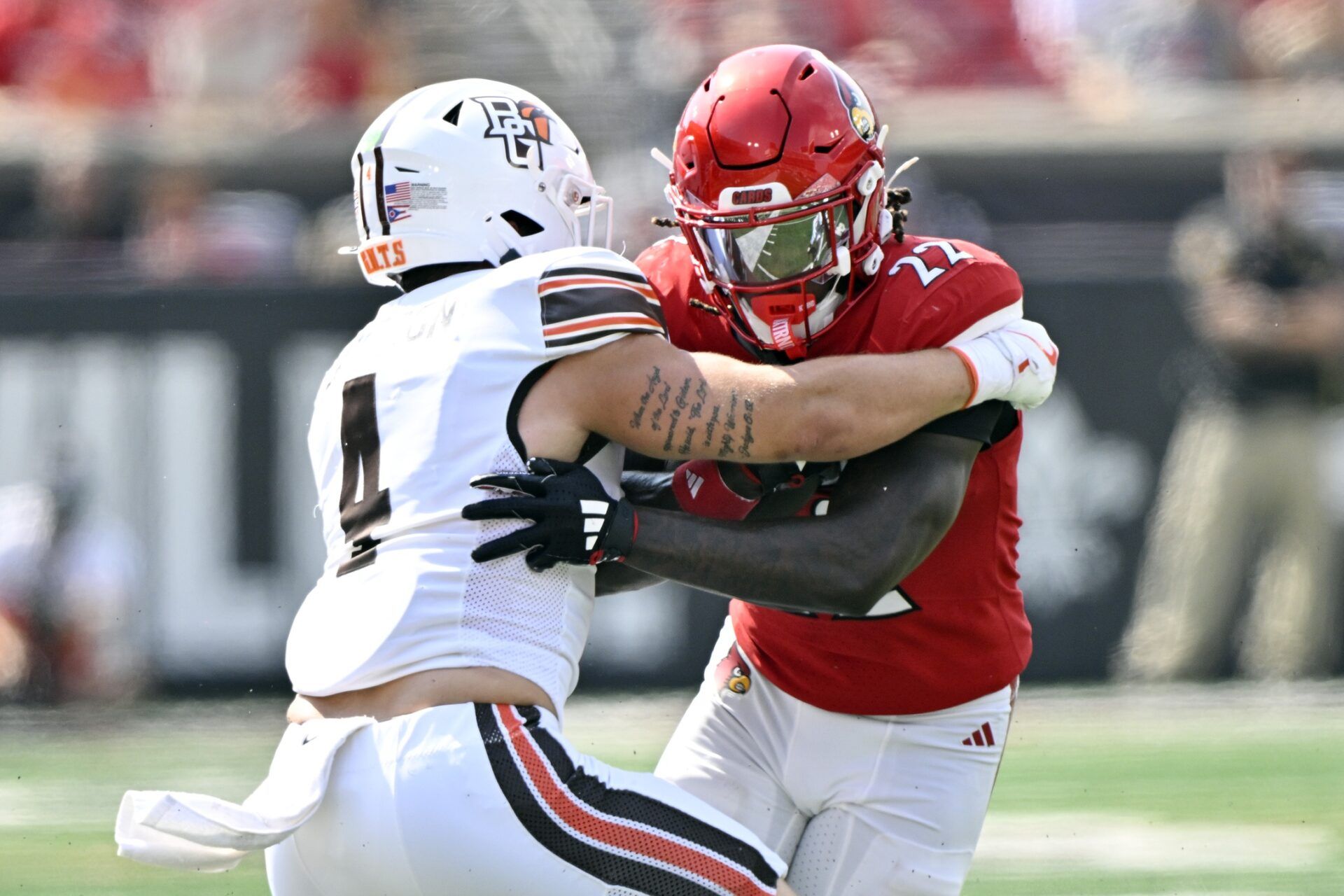
In the transfer portal, as on the field, linebacker remains a difference-making position. With a potential championship on the line, linebackers have the ability to change the game’s outcome.
10) Mekhi Mason, Louisiana Tech
PFSN College LB Impact Score: 76.1 (C)
Arguably the Bulldogs’ best pass rusher, Mason brings a diverse skillset to the field. With functional flexibility and closing speed, the rising senior quickly closes the gap between himself and the ball.
Moreover, Mason’s excellent tackling ability allows him to bring down both quarterbacks and running backs. His lone flaw seems to be his coverage skills, as he struggles when playing far from the line of scrimmage. Mason ranked 90th in PFSN’s LB Impact metric.
9) Christian Alliegro, Wisconsin
PFSN College LB Impact Score: 76.7 (C)
With excellent size for an inside linebacker (6’4″, 247 pounds), Alliegro is a downhill defender who controls the A gaps in both the run game and pass rush. He follows the time-honored tradition of ‘see ball, get ball.’ Nothing Allegro does is fancy; his approach relies on quick hands and a wide tackle radius.
8) Caleb Bacon, Iowa State
PFSN College LB Impact Score: 76.9 (C)
While Bacon played outside linebacker in Ames, his knack for sniffing out and stopping the run could allow him to evolve into an inside or middle linebacker. The one thing he needs to work on is refining his tackling technique. Currently, he uses a lot of grab-and-drag, which stronger or more experienced backs with good contact balance can easily shake off.
7) Kooper Ebel, Iowa State
PFSN College LB Impact Score: 77.9 (C+)
Another Cyclone linebacker with a similar skillset and a rangy frame. Unfortunately, like his teammate, he also struggles with tackling. To become NFL-ready, Ebel will need to choose a school with a strong linebackers coach, someone who can teach him that reaching the ball carrier must be followed by finishing the play.
6) Ethan Wesloski, North Texas
PFSN College LB Impact Score: 79.3 (C+)
At six-foot-one, Wesloski lacks the typical frame of an off-ball linebacker. However, body type doesn’t always dictate production. Over his years in Denton, Wesloski’s role shifted from blitzer to run stopper with strong coverage skills. As a result, his future school can use him in various defenses and fronts as a three-down linebacker who makes plays all over the field, as shown by his team-leading 80 tackles.
5) Austin Romaine, Kansas State
PFSN College LB Impact Score: 79.4 (C+)
In coverage, Romaine played solid football, but he built his reputation on hitting and jarring the ball loose. With three career forced fumbles, he continuously fought through blockers to make plays. However, he struggles a bit with timing and breaking down to tackle. Every season in Manhattan, he recorded more solo tackles than assists.
4) Owen Chambliss, San Diego State
PFSN College LB Impact Score: 79.5 (C+)
At 230 pounds, you might not expect the former Utah transfer to excel at blitzing (four sacks) or coverage (five pass breakups, one interception), but Chambliss made the most of his first full season as a starter. Finding a three-down linebacker who can trail tight ends down the seam is rare. While not the biggest name, Chambliss should land a sizable NIL deal.
3) Ray Coney, Tulsa
PFSN College LB Impact Score: 79.6 (C+)
Normally, when a player moves up from an FCS team, there is a learning curve. However, the East Tennessee State transfer immediately earned a starting role for the Golden Hurricane. Coney projects as a middle linebacker with some blitzing skill and a need to improve his coverage.
2) Keaton Thomas, Baylor
PFSN College LB Impact Score: 81.4 (B-)
A playmaker whose absence will hurt Baylor. Thomas doesn’t weigh 230 pounds, but he shreds blocks with both power and dexterity. While not a great blitzer, he fills gaps against the run and performs well in coverage, whether facing receivers crossing his path or when shadowing one.
1) Gideon Lampron, Bowling Green
PFSN College LB Impact Score: 82.3 (B-)
With one year remaining, a contender will get a player who can upgrade any defense. Granted, ‘active’ is a relative and overused term, but it fits Lampron. After transferring from Dayton to FBS, he posted a 119-tackle season and 17.5 tackles for loss, establishing himself as an elite run stopper who shoots gaps and flies to the ball.
