
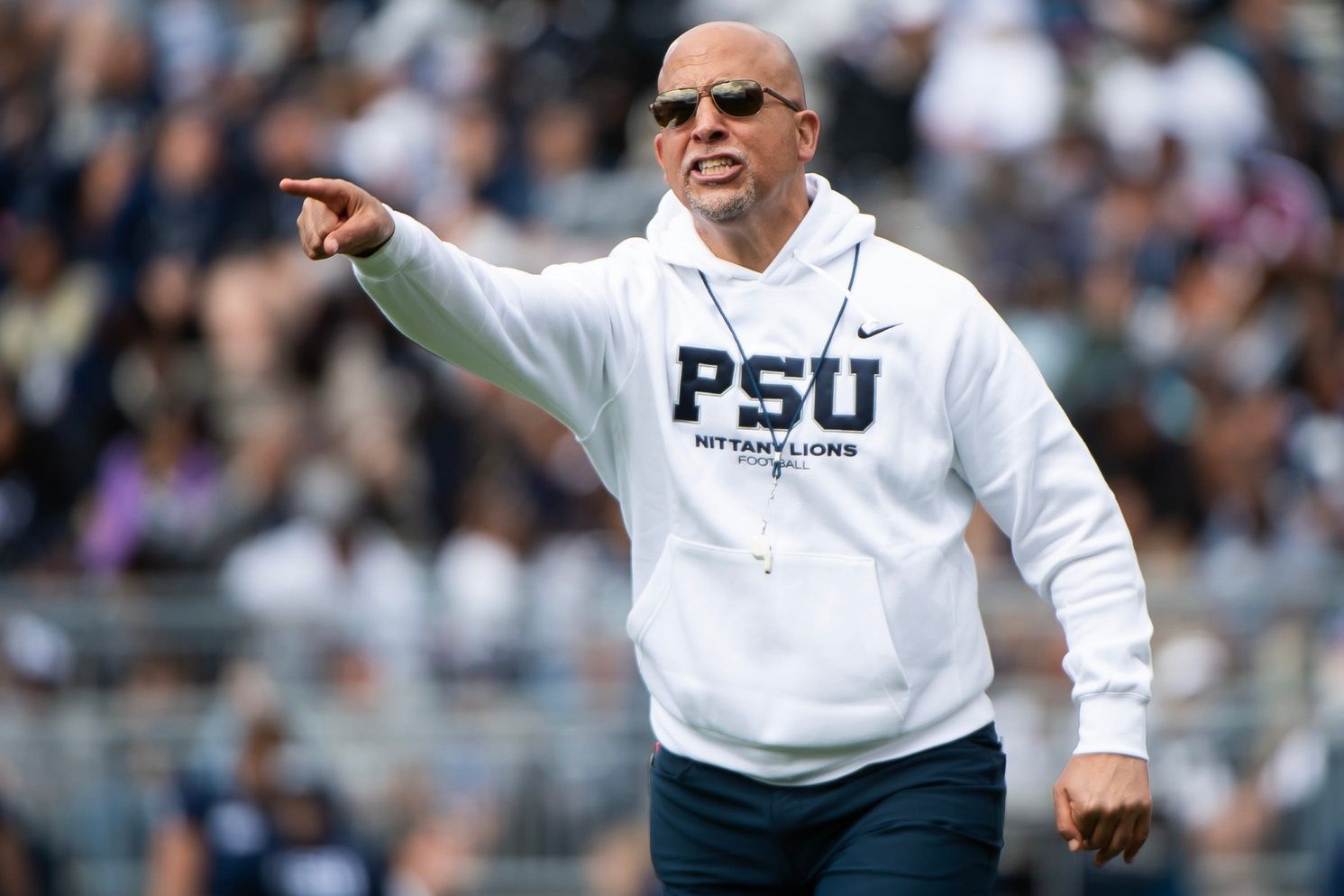
As college football braces for major structural changes, Penn State head coach James Franklin is making it clear that the sport is entering a new era. During a recent appearance on “The Triple Option” podcast, Franklin outlined a future shaped by revenue sharing, NIL regulations, and centralized enforcement.
As Franklin prepares for his 12th season leading the Nittany Lions, the program is riding the momentum of a record-setting campaign.
James Franklin Delivers Blunt Message as College Football Evolves
Penn State head coach James Franklin did not hold back during a recent appearance on “The Triple Option,” voicing his candid perspective on the sweeping changes reshaping college football.
As the sport prepares for a future defined by revenue sharing and NIL regulation, Franklin offered insight into a new power structure that could dramatically alter how the game is governed.
Franklin said the changes ahead will go beyond NIL and athlete compensation, describing an emerging model that may centralize control of college football under a single enforcement entity.
“The way I kind of understand it is this is revenue sharing rules and NIL rules kind of are all under this umbrella,” Franklin said. “But I would also say that I really think it’s pretty much going to be everything. I think football is going to be run by this entity.”
He drew a sharp contrast between this new enforcement body and the NCAA’s historically slow response system. According to Franklin, this new structure will carry subpoena power and move swiftly on violations, unlike NCAA investigations that often dragged on for years.
“This is going to be different than anything we’ve all experienced because they’re going to have subpoena power and they are going to act and act swiftly,” Franklin said. “This is not going to be one of these things that we’ve all kind of grown up with under the NCAA, where it goes on for two years.”
Franklin explained that the agreement schools will sign under this new framework carries significant legal implications. “If you want to be a part of this, you’re in, and if you don’t want to be a part of it, then go play somewhere else.”
KEEP READING: Why New College Football Payment Rules Won’t Ruin Game Day
Franklin acknowledged the growing pains that could accompany such a transition. “In theory, I think you’ll like what they’re trying to do. Now, as we both know, the theory of it and the reality are two different things,” he said, emphasizing that despite optimism, implementation will not be without obstacles.
Starting July 1, the House v. NCAA Settlement will reshape NIL practices, enabling schools to directly pay athletes. Under this model, institutions can distribute as much as $20.5 million annually to players, signaling a major change for programs still rooted in outdated structures, Franklin warns, are quickly becoming obsolete.
The Road Ahead: Implementation Challenges
While Franklin painted a picture of swift enforcement and clear rules, the reality of implementing such sweeping changes by July 1 presents significant hurdles that even he acknowledged won’t be seamless.
The $20.5 million question facing athletic directors is how to distribute it. Schools must navigate uncharted waters in determining which athletes get what share, all while maintaining competitive rosters and keeping boosters happy.
Penn State, with its massive football program and 31 varsity sports, will need to balance revenue sharing across all athletes while likely prioritizing football and basketball, where the bulk of revenue is generated.
One thing to also consider is Title IX compliance. Legal experts have already flagged that unequal compensation between men’s and women’s sports could trigger discrimination lawsuits. If football players receive the lion’s share of that $20.5 million pot, female athletes might have grounds to challenge the distribution model—something the settlement doesn’t adequately address.
Perhaps most intriguing is how NIL collectives will operate under this new enforcement body’s watchful eye. These donor-funded organizations have become the lifeblood of recruiting, often operating in gray areas the NCAA couldn’t touch. Franklin’s mention of “subpoena power” suggests the new entity plans to scrutinize these arrangements far more aggressively than the NCAA ever could.
For programs like Penn State that have built robust NIL infrastructure, adapting to enhanced oversight while maintaining competitive advantages will require careful navigation.

Franklin speaks from a position of ignorance. Watch the first time the “non-biased” NIL Go disallows a NIL contract for a player and they get sued for the same predatory behavior that got them in trouble in the first place. Unlike the “perceived” subpoena power of college football they will see the real subpoena power when they are drug into federal court every other day. The government does not take kindly to restrictions on commerce.
Every football season Franklin further proves he is not a top tier coach. He’s a nightmare of a head coach. PSU will never be the National Champs under him.
Franklin is a whiny and has his underwear tied up in knots over notre dame
Get used to it James it s going to be a long ride and you are going to be at the back of the bus. You can whine all you want but it gets you nowhere. Only results count.
Wait until ND is bound to join a Big Boy Conference and not get the ACC cupcakes and forgive me the Service Academies. ND is and has been the most overated program in Division 1. The Dome is tarnished and will never be polished. Imagine how ANONYMOUS will feel. So typical.