
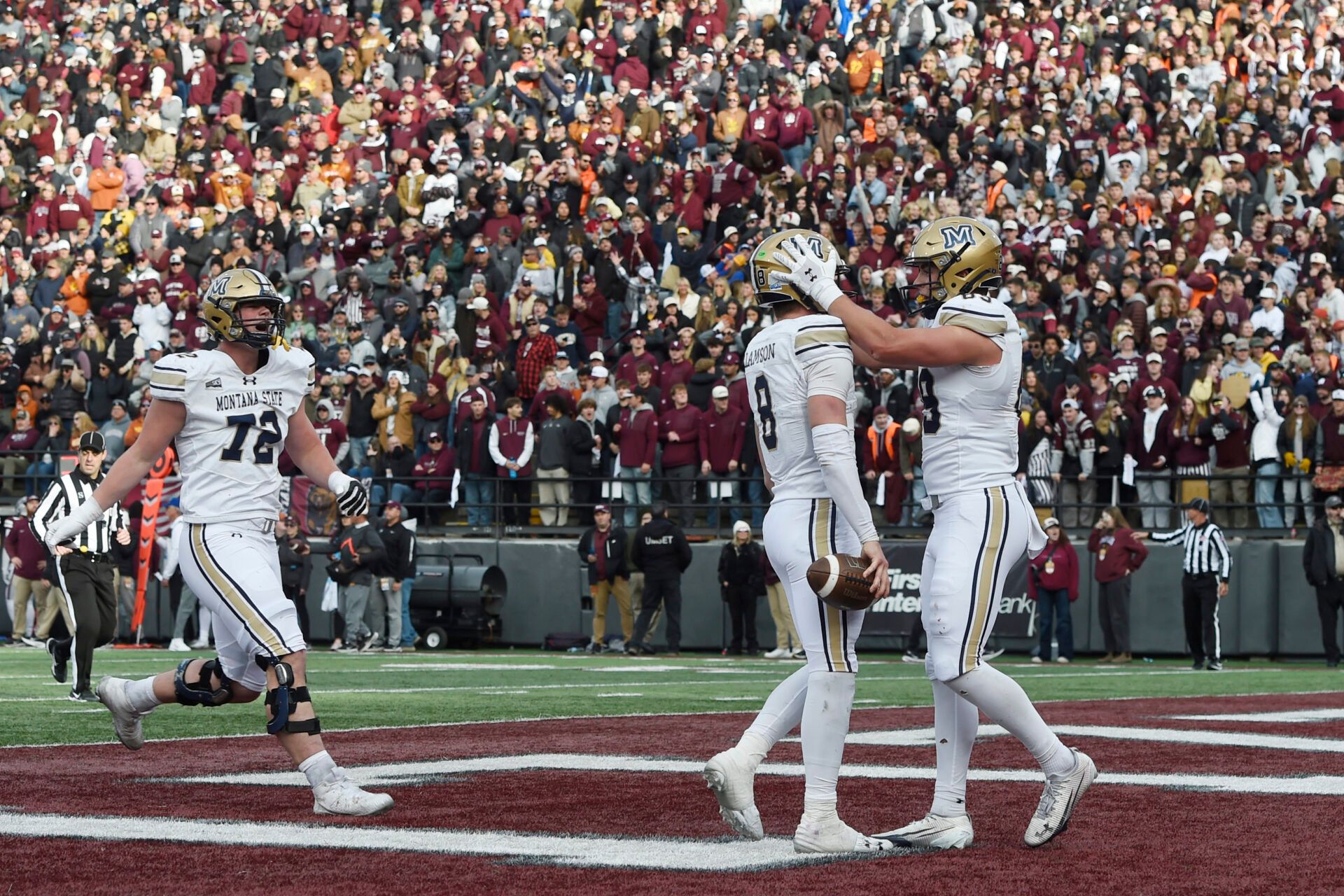
Forty-one seasons have passed since the Montana State Bobcats last lifted a national championship trophy. On a December day in Charleston, South Carolina, Dave Arnold’s 1984 squad dismantled Louisiana Tech 19-6, capping one of college football’s most improbable turnaround stories.
Tonight, in Nashville’s FirstBank Stadium, Brent Vigen’s Bobcats have the chance to finally close that chapter and begin a new one. Standing in their way are the Illinois State Redbirds, a team that has rewritten what’s possible in the FCS playoffs.
Montana State, Illinois State, and The Purity of the FCS Postseason
The 2026 FCS Championship Game between Montana State and Illinois State proves there is a world (and postseason format) where every team, regardless of size, infrastructure, or national perception, can compete on the biggest stage without bias-led narratives to the contrary.
Brent Vigen’s Montana State might be a substantial favorite entering the game, but you simply can’t rule out the Cinderella Redbirds, and neither should you want to. This is what college football is all about in its purest, most awesome form.
The No. 2-seeded Bobcats (13-2) enter on a 13-game winning streak, the kind of sustained excellence that makes them deserving favourites.
Yet Brock Spack’s unseeded Redbirds (12-4) have become the first team in FCS history to win four consecutive road playoff games, including what many are calling the biggest upset in FCS postseason history: a 29-28 triumph over defending champion and previously unbeaten North Dakota State in Fargo.
That alone should give Montana State pause.
The Weight of History in Bozeman
Montana State remains the only college football programme to have claimed national championships at three different levels: NAIA in 1956, NCAA Division II in 1976, and NCAA Division I-AA in 1984.
That final crown, won under Arnold after a dismal 1-10 campaign the previous year, has taken on almost mythical status in Bozeman.
In October 2024, the programme honoured the 1984 team during a home victory over Northern Colorado. More than 60 members returned to relive their glory, and the message to the current squad was unmistakable.
“They aren’t special because they won,” Vigen told his players. “They won because they’re special, and that’s what we’re trying to become.”
The Bobcats have come agonisingly close under Vigen’s stewardship. This marks their third championship game appearance in five seasons, with losses to North Dakota State in both 2021 and 2024.
Vigen’s .887 winning percentage is the best in school history, his 60 wins are among the most for the Bobcats, and he’s the only Montana State coach to lead the programme to consecutive title game appearances. The credentials are impeccable. The trophy case, however, remains incomplete.
A Stanford Transfer’s Remarkable Journey
Justin Lamson spent the 2023 and 2024 seasons as a backup at Stanford, appearing in 23 games but making just four starts. When he entered the transfer portal following a coaching change at Bowling Green, where he’d initially committed, Montana State represented something different: a programme consistently contending for championships that needed a quarterback.
The fit has been seamless. Lamson leads the FCS with a 72% completion rate and has thrown for 2,892 yards with 24 touchdowns against only three interceptions.
He went the entire Big Sky Conference regular season without throwing a pick. His 704 rushing yards and 14 rushing touchdowns make him the kind of dual-threat weapon that keeps defensive coordinators awake at night.
“Last year at this time I didn’t really know what was next for me,” Lamson reflected upon arriving in Nashville. “I’m very fortunate to be in this position. I wouldn’t trade it for the world.”
The Big Sky named him Newcomer of the Year, but individual honours matter little now. One game remains between Lamson and the legacy he came to Bozeman to help build.
Illinois State, The Miracle Workers from Normal
Illinois State’s path to Nashville defies belief.
After losing to Southern Illinois 37-7 in their regular-season finale, the Redbirds entered the playoffs unseeded and overlooked. They’d already lost to North Dakota State 33-16 in October. Their record sat at 8-4, hardly the profile of a championship contender.
What followed has been extraordinary.
A 21-3 dismantling of Southeastern Louisiana. Then, in Fargo, the signature moment: trailing 28-14 with under three minutes remaining against top-seeded NDSU, Tommy Rittenhouse overcame five interceptions to connect with Daniel Sobkowicz for two late touchdowns.
On fourth-and-goal with 51 seconds left, Rittenhouse found Sobkowicz again, then hit Scotty Presson Jr. for the game-winning two-point conversion.
The defending champions were done. Illinois State’s Cinderella story had begun in earnest.
Wins at UC Davis (42-31) and Villanova (30-14) followed, the latter representing the largest semifinal road victory in 30 years. Spack’s group has proven they belong, even if they’re reluctant to embrace the fairytale framing.
“You don’t win four in a row in a tournament like this and be a Cinderella, in my opinion,” Spack said Saturday. “We come from a great football conference. I think all of the Missouri Valley gets us ready for a tournament like this because every weekend, you have to be ready to play in our league.”
What to Watch in Illinois State vs. Montana State
Montana State’s offense has been among the FCS’s most prolific, averaging 38.1 points and 437.1 yards per game. They rank fourth nationally with 234.5 rushing yards per contest, powered by the trio of Lamson, Julius Davis (1,100 yards, 6.7 yards per carry), and Adam Jones (1,000+ yards, 6.2 yards per carry).
The Bobcats have averaged at least five yards per carry against every FCS opponent this season.
MORE: NFL Black Monday: College Football Coaches Who Could Replace Fired HCs Include Lincoln Riley
Yet Illinois State’s defensive front, anchored by All-American Paul Brott, linebacker Tye Niekamp (155 tackles, 14.5 for loss), and edge rusher Garrett Steffen (seven sacks), held opponents to 3.79 yards per carry and just 99 rushing yards per game during the playoffs. This is the best defensive line Montana State will have faced since their Week 2 loss to South Dakota State.
The Redbirds counter offensively through the Rittenhouse-to-Sobkowicz connection, which has produced 403 yards and seven touchdowns in the playoffs alone.
Sobkowicz may be the most complete receiver in the FCS and has NFL scouts taking notice. Running back Victor Dawson provides balance with 512 playoff rushing yards, the kind of consistent four-and-five-yard gains that sustain drives and keep defences honest.
Montana State’s depth, however, could prove decisive. The Bobcats regularly rotate 19 defensive players who see significant snaps, compared to Illinois State’s 14 or 15. In a physical championship bout, fresh legs in the fourth quarter matter.
What’s at Stake in the FCS National Championship Game?
For Montana State, tonight represents the chance to end four decades of waiting, to give Vigen the crown that has twice slipped away, and to add another championship banner alongside 1956, 1976, and 1984.
For Illinois State, victory would deliver the programme’s first national championship in any Division I sport. Spack, the winningest coach in Redbirds history with 123 victories across 17 seasons, lost the 2014 title game to North Dakota State 29-27.
A win tonight would exorcise that demon and complete one of college football’s most remarkable postseason runs.
The Bobcats are 10-point favourites. They have the pedigree, the depth, and the experience of two previous championship game appearances under this coaching staff.
Yet this is FCS football, where programmes from Normal, Illinois, can topple dynasties in Fargo and reach championship games through sheer will and execution, where a Stanford backup can become a conference newcomer of the year in Bozeman, where 42-year droughts can end on a Monday night in Nashville.
That’s the beauty of it.