
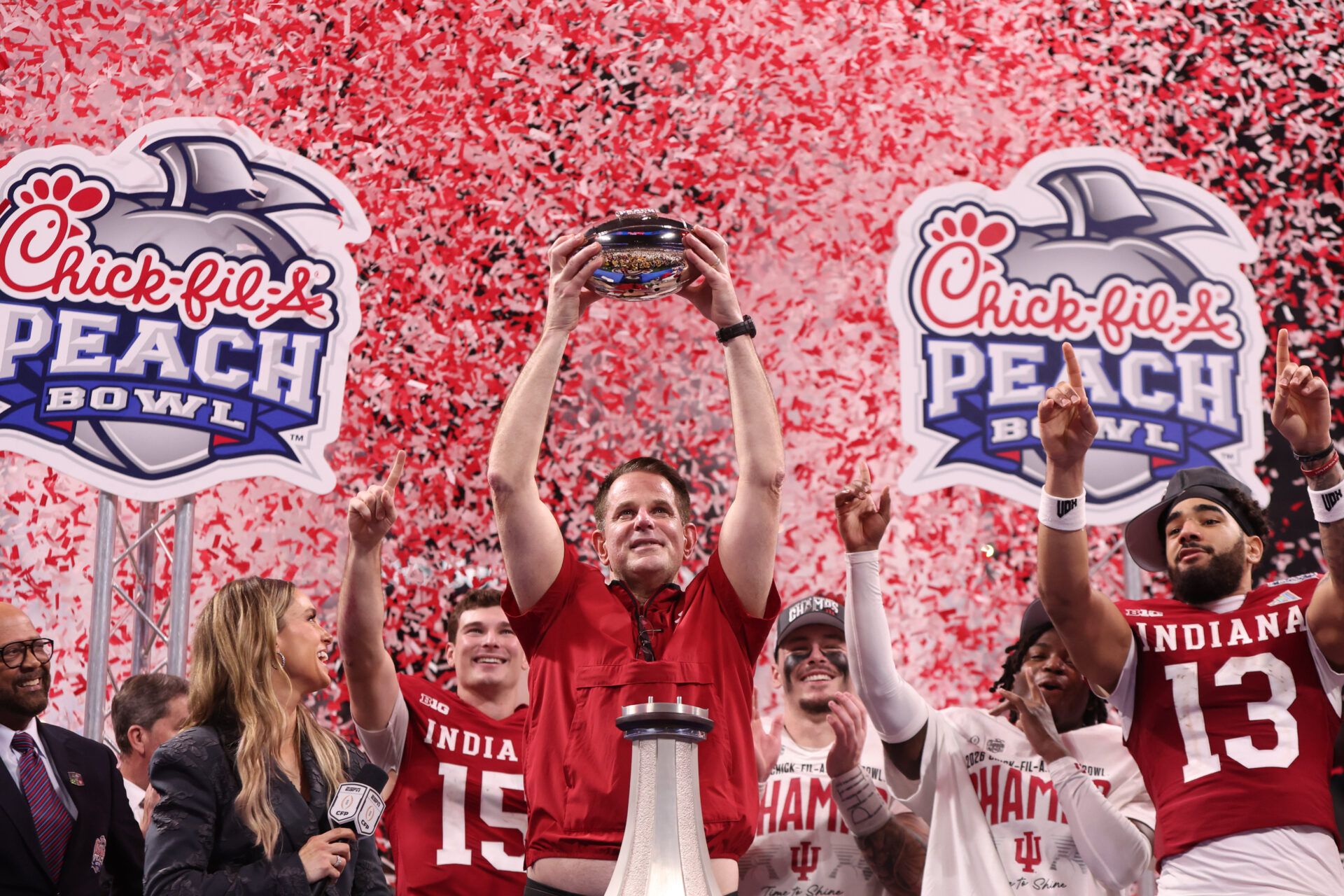
When Curt Cignetti stepped to center court at Simon Skjodt Assembly Hall on Dec. 1, 2023, nobody in Bloomington knew what was coming. The newly hired Indiana football coach, introduced to fans during a timeout at a men’s basketball game, took the microphone and delivered 33 words that would change everything.
How Curt Cignetti Changed the Perception of Indiana Football Forever
“Hey, look, I’m super fired up about this opportunity. I’ve never taken a back seat to anybody and don’t plan on starting now. Purdue sucks! But so does Michigan and Ohio State! Go IU!”
At the time, Indiana held the most losses (715) of any program in Division I football history. The Hoosiers hadn’t won a bowl game since 1991, hadn’t claimed an outright Big Ten title since 1945, and had endured losing seasons as routinely as the limestone buildings on campus collected moss.
When a reporter asked Cignetti weeks later why anyone should believe he could end all this losing, he offered the response that would become legend: “It’s pretty simple. I win. Google me.”
Now, 25 months later, the Hoosiers sit one game from completing one of the most remarkable transformations in American sports history. Monday night at Hard Rock Stadium, No. 1 Indiana (15-0) faces No. 10 Miami in the College Football Playoff National Championship Game, 60 minutes from becoming the first 16-0 team since Yale in 1894.
To appreciate the magnitude of what Cignetti has built, you need to understand the depths from which Indiana emerged. The numbers tell a brutal story, but they don’t capture the decades of institutional despair.
From 1992 to 2006, Indiana failed to produce a single winning season — a 15-year span of futility that saw seven different head coaches cycle through Bloomington.
The program managed just three winning records between 1995 and 2023. Ohio State had defeated Indiana 30 consecutive times. The series against Michigan since 1968 read 88-4-1 in favour of the Wolverines. Memorial Stadium routinely sat half-empty, fans trickling out by halftime regardless of the score.
“One of my first memories, talk about being in my DNA, was we always lost,” Angelo Pizzo, the Indiana alumnus who wrote Hoosiers and Rudy, told the Associated Press this week.
Galen Clavio, a 2001 IU graduate and current associate dean at the school, put the transformation in starker terms when speaking to NBC News: “It feels like someone beamed somebody else’s team down to play.”
Cignetti’s Roster Construction Philosophy Goes Against the Grain
What separated Cignetti from the parade of coaches who came before him wasn’t just confidence; it was clarity of vision backed by a proven process.
“I remember even during our first conversation, I said to him, ‘Curt, do you really believe you can win here?'” Athletic Director Scott Dolson told the AP. “He just said, ‘Scott, if I have average resources, I’m 100% sure I will win here. There’s no question about it.'”
Cignetti arrived from James Madison with 13 players in tow, a baker’s dozen who understood his expectations intimately. The transfer portal became his mechanism for rapid roster construction, but his approach defied conventional wisdom.
Where other coaches chased potential and recruiting stars, Cignetti sought proof.
“As Cig has said, he wants performance, not potential, which is exactly what he focused on,” billionaire Indiana alum Mark Cuban told CBS Sports.
“He put together a team where players knew their roles coming in, a coaching staff that could take those experienced players and mold them quickly, and an organization that understood exactly how to get the pieces they needed.”
The philosophy trickled down to granular detail. Cignetti developed hand signals to communicate evaluation concerns to his assistants. One signal, hands separating into a V-shape, indicated “duck feet” — a physical trait that could limit a prospect’s potential.
MORE: Elijah Sarratt: How Indiana’s ‘Waffle House’ Became College Football’s Most Clutch Receiver
The meticulous evaluation extended to intangibles: how prospects shook hands, how they absorbed coaching, and whether they could immediately translate instruction to the field.
“Once you become kind of the CEO and your stamp is on it, you want to be invested in who you bring through the door, coaches and players,” Cignetti explained. “You want to put the final stamp on them.”
Year 1 Under Cignetti Laid the Foundation for the 2025 CFP Run
Cignetti’s first season at Indiana produced 11 victories, shattering every program record for wins in a season. The Hoosiers reached the College Football Playoff, losing to Notre Dame in a first-round game that left wounds rather than satisfaction.
The experience galvanised Cignetti’s roster decisions heading into 2025. Among the additions: Fernando Mendoza, a redshirt junior quarterback transferring from California who would become the school’s first Heisman Trophy winner.
Mendoza’s journey mirrors Indiana’s larger narrative. He began his college career as a Yale commit before flipping to Cal, where he developed into one of the nation’s most efficient passers despite limited team success. When Cignetti came calling, Mendoza saw an opportunity to chase something bigger alongside a program equally hungry for validation.
“I want to thank God for giving me the opportunity to chase a dream that once felt a world away,” Mendoza said during his Heisman acceptance speech in December.
“Standing here tonight, holding this bad boy, representing Indiana University, still doesn’t feel real. If you told me, as a kid in Miami, that I’d be here on stage, holding this prestigious trophy, I probably would have laughed, cried, like I’m doing now, or both.”
Mendoza finished the 2025 regular season completing 71.5% of his passes for 2,980 yards and a nation-leading 33 touchdowns against just six interceptions. He won the Heisman with 84.66% of possible points, the seventh-highest percentage in the award’s 91-year history.
While Mendoza provided Indiana’s offensive engine, the defense emerged as the program’s identity under coordinator Bryant Haines, who has worked alongside Cignetti for more than a decade across multiple stops.
Senior linebacker Aiden Fisher, another James Madison transfer, personified the unit’s approach. Once a zero-star recruit from Virginia, Fisher developed into a first-team All-American through relentless preparation and an insatiable appetite for film study.
“There’s a hunger in me that I just want to be great,” Fisher told Big Ten Network.
The defence’s impact extended beyond statistics, though those numbers — a program-record 44 sacks, 21 forced turnovers, and an FBS-leading turnover margin of plus-21 — told their own story.
Indiana’s ability to create chaos on opposing first drives became a hallmark. Against Oregon in the Peach Bowl semifinal, cornerback D’Angelo Ponds returned a pick-six on the Ducks’ opening play from scrimmage. Fisher explained the phenomenon with characteristic humility.
“We have things that we can see within our preparation, and then we have the best D coordinator in college football. So, when you match up those things, you get off to fast starts as a defense.”
Cignetti Orchestrated a Culture Shift
Perhaps nothing illustrated Indiana’s transformation more than the scene at the Big Ten Championship Game in Indianapolis. The Hoosiers, ranked No. 2 nationally, faced No. 1 Ohio State in a rivalry the Buckeyes had dominated for 30 consecutive years.
When it ended, Indiana had won 13-10 for its first victory over Ohio State since 1988, its first Big Ten title since 1967.
“We were never supposed to be in this position,” Mendoza said after the game, voice trembling with emotion, “but by the glory of God, the great coaches, the great teammates, everyone we have around us, we were able to pull this off.”
The victory drew 18.3 million television viewers, making it the most-watched conference championship game in college football history. Back in Bloomington, Memorial Stadium had become a different place. Eight of the ten largest crowds in programme history occurred during Cignetti’s tenure. Indiana surpassed Penn State for the nation’s largest living alumni base.
MORE: Two Sets of Brothers, One Championship Dream: Inside Indiana’s Unique Family Bonds
Mark Cuban, asked by NBC News whether he ever imagined Indiana reaching Ohio State’s level, offered a response fitting for a school that once seemed destined for eternal mediocrity: “Hell no. I thought I would be dunking with my feet before that would happen.”
Indiana’s playoff run has been dominant by any measure. The Hoosiers destroyed Alabama 38-3 in the Rose Bowl quarterfinal, the program’s first bowl victory since defeating Baylor in the 1991 Copper Bowl. Mendoza threw three touchdowns on 14-of-16 passing.
The semifinal rematch with Oregon proved even more emphatic. Indiana led 35-7 by halftime and cruised to a 56-22 victory, with Mendoza completing 17 of 20 passes for five touchdowns. The combined margin through two playoff games: 69 points.
Yet Cignetti has resisted any temptation to treat Monday’s championship as a coronation.
“We’re still in our process, our preparation process. We all understand that,” Cignetti said at Saturday’s media availability.
“Obviously, the last two years, it’s been a great story. It’s been fast progress, kind of surreal to some degree. It’s a big story nationally. I get that. But that’s separate, sort of, from our team mindset right now, in terms of us physically being here and what our intentions are today, what we’ve got to get done today.”
The Hoosiers’ methodology hasn’t changed since Cignetti arrived at Memorial Stadium around 5 a.m. each morning during his first weeks on the job. He still stays late watching film.
The 24-hour celebration window after victories remains inviolable. The standards that seemed audacious when a coach with a stone-faced grimace proclaimed “Purdue sucks, but so does Michigan and Ohio State” have simply become the floor.
When Cignetti challenged fans to Google him, he was making a statement about track record. His 119-35 career record spoke for itself. Yet the deeper meaning has emerged over two seasons: Cignetti wasn’t just asking people to verify his wins. He was telling them to look harder at what they believed was possible.
“I was on campus for about 10 minutes,” Cignetti recalled to ESPN’s Jen Lada, “and I could detect the doom and gloom. That night at the basketball game, I felt like ‘you know, I gotta wake these people up.'”
He did more than wake them. He gave a fanbase that had accepted losing as inevitable permission to dream about winning. Not 6-6 seasons. Not occasional bowl eligibility. National championships.
“Success is a choice,” Cignetti told FOX Sports. “Nothing good in life comes easy. You gotta be willing to pay the price.”
Indiana has paid it. Now they’re one game from collecting the reward that once seemed as plausible as, well, dunking with your feet.
Mendoza, in his Heisman speech, spoke directly to the overlooked and underestimated who might see themselves in Indiana’s journey.
“This is an important one. I want every kid out there who feels overlooked and underestimated — I was you. I was that kid, too. I was in your shoes. The truth is, you don’t need the most stars, hype, or rankings. You just need discipline, heart, and people who believe in you and your own abilities.”
For the Indiana Hoosiers, belief finally arrived on Dec. 1, 2023, in the form of a coach with a stone-faced grimace and two words that changed everything.