
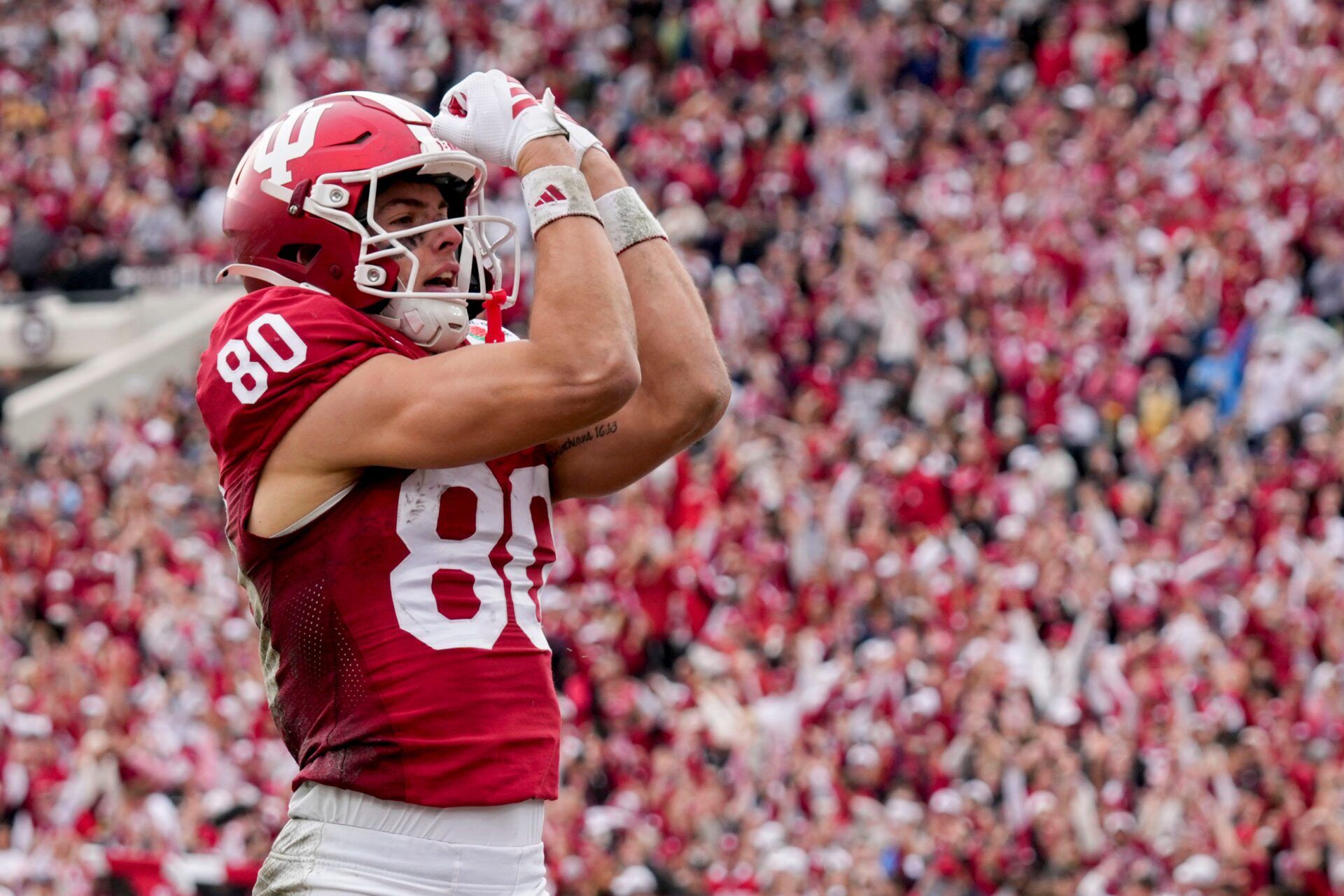
When people talk about Indiana’s receiving corps, the conversation almost always starts and ends with Elijah Sarratt and Omar Cooper Jr. And to be fair, that attention is warranted. Both have been dynamic and reliable weapons and foundational pieces of the Hoosiers’ offense.
But beneath the spotlight, another name has quietly emerged as a crucial part of Indiana’s late-season surge and Fernando Mendoza’s rise to stardom. That name is Charlie Becker.
Charlie Becker Is the Indiana Hoosiers’ Unsung Hero
At 6’4”, 204 pounds, Becker doesn’t exactly look like an under-the-radar player. Still, as a sophomore surrounded by experienced and established receivers, his path to meaningful snaps wasn’t guaranteed.
Early in the season, opportunities were limited as Sarratt and Cooper Jr. naturally commanded the first looks in the rotation. Becker had to earn everything he got. And when the opportunity finally came, he was ready.
As Sarratt battled through some injuries and Indiana searched for answers, Becker stepped into a larger role and immediately made his presence felt. By season’s end, Becker totaled 28 receptions for 566 yards and three touchdowns, eye-catching numbers for a WR3, especially one still learning his way at the college level.
What truly separates Becker, though, is how he produced those numbers. His 20.2 yards per catch ranked sixth-best in the nation among all receivers, a testament to his big-play ability and downfield impact. When Becker touches the ball, defenses feel it.
The moment he truly announced himself came in Week 11 against Penn State. On the road, in one of the most challenging environments in college football, Becker delivered the game of his young career: Seven catches, 118 yards, and countless momentum-shifting plays.
He was a significant reason Indiana completed a stunning comeback win in Happy Valley, consistently attacking Penn State’s secondary and giving Mendoza a reliable target when it mattered most.
The advanced metrics back it up. Becker earned a 77.9 PFSN grade in Week 11 (27th among receivers), followed by a 79.5 grade in Week 12 (12th best). His best performance yet came against Alabama, where he posted an 84.6 grade, the second-best of any receiver that week.
Those performances didn’t just elevate Becker; they elevated his quarterback.
Fernando Mendoza’s New Favorite Target?
Mendoza’s Heisman campaign surged at the same time Becker became a consistent part of the offense. As the saying goes, the award is won in November, and Mendoza saved his best football for the season’s most crucial stretch.
His PFSN College QB Impact metrics tell the story: 75.6 in Week 11, 86 in Week 12, 80.1 in Week 14, and a stellar 91 against Alabama. It’s grades like those that have helped him also spot the QB1 ranking in the PFSN 2026 NFL Draft Consensus Big Board.
It’s no coincidence that as Becker’s role grew, Mendoza’s consistency followed.
Down the stretch, Becker emerged as a legitimate red-zone threat and a trusted safety net. His size, catch radius, and ability to win vertically gave Mendoza an option he could rely on when plays broke down or when defenses keyed in on Sarratt and Cooper. Becker didn’t need a high volume of targets to make an impact; he made the most of the ones he got.
And perhaps the most interesting detail of all? Mendoza and Becker are roommates.
That off-field chemistry shows up on Saturdays. Timing, trust, and communication don’t develop overnight, and the comfort between quarterback and receiver was evident as the season progressed. Routes were crisper, decisions were quicker, and big plays became more frequent.
Indiana’s offense didn’t just rely on its stars; it evolved because of its depth. Becker may not yet be a household name, but his emergence played a significant role in both the Hoosiers’ success and Mendoza’s Heisman-winning season.
The rest of the country may still be catching up, but Indiana fans know the truth: Becker isn’t just the “other” receiver anymore. He’s a star in the making.
