
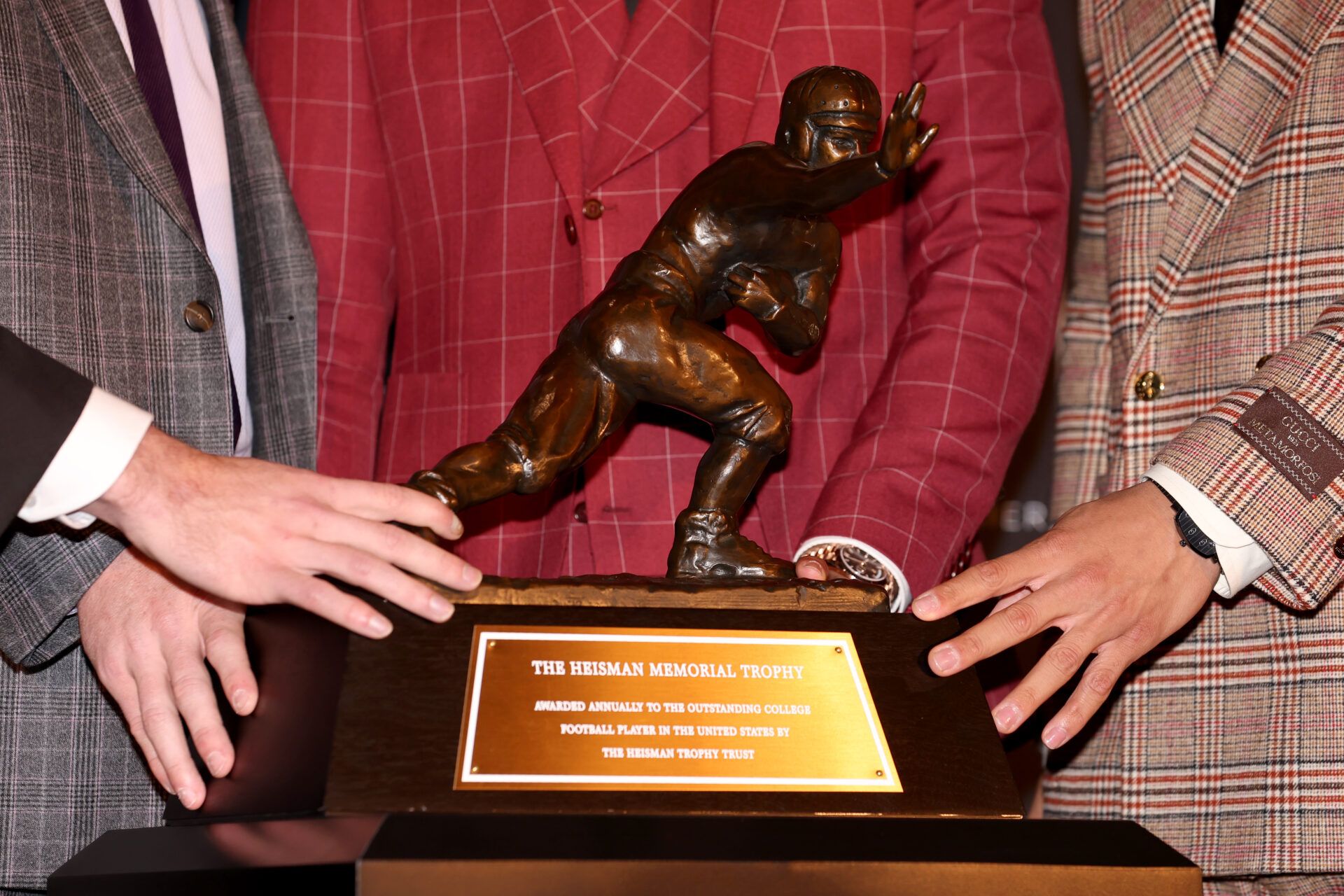
The Heisman Trophy finalists have been announced, and four of college football’s brightest stars are heading to New York with a chance to take home the sport’s most iconic award. Indiana QB Fernando Mendoza, Notre Dame RB Jeremiyah Love, Ohio State QB Julian Sayin, and Vanderbilt QB Diego Pavia each delivered special seasons that elevated their programs.
But while the Heisman celebrates college football greatness, NFL evaluators see these players through a different lens. With the 2026 NFL Draft approaching, it’s time to power rank the Heisman finalists based on their draft stock, not their Heisman cases.
1) Fernando Mendoza: QB, Indiana
This top spot was extremely close, but Mendoza edges out the competition for one fundamental reason: quarterback value rules the NFL Draft. And Mendoza checks nearly every box teams look for in a franchise passer.
At 6’5″ and around 225–230 pounds, Mendoza possesses the prototypical frame NFL teams covet. Through the regular season, he threw for 2,738 yards, 32 touchdowns, and just 5 interceptions, offering elite efficiency and big-play ability.
He also owns the second-highest PFSN QBi score (92.2), and he has Indiana positioned better than they’ve been in nearly six decades. His film shows above-average arm talent, strong processing ability, impressive toughness, and sneaky athleticism. Considering 2025 was his first year in Curt Cignetti’s system after transferring in, evaluators see even more room for growth.
It’s no surprise the PFSN Big Board ranks him as the No. 2 quarterback and No. 6 overall prospect, with a consensus between draft analysts Ian Cummings and James Fragoza. If he declares, he has a real chance to be a top-five pick and even make a push for first overall.
2) Jeremiyah Love: RB, Notre Dame
In terms of pure talent, Jeremiyah Love had a legitimate argument for No. 1. He’s the best running back in college football and is viewed as one of the most impressive RB prospects in recent memory.
Love blends power, agility, balance, and breakaway speed in a way that evokes comparisons to Ashton Jeanty, Bijan Robinson, and even Saquon Barkley. That’s the level of respect scouts have for his tools and translatable traits.
He posted a 92.2 RB Impact Grade in 2025, ranking 5th among all running backs, despite sharing backfield touches with Jadarian Price, arguably the best backup RB in the country. Notre Dame didn’t have to overwork him, and his efficiency remained elite.
PFSN ranks Love as the No. 1 running back and No. 7 overall prospect in the 2026 class. Even in an era when NFL teams undervalue the position, Love is talented enough to push for a top-10 selection. He’s that good.
3) Julian Sayin: QB, Ohio State
In terms of long-term projection, Julian Sayin could eventually top this list but today, he sits at No. 3 because he’s not draft-eligible until 2027. That said, Sayin’s 2025 season showed why he was one of the most coveted quarterback recruits in recent years. Only a sophomore and in his first year as a full-time starter, he displayed remarkable poise and decision-making.
Sayin led the nation with a 78.4% completion, paired with a strong 31–6 TD–INT ratio. His arm strength is solid, but his game is defined more by anticipation, accuracy, and operating within structure.
Physically, he still needs to grow into his frame, listed at 6’1″, 210 pounds, but with another year under Ryan Day’s quarterback-friendly development pipeline, Sayin has a chance to enter the 2027 draft cycle as the top quarterback in the country and possibly the future No. 1 overall pick.
4) Diego Pavia: QB, Vanderbilt
Diego Pavia is one of the best stories in college football and the engine behind Vanderbilt’s remarkable rise under his leadership. He posted the highest PFSN QB Impact Grade in the country (94.8). He carried the Commodores into relevance in the SEC, something almost unthinkable before he arrived as a transfer two years ago.
As a college player, he’s electric. As an NFL prospect, evaluators are more reserved.
Pavia is listed at 6’0″ (possibly a bit shorter) and around 210–215 pounds, smaller than the typical NFL prototype. His arm talent is serviceable but not exceptional, and his mechanics can be inconsistent. Additionally, he will be 25 years old when the 2026 NFL season begins, making him an older prospect with a more limited developmental window.
On the positive side, Pavia offers plus athleticism, high-end competitiveness, and strong leadership traits, qualities that make him a valuable presence in any locker room.
NFL evaluators see him as the type of quarterback who can carve out a long career as a high-end backup, but he lacks the traits teams look for in long-term starters. Still, his college success has been remarkable and deserves recognition.
