
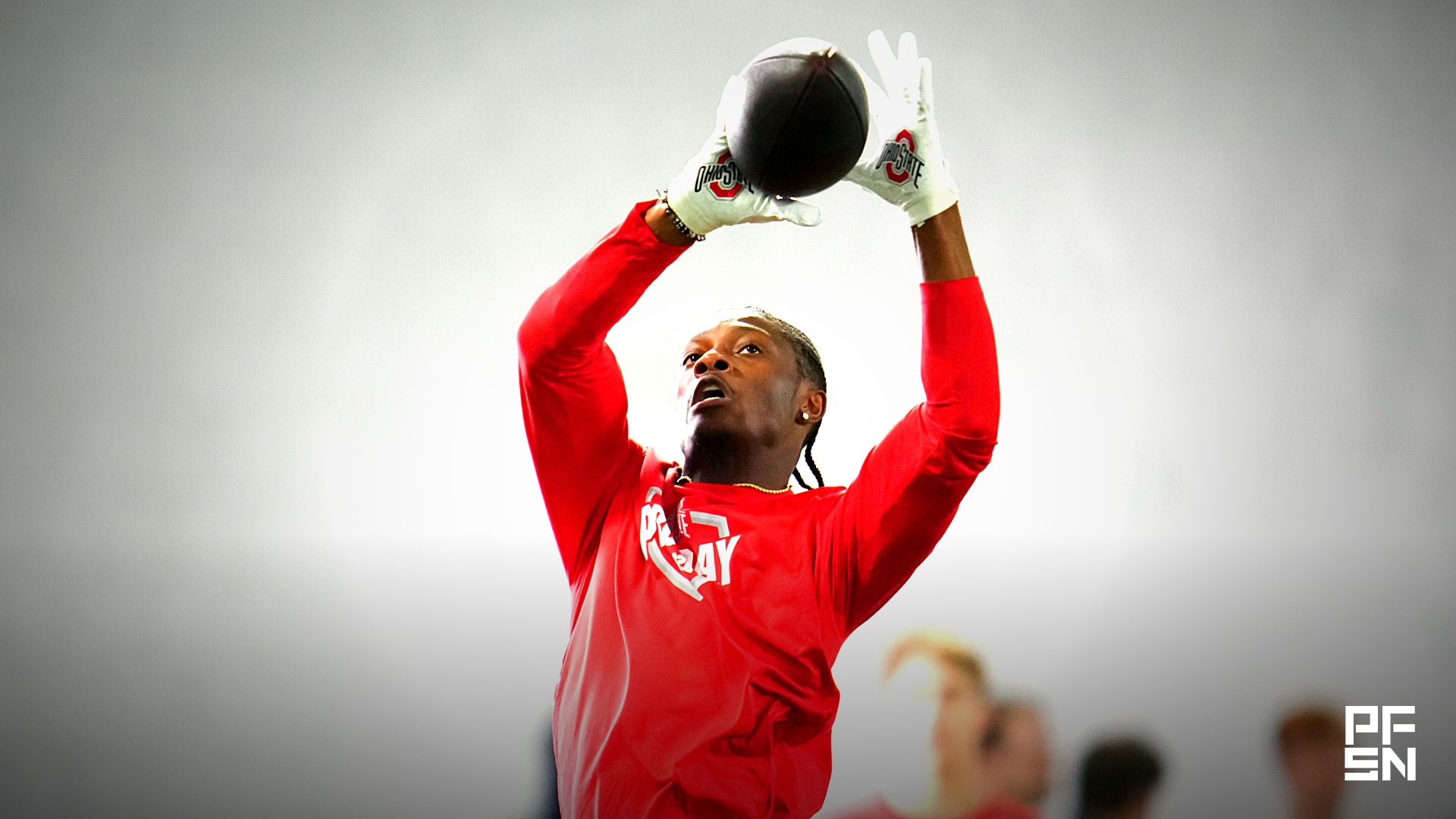
In the 2025 college football season, Carnell Tate ran 66 routes where a quarterback threw in his direction. He caught the ball 51 times. He dropped it zero times.
That is not a typo. Not a rounding error. The Ohio State wide receiver who is projected to go in the top ten of this draft played 11 games (he missed three with a calf strain), caught balls over the middle, tracked deep shots down the sideline, adjusted to difficult angles, and never once let a catchable ball hit the ground.

Carnell Tate’s Impressive Season Ahead of the 2026 NFL Draft
The debate around Carnell Tate has circled almost entirely around his 40-yard dash. He ran a 4.53 at the combine, the kind of number that travels fast in draft circles and tends to define a receiver for months regardless of what else the tape shows.
On the combine floor, ESPN’s Adam Schefter reported that several NFL executives and GMs hand-timed Tate between 4.45 and 4.47 seconds on their own stopwatches, a faster read than the official 4.53. At his pro day a month later, Tate declined to re-run the 40 at all, calling it a bit “overvalued.”
The speed conversation is real, but it’s also a distraction. The thing that tells you who Carnell Tate is as a receiver is not his 40 time. It’s the number at the top of this article.
To contextualize the 0.0 percent drop rate: over his college career at Ohio State, Tate accumulated 161 total targets and 121 catches. His career drop total through that span is 5. That works out to a career drop rate of roughly 4 percent using the standard formula (drops divided by drops plus catches), already elite by any analytical standard.
His 2025 season was even cleaner than his career average, which suggests not a fluke year but a receiver who has refined his technique to the point where dropping footballs has become essentially foreign to him. He finished the year with an 84.5 CFB WR Impact Score (B).
The NFL has studied this skill set closely enough to have data on it. The correlation between college drop rate and NFL drop rate is not subtle. Analytics research tracking draft-eligible receivers has found a strong inverse relationship between college drop rate and NFL production. Receivers who maintained the cleanest drop rates in college consistently appear at the top of career receiving rankings.
More to the point: catching the football reliably at the college level is one of the most translatable skills a receiver can carry into the professional game. Route running can be refined, the separation technique can be coached, but the ability to secure the ball when it arrives is something the best receivers simply have.
BE AN NFL GM: PFSN’s Ultimate GM Simulator
PFSN’s NFL Draft Analyst Ian Cummings had this to say about Tate ahead of the draft. “Carnell Tate is PFSN’s WR1 in the 2026 NFL Draft, and a true X-factor in waiting. He first showed promise with a 52-733-4 receiving line in 2024, producing in spite of his place as the Buckeyes’ third option alongside Jeremiah Smith and first-round NFL Draft pick Emeka Egbuka. But in 2024, Tate’s technical feel was still underdeveloped.”
The Pickens Comparison and What Scouts Are Actually Saying
CBS Sports described Tate as having a “George Pickens-type skill set, but with better hands.” That comparison lands hard in 2026, given what Pickens just commanded in trade value. If you are building the case for Carnell Tate as a franchise receiver, the argument is that you get the contested catch ability, the size, and the vertical routes, minus the drops that plagued Pickens at certain points in his Pittsburgh tenure.
Tate visited the Cleveland Browns first among his pre-draft team visits, which is the kind of scheduling detail that tends to be meaningful. The Browns project to pick sixth overall, which puts them squarely in the range where Tate will be available.
Multiple projections have him going to Cleveland at six, and Tate acknowledged his comfort with the geography on “The Rich Eisen Show,” as Ohio State is roughly an hour and a half to two hours from the Browns’ facility.
The question of whether he lands in Cleveland or elsewhere will be answered tonight. What will not be answered is whether the 0.0 percent drop rate is real or sustainable. That data point already has its source. It is not a projection as it happened in his final college season against competition that will send dozens of players to NFL rosters.