
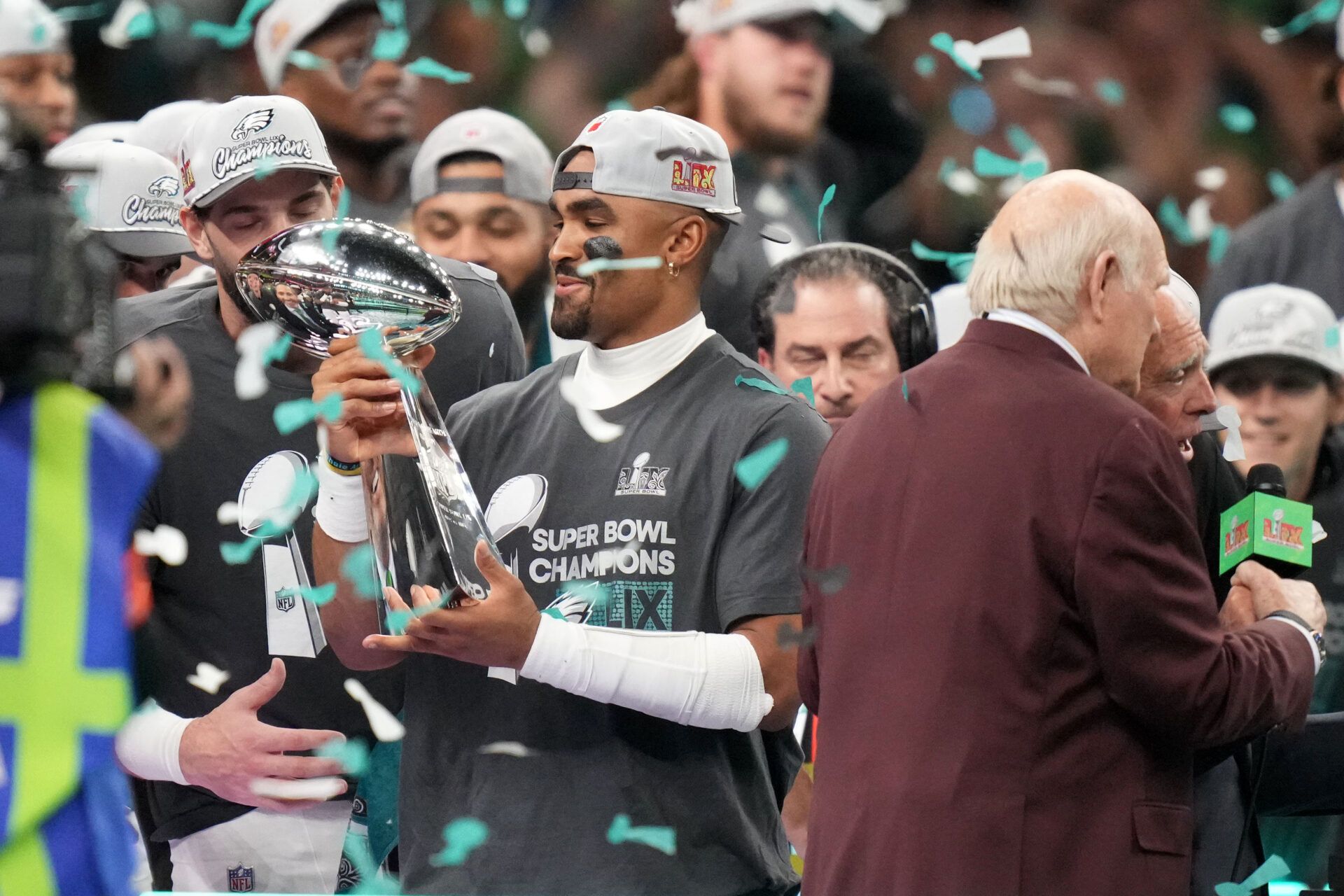
When you’re debating the top 10 quarterbacks in the NFL, the conversation usually comes down to numbers, wins, and stats. Who comes through in clutch moments? Who’s earned those MVP trophies and Super Bowl rings?
So when Cam Newton leaves Super Bowl MVP Jalen Hurts off his top-10 list, it raises eyebrows. But Newton’s got his reasons, and they might make more sense than you think.
Why Does Cam Newton Question Jalen Hurts’ Elite Status?
During his 4th and 1 show, Newton broke down his thinking. He’s not saying Hurts is bad, but he questions how much of Philadelphia’s success comes from the quarterback versus the talent around him.
“It’s hard for me to grade Jalen Hurts with the metrics that he, with the talent he has around him,” Newton said. “Jalen Hurts is a great quarterback. Do not get that twisted. But if we’re talking about what they bring to the table, right, holistically, it’s hard to judge what Jalen Hurts can do when you when you’re throwing to a guy like AJ Brown, Devonte Smith, when … you have a dominant defense. The best running back in the game.”
Newton then pointed to Lamar Jackson as a contrast. When comparing what Jackson works with versus Hurts’ supporting cast, Newton sees a clear difference in how much each quarterback elevates his team.
“Like you got King Henry, right? Then you got Zay Flowers. Mark Andrews. Isiah Likely … Lamar Jackson still shows you why he’s an elite player. You feel what I’m saying?” Newton said, suggesting Jackson carries the Ravens while Hurts benefits from his supporting cast.
What Makes Newton’s Argument Worth Considering?
The numbers back up Newton’s point about supporting casts. Hurts throws to an elite receiving duo in Devonta Smith (68 catches) and A.J. Brown (67 catches), plus he hands the ball off to Saquon Barkley, who ran for 2,005 yards behind the 11th-best offensive line in the NFL.
Meanwhile, Jackson almost won another MVP Award surrounded by Derrick Henry, Zay Flowers, Rashod Bateman, Mark Andrews, Isiah Likely, and the second-best o-line in football. However, Flowers was hurt in the playoffs, and Baltimore floundered in a heartbreaking division round loss in Buffalo.
Newton speaks from experience about carrying a team. When he led the Carolina Panthers to the Super Bowl after the 2015 season, his receiving corps looked nothing like what today’s elite quarterbacks enjoy. His leading receiver was tight end Greg Olsen, who caught 77 passes for 1,104 yards and seven touchdowns.
Newton’s next best target was Ted Ginn Jr., who had 44 catches, 739 yards, and 10 touchdowns. His third option was Jerricho Cotchery with 39 receptions, 485 yards, and three touchdowns. With that supporting cast, Newton still won the MVP that year.
This isn’t the first time Newton has gone against popular opinion. He recently pushed back against Ryan Clark, who criticized him for suggesting that Jayden Daniels could be a one-hit wonder.
Newton isn’t afraid to go against the grain, and his perspective on what makes a quarterback truly elite comes from someone who carried a franchise on his back.
