
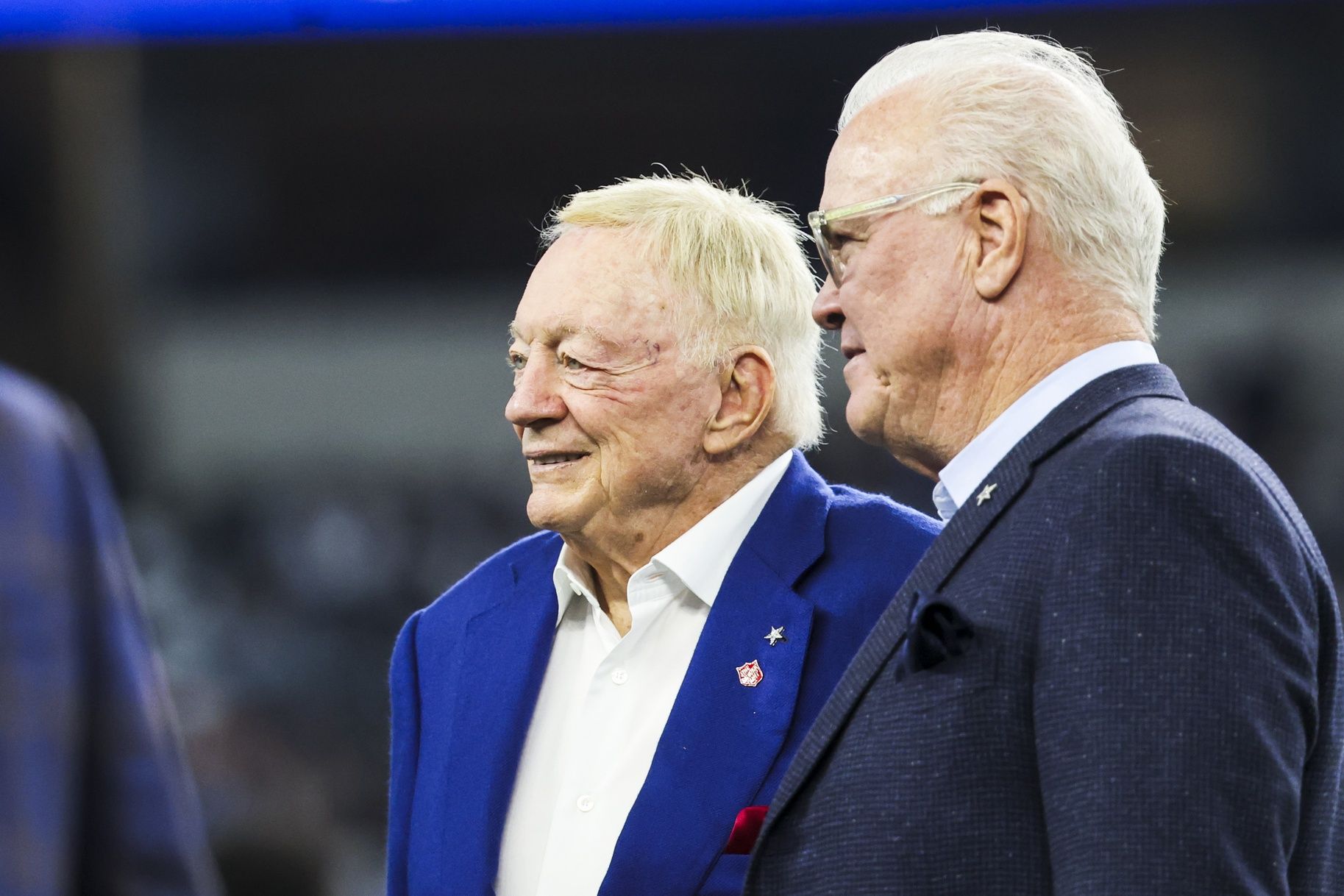
The Dallas Cowboys have taken a measured approach to the early stages of NFL free agency, focusing on depth and defensive reinforcements rather than marquee signings. While the front office added multiple players and even traded for pass rusher Rashan Gary, questions remain about whether their long-standing strategy is holding them back, a point strongly emphasized by analyst Bob Sturm.
Bob Sturm Explains Cowboys’ Conservative Free Agency Philosophy
During a recent discussion in a podcast with D Magazine, Sturm outlined why Dallas often avoids aggressive bidding wars in free agency, suggesting it stems from a philosophical aversion to overpaying.
“What happens is they are comically low ballers because that’s what they do,” Sturm said. “I’m a land man or whatever you are, whatever I like to get bargains, just the principle, just the joy of the fight. I like to think I want a negotiation. You’re not going to win in free agency. You’re going to overpay. So the question is, do you want to participate or do you want to feel good about you never lose leverage?”
Sturm’s point centers on the idea that Dallas prioritizes “winning” negotiations rather than securing top talent, even if that means missing out on elite players who command higher prices in an open market.
Why Cowboys Often Miss Out on Top Free Agents
Expanding on that idea, Sturm explained how the Cowboys’ reluctance to match market value often takes them out of serious contention for high-end targets.
“That’s the simplest reason they don’t participate in free agency is they don’t want to feel like the agent who claims the Bengals just offered this and the Jaguars just offered this. Do you want the guy or don’t you? And they’re like, ‘We were planning on paying Nakobe Dean like 9 million. That’s not in this conversation. The conversation is 12 million. So I’m going to need you to either get to 12 or even go to 13 if you really want him,'” Sturm said.
Sturm highlighted how negotiations quickly escalate beyond initial expectations, forcing teams to decide whether they are truly committed. According to him, Dallas often hesitates at that crucial moment, preferring discipline over aggressive spending.
Long-Term Pattern Continues to Shape Dallas’ Roster Building
Sturm also connected the Cowboys’ current behavior to a broader, long-term trend, arguing that their struggles in free agency are rooted in years of the same cautious approach.
“I read it as the very same reason they sat out free agency for 13 years is the same reason they’re very bad at free agency. And just to elaborate a little bit, they don’t like losing leverage at the table,” Sturm said.
The Cowboys were never ever going to be successful at free agency and there are a few reasons why. @SportsSturm of 1310 The Ticket breaks down why there was little hope that the Jones boys were going to learn how to make deals in the moment or without leverage to fix their… pic.twitter.com/vh7aKqYl7s
— D Magazine (@DMagazine) March 16, 2026
Sturm pointed to contract negotiations with key players as evidence of a recurring pattern, one where drawn-out talks and rigid offers can create tension and inefficiency.
“And the problem is, if you haven’t participated in free agency ever, we know what their first bid looks like when they have all the leverage, because we see it all the time. We see how Brandon Aubrey sees his first bid. We see what Micah Parsons thought about his first bid. We see Dak Prescott. I mean, the list is so long. And in every one of those negotiations, which are painfully slow and frustrating and often end in divorce,” Sturm added.
Cowboys Add Defensive Pieces, But Questions Remain
Despite the criticism, Dallas has been active, especially in their defense overhaul. The team brought in eight new players early in free agency, with six additions focused on defense after a historically poor 2025 campaign. Moves such as acquiring Rashan Gary and signing multiple secondary pieces aim to stabilize a unit that struggled massively in the 2025 season.
BE AN NFL GM: PFSN’s Ultimate GM Simulator
Owner Jerry Jones had previously hinted at a more aggressive offseason, and while the Cowboys have increased activity compared to past years, they have still avoided the biggest names on the market.
The Cowboys still have opportunities to strengthen their roster, with additional free agents available and crucial draft capital, including two first-round picks in 2026. Their current approach suggests a preference for calculated upgrades rather than headline-grabbing moves.
