
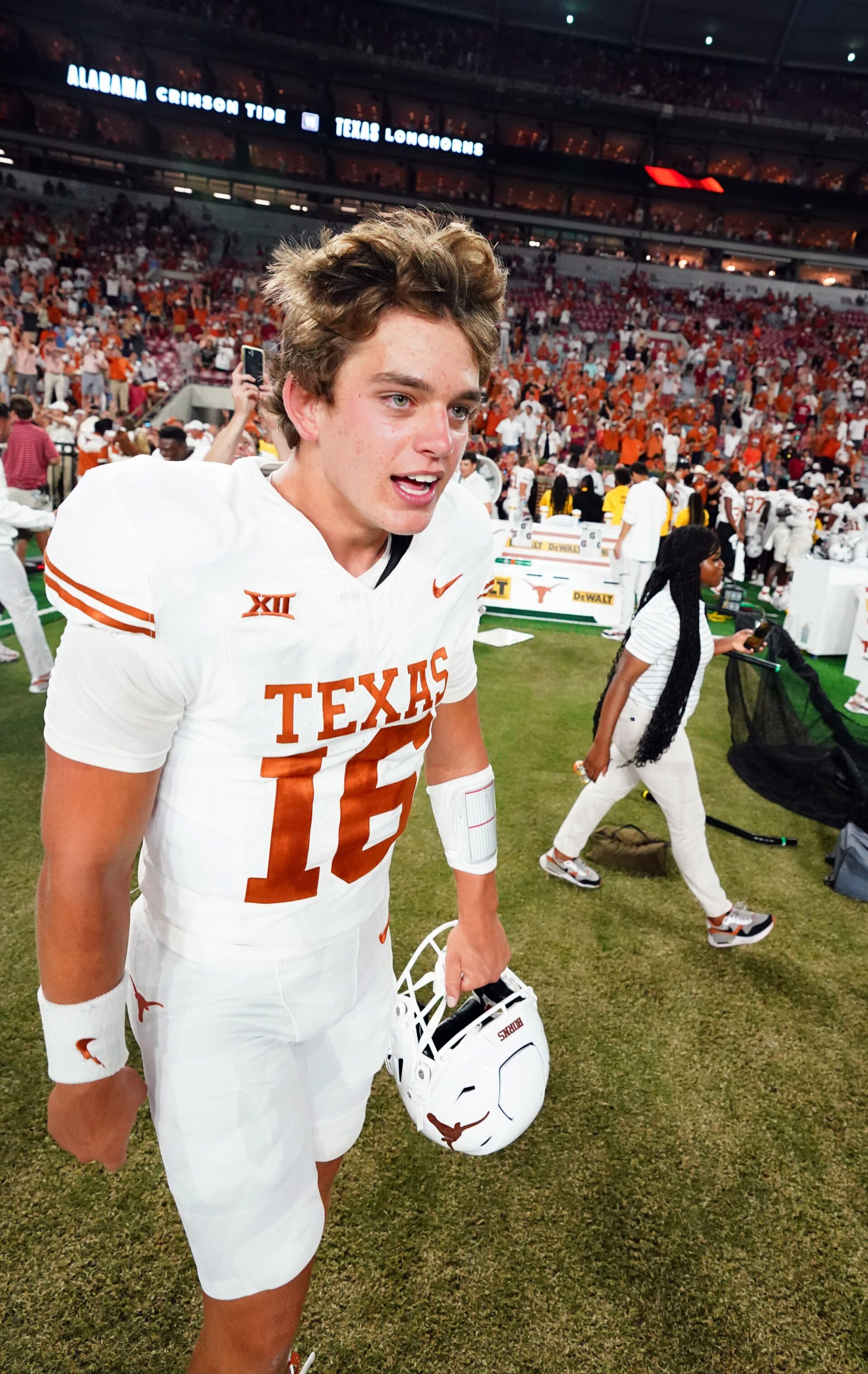
Arch Manning’s name already carries weight in NFL circles, but his on-field trajectory is beginning to match the expectations. As the 2026 NFL Draft conversation centers on quarterbacks, one hypothetical has sparked debate: Where would Manning be selected if he had declared?
This year’s QB class is widely viewed as one of the weakest in recent memory, often compared to the 2022 group that saw Kenny Pickett go to the Pittsburgh Steelers as the first quarterback off the board. In that context, Fernando Mendoza has emerged as the consensus top quarterback and is expected to go No. 1 overall to the Las Vegas Raiders. But evaluators believe the conversation would look very different with Manning in the mix.
Why Arch Manning’s Traits and Pedigree Fuel His QB1 Argument
Manning’s case starts with tools and lineage. As the nephew of Peyton and Eli Manning and grandson of Archie Manning, he entered college with rare expectations. But beyond the last name, his physical traits and late-season progression in 2025 have fueled strong projections.
In his first full year as a starter at Texas, Manning completed 61.4% of his passes for 3,163 yards, with 26 touchdowns, and 7 interceptions. He posted a 147.0 passer rating and showed steady growth in command and decision-making. That development arc is central to why some analysts believe he would have jumped to the top of this year’s board.
“He’d have been QB1, and he would have been player No. 1 on my board,” said 32BeatWriter’s lead NFL draft analyst TJ Wengert on the latest episode of PFSN’s “Football Debate Club.”
“The athleticism, the arm talent, I think he’s headed in the right direction. The last half of the ’26 tape would have made him the number one guy on my board in this year’s class.”
PFSN’s NFL Draft analyst Ian Cummings didn’t agree with this take, but he did note that Manning would’ve been his No. 2 QB in the 2026 class.
“I would’ve had him as QB2 between Fernando Mendoza and Ty Simpson. Not quite QB1,” Cummings said. “He took great strides down the stretch last year but still has work to do. Fringe first rounder.”
Mendoza ranked No. 2 in PFSN’s CFB QB Impact Metrics with an A grade, trailing only Vanderbilt’s Diego Pavia, who is being projected as a late-round pick in this year’s draft.
Manning, meanwhile, ranked No. 37 among quarterbacks in QBi, earning a B grade (83.1). On paper, that gap is significant. But draft conversations are often driven by traits and trajectory, not just current production, and that is where Manning separates himself in the eyes of some evaluators.
While Mendoza’s efficiency and production have made him the safest option in this class, the case for Manning is that he has all of the physical tools and potential to become a franchise-changing superstar.
Why Manning Returned to Texas Instead of Declaring for the NFL Draft
Despite being eligible for the 2026 NFL Draft, Manning chose not to enter. Instead, he returned to Texas for the 2026 season, prioritizing development, experience, and a chance to compete for a national championship under Steve Sarkisian.
Up until 2025, Manning had played in just 12 games across two seasons. That limited experience remains the biggest question mark in his profile. Another full season gives him a chance to improve consistency, expand his sample size, and prove that his late-season surge is sustainable.
The bigger picture also played a role. The 2027 NFL Draft is shaping up to be significantly stronger, with the potential to rival the 2024 class that featured Caleb Williams, Jayden Daniels, and Drake Maye.
There is even a scenario in which six quarterbacks could go in the first round, something that has not happened in four decades. The last time a class reached that level included Hall of Famers John Elway, Jim Kelly, and Dan Marino, along with Todd Blackledge, Tony Eason, and Ken O’Brien.
BE AN NFL GM: PFSN’s Ultimate GM Simulator
By returning to school, Manning will gain more starting experience under coach Steve Sarkisian, positioning himself to enter that potentially loaded class as a more complete prospect. Instead of being judged against a weaker 2026 group, he could headline a much deeper and more competitive field.
The hypothetical remains compelling. Mendoza will almost certainly go No. 1 overall this year, but the presence of Manning likely would have changed the entire conversation at the top. Instead, that debate has been pushed to next year, setting up what could be one of the most fascinating No. 1 pick races the NFL has seen in years.
