
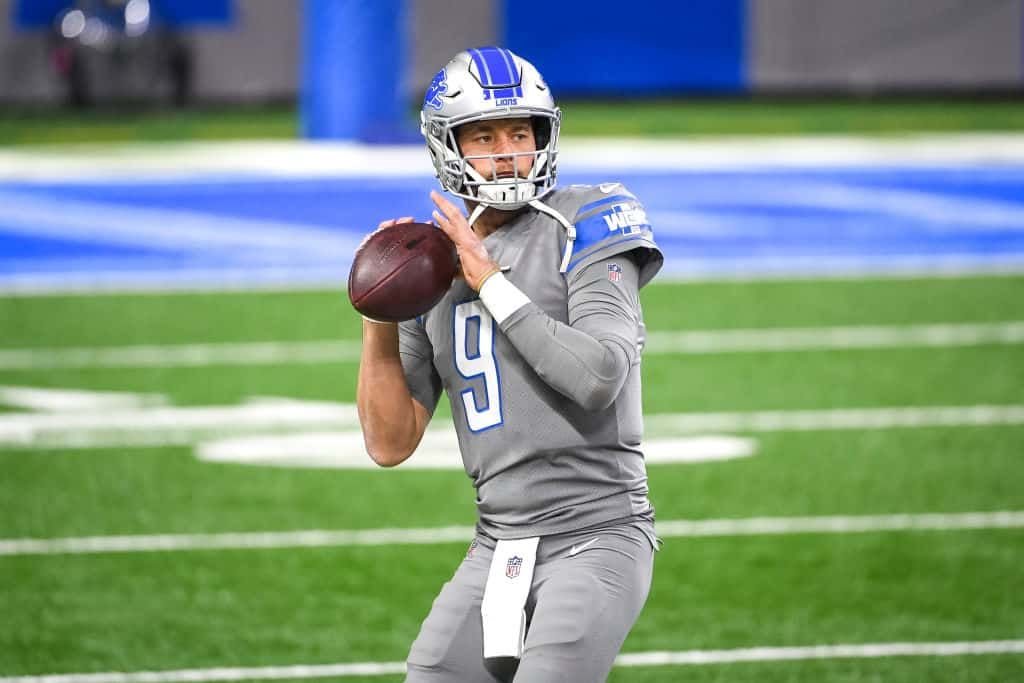
With the NFL season almost over, rumors fly regarding Matthew Stafford’s future with the Detroit Lions. Many are speculating that he will be suiting up for a different team next season. As such, it’s worth examining how well he is actually playing at the moment. Unfortunately for those with high expectations for the veteran QB, he hasn’t provided as much value to the Lions offense as you might think.
Matthew Stafford’s traditional statistics this season have been mediocre
Let’s start our analysis of Stafford’s 2020 performance by looking at his box score statistics from this season. Thus far, he has thrown for 3,791 yards, 23 touchdowns, and nine interceptions. Looking at those numbers, I think most people would agree that none of them are particularly awe-inspiring. They aren’t terrible, by any means. That said, they are still far from the gaudy statistics produced by the likes of Patrick Mahomes or Aaron Rodgers.
Of course, placing all of the responsibility for Stafford’s relative lack of statistical success solely on his shoulders isn’t entirely fair. After all, a quarterback’s numbers can be heavily affected by their circumstances. Consider Ryan Tannehill, for example.
Since joining the Tennessee Titans, he has been playing at an elite level. However, his statistics haven’t always reflected that. The Titans offense is built around Derrick Henry and the running game, which limits Tannehill’s opportunities.
Detroit’s offensive style might not affect Stafford to the same extent. Still, it could well be the case that the lack of talent on the Lions roster is holding their QB back.
Using the OVM to measure Stafford’s performance
To evaluate Matthew Stafford properly, we will turn to the Offensive Value Metric (OVM). The metric was created by the (Bx) Movement to measure the amount of value a player is providing to their offense. It doesn’t do so by looking at the player’s box score statistics. Rather, it does so by examining how effective they were within the confines of their specific situations.
Often, a player’s OVM grade will paint a completely different picture from their more conventional statistics. In Stafford’s case, however, his 2020 grade agrees with what the box score tells us.
At 25.4, his OVM grade currently sits in a tie for 16th in the NFL. That’s not terrible, but it isn’t elite either. Perhaps equally importantly, it is Stafford’s second-worst grade in the five years of OVM data we have recorded. He simply has not been providing a great deal of value to Detroit in 2020. Worse still, he isn’t even playing up to his usual standard.
Stafford has attempted many difficult passes in 2020
If we want to explain why Matthew Stafford’s OVM grade is relatively low, we need to examine the advanced metrics that go into creating it. As a first step, let’s look at the factors that have worked in his favor this season. These statistics all relate to the difficulty of his pass attempts.
Through the first 16 weeks of the season, Stafford has thrown into tight coverage 17.1% of the time, the 16th-highest percentage among all qualifying quarterbacks this season. Meanwhile, his average pass traveled 8.6 yards downfield through the air, the 13th-highest average distance. His average air yards look even better if you look exclusively at his completions. On those passes, the ball traveled an average of 6.6 yards, tied for 11th.
When you combine those statistics, it creates the image of a player who, either due to his receivers failing to get open, play calling decisions by his coaches, or simply his own aggressive play style, has tried to push the ball downfield and into tight windows more often than the average NFL quarterback.
Stafford’s completion percentage statistics hold his grade back
Unfortunately, Stafford hasn’t been able to overcome the challenges of his circumstances. That is evidenced by his completion percentage and the advanced metrics relating to it. So far in 2020, he has completed 64.2% of his passes. That ranks as the 10th-lowest among all qualifying quarterbacks.
That statistic looks terrible on the surface, but it isn’t necessarily a damning indictment of Stafford’s season. After all, I just spent an entire section of this article explaining that Stafford has attempted difficult passes this season. As such, his low completion percentage arguably shouldn’t be a surprise. However, while that is true to an extent, Stafford isn’t entirely blameless here.
The NFL uses numerous factors to estimate the percentage of passes that a quarterback should have completed throughout the season. In Stafford’s case, his expected completion percentage was calculated to be 65.6%. After some basic math, we can see that it is 1.4% lower than it should have been, a differential tied for eleventh-largest. Therefore, even given the struggles that Stafford needed to overcome, the Lions QB still underperformed.
Examining Stafford’s weekly grades
Before we come to a conclusion regarding Matthew Stafford’s 2020 performance, it’s worth taking a more in-depth look at how his OVM grades have changed throughout the season. Below, you can see a chart that shows his weekly grades, marked by the black dots. For comparison, the league average OVM grade for quarterbacks this season is marked by the yellow line.
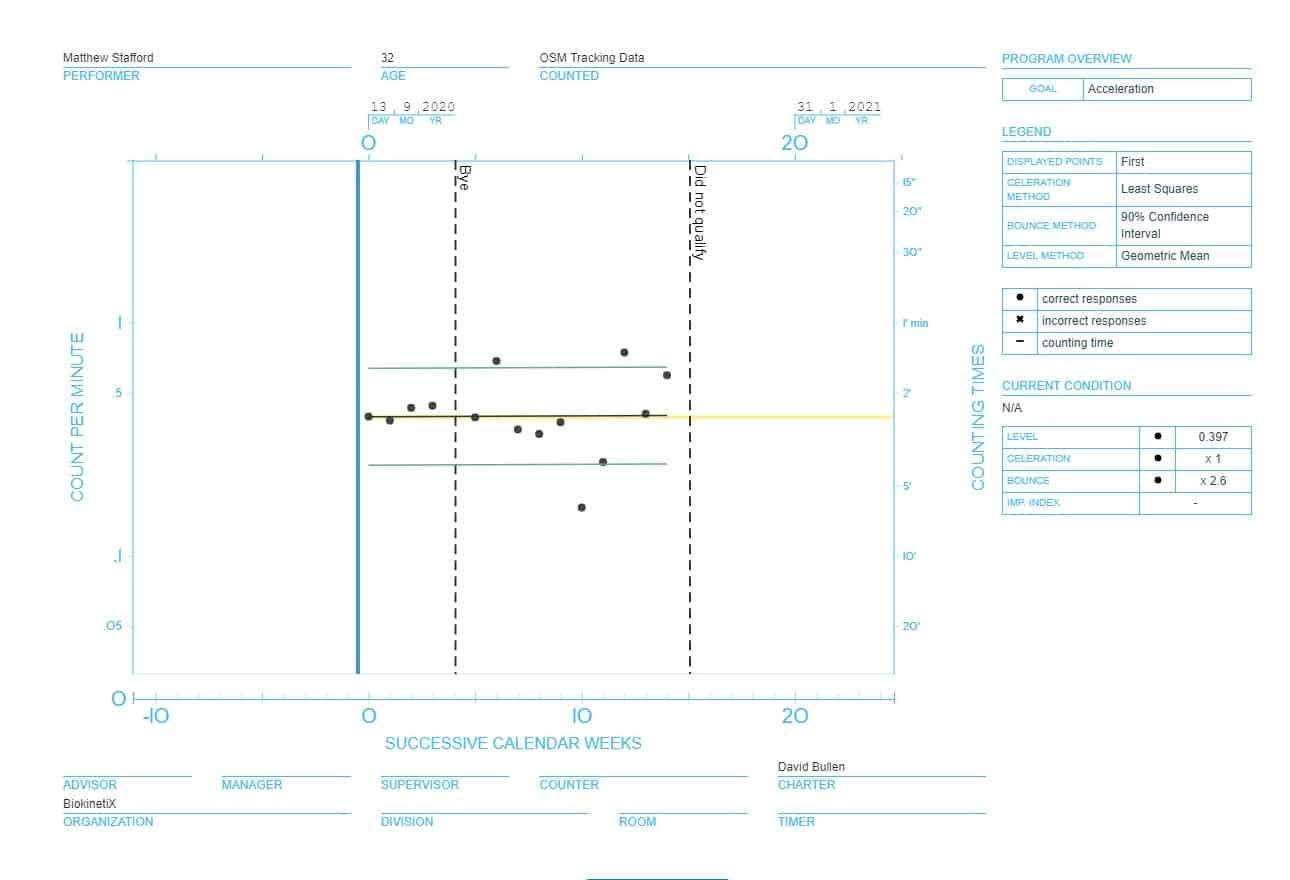
Stafford’s grades this season have been fascinating to watch. Early in the season, he was incredibly consistent, matching the league average almost exactly. However, as the year progressed, they began to vary wildly, ranging from legitimately impressive to completely ineffective.
His grades of 41.06 and 44.66 ranked second and first in their respective weeks. On the other hand, his Week 11 grade of 9.67 was among the worst of the week — the only quarterback ranked lower was Jake Luton of the Jacksonville Jaguars. If Stafford could play at his peak level on a more consistent basis, he would be an elite quarterback. However, his inconsistencies this season have held him back significantly.
Despite his occasional struggles in 2020, Stafford was excellent in 2019
It is worth mentioning that Matthew Stafford is not far removed from playing at an elite level. In 2019, his season was unfortunately cut short when it was only halfway over. Before that happened, however, he was having an incredible year as the Lions QB.
Through eight games, the Lions QB had thrown for 2,499 yards, 19 touchdowns, and five interceptions. That put him on pace to reach near career-highs in both passing yards and touchdowns while throwing a career-low number of interceptions. Additionally, his OVM grade of 32 was his highest in the last five years. More impressively, it ranked as the second-highest among all qualifying NFL quarterbacks in 2019.
Had he played the entire season, Stafford might have had the best season of his career on almost every metric. Unfortunately, 2020 represented a significant regression from the standards he set the year prior. However, it is not impossible for him to see a return to form next season.
After all, Stafford showed this season that he can still play at that level, even if he didn’t always do so. Perhaps a change of scenery would help him regain some of the consistent excellence he showed in 2019. And if that happens, whichever team he starts for next season will be happy to have him.
Matthew Stafford could be a valuable addition to many teams, but he won’t fix all of their problems
I don’t want to imply that Stafford has been terrible this season. All of his metrics show that he is playing at an above-average level. And several quarterback-needy teams could benefit from adding him to their roster. However, fans that are looking for a savior should temper their expectations.
Stafford has played QB on below-average Lions rosters for most of his career. Despite his individual successes, he has never truly been able to elevate his team in the same way that the league’s truly elite quarterbacks can. That doesn’t mean no team would improve by adding him. Stafford could be a perfect fit for a roster that is already close to competing for a Super Bowl and simply needs a solid quarterback to push them over the finish line.
The San Francisco 49ers and Indianapolis Colts (assuming Philip Rivers isn’t around next season), two popular potential destinations for Stafford, both fit this mold. He could be exactly what they are looking for. That said, barring the reemergence of the Stafford we saw early in the 2019 season, they will need to surround him with a great deal of talent if they want to succeed truly.
Lucas Ellinas is a writer for Pro Football Network. You can follow him on Twitter @Lucas_Ellinas.
