
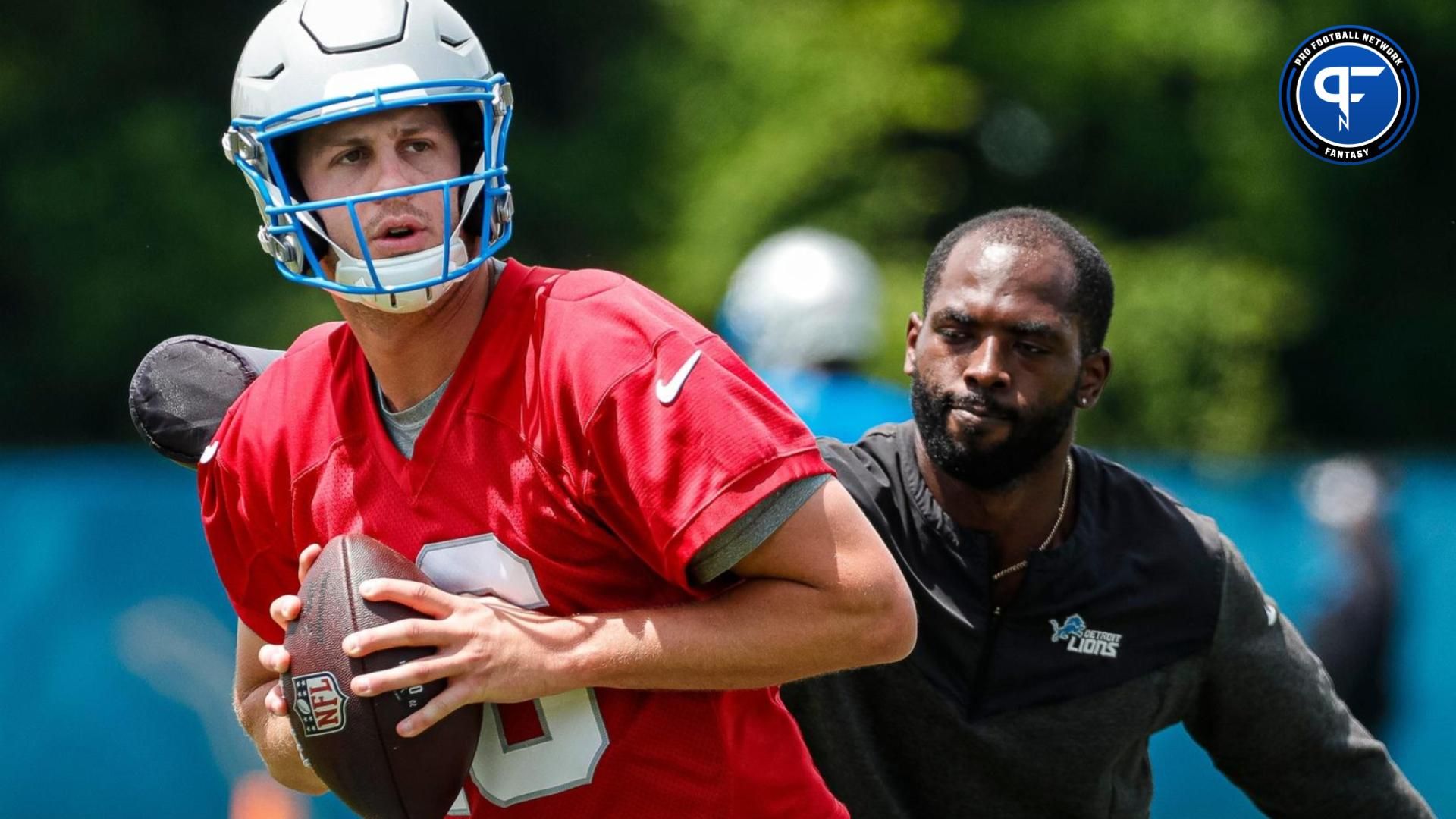
Since taking over as the starting quarterback of the Detroit Lions, Jared Goff has been better than anyone expected. While he’s been a value in fantasy football, he hasn’t exactly been a quarterback managers should aggressively pursue. Could that change this season?
Jared Goff’s 2024 Fantasy Forecast
In his first year with the Lions, Goff had the worst fantasy season of his career, averaging a paltry 14.5 fantasy points per game. Since then, all he’s done is prove he’s the Lions’ long-term answer at the position.
Two years ago, Goff threw for 4,438 yards and 29 touchdowns. Last year, he threw for 4,571 yards and 30 touchdowns.
Goff has had a high completion percentage, a very good yards per attempt, and a great deep ball despite lacking quality downfield weapons. Everything about his performance suggests a very good, but not quite great QB. Yet, it hasn’t translated into a fantasy starter.
In 2022, Goff averaged 17.1 points per game and 17.8 in 2023. Those were good for QB14 and QB11 finishes, respectively. That’s fine. There will be multiple teams in every fantasy league that can use that sort of production. Unfortunately, it just doesn’t move the needle.
In modern fantasy football, it’s very difficult to be an elite fantasy quarterback, or even a mid-QB1, without rushing. A quarterback doesn’t have to be Lamar Jackson or Jalen Hurts, but he needs to add a couple of points per game on the ground. Goff quite literally provides nothing in that department.
When the entirety of a quarterback’s production comes from passing yards and touchdowns, it takes a legendary season to even sniff 20 fantasy points per game. The example I always go to is Matthew Stafford’s 2021 season.
In 2021, Stafford threw for 4,886 yards and a whopping 41 touchdowns. Yet, he barely got to 20.4 fantasy points per game and finished as the QB11.
Could Goff throw for 40 touchdowns? Sure. The Lions have enough receiving talent in Amon-Ra St. Brown, Sam LaPorta, and Jahmyr Gibbs for it to be possible. But given Detroit’s propensity to run the ball at the goal line, it’s not likely. Plus, even if Goff gets there, he’s still only producing back-end QB1 numbers.
Goff currently has a QB14 ADP (No. 114 overall), which is lower than where he’s finished in either of the past two seasons. He’s a pretty strong bet to outperform his ADP, but it just isn’t going to matter.
Drafting Goff as the QB14 and getting the QB10 isn’t helping you win a championship. You can stream the QB10.
The best way to handle Goff for fantasy this season is to treat him as a safety net for a more volatile QB1 option. If you take a swing on a volatile rookie like Jayden Daniels or Caleb Williams, or an injury risk like Anthony Richardson, pair him with a guy like Goff.
You obviously want your upside guy to hit, but in the event he doesn’t, Goff can keep your fantasy team afloat, as well as throw in the occasional three-touchdown game.
I have Goff ranked as my QB16. Barring disaster, he won’t be my QB1 in any leagues. But I can absolutely envision drafting him as a backup in situations where I can’t fully trust my QB1.
Kyle Soppe’s Analysis of Jared Goff
For me, drafting Goff isn’t a player evaluation decision, it’s a roster construction one.
I’m not drafting a backup signal-caller if I spent up at the position, so the only situation in which I’m going in this direction is if I punted QB early and am looking to roster two to patch together QB1 production.
As discussed above, I think there’s a way to get even more creative than Goff as a solution to this problem, though I will admit he’s not a bad option if you pair him with a path to upside late.
Goff is safe. He’s your local college that accepts 97% of people who apply from your high school. You owe it to yourself to apply to your dream school. Worst case, you get rejected and you have a backup plan. Best case, you catch lightning in a bottle and are positioned for the best four years of your life.
Having Goff as your primary option is by no means a failure in the draft. He’s a suitable option that will steady the ship most weeks and give the rest of your roster a chance to win you the week. But he’s not “special” and has little room for growth. If I’m signing up for Goff in the middle third of my draft, I’m layering in some upside late.
Maybe that is Will Levis in a Tennessee Titans offense looking to open things up a bit. Maybe it’s J.J. McCarthy, with the hope that he’s “the guy” sooner rather than later and that the greatness of Justin Jefferson can result in production above expectations.
Could Bryce Young take a step forward in an offense that is in a better spot than it was during his underwhelming rookie season?
At the end of the day, Goff is part of a monster tier, and I’m not landing on him often. I don’t mind taking him ahead of pedigree QBs like Trevor Lawrence and Justin Herbert — two options who lost talent at the receiver position this offseason — but I’m not rolling the dice on Goff over either of the rookie quarterbacks who are walking into fantasy-friendly spots (Caleb Williams and Jayden Daniels).
There is some room for growth in Goff’s profile (Detroit ranked 25th in pass rate over expectation a season ago), but not enough for me to overlook the profiles of the first-year options that have a far higher ceiling.
