
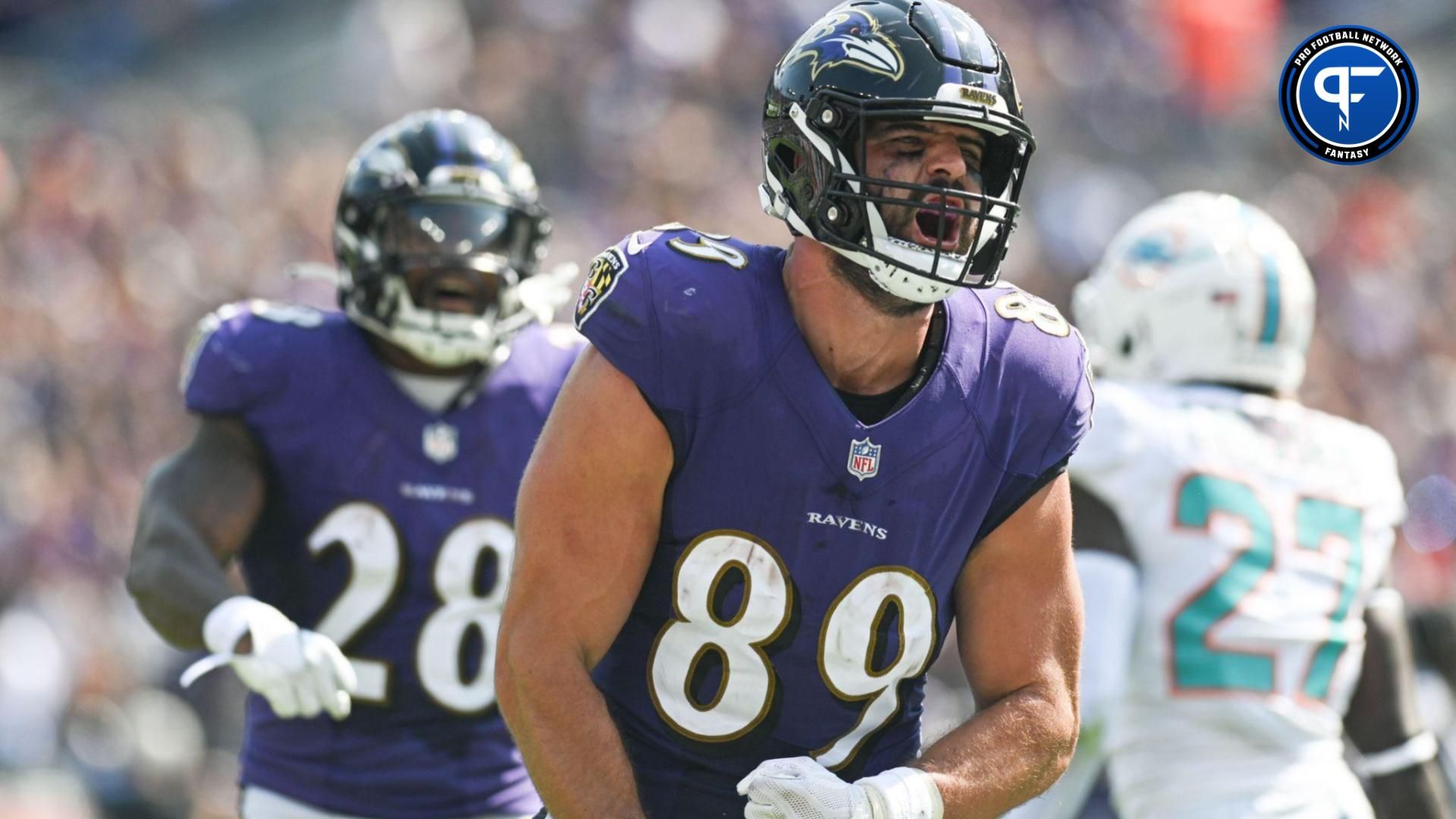
Baltimore Ravens TE Mark Andrews turns 29 years of age in September and has played just one full season since doing so as a rookie. That said, he scored one more touchdown in 10 games under Todd Monken last season than he did in 15 games the season prior and continues to be Lamar Jackson’s first option.
The tight end position is deeper than it has been in years past for fantasy football purposes, thus raising the bar for a minimum stat line to be considered elite. Can Andrews keep up with the youth movement? Or is now the time to pass on him, with the thought being that Andrews’ name is driving his ADP more than projectable projection?
Mark Andrews’ 2024 Fantasy Forecast
In Year 1 under Monken, the Ravens set team highs for shotgun rate (58%) and pass rate over expectation (-0.5%). Even while battling injuries, Andrews saw good returns on these tendencies by averaging 4.5 catches per game (career average: 4.4) and scoring on 9.8% of his targets (career average: 7.1%).
There is still room to grow, but I saw everything I needed from the veteran prior to his injury to think he could still compete with the best at the position.
Andrews hauled in a 20+ yard pass in six of 10 games (2022: 43.8%), and despite missing seven full games, he led Baltimore in touchdown receptions (the tight end position as a whole turned 101 targets into 11 scores).
The scoring bump was what made fantasy football happy, but it’s what some are questioning in 2024 due to Derrick Henry’s arrival. I understand the general train of thought, as Henry has been the top-scoring threat of the generation and profiles as borderline unstoppable in this wide-open system.
But I’m not worried about Andrews’ scoring rate as a result. Why?
The Ravens saw running backs score 20 times on the ground last season. That doesn’t include Jackson pushing five across himself (matching his total from the previous two seasons combined).
Henry might match or even exceed Gus Edwards’ 13 from a season ago, but I’m having a hard time penciling in anything more than 25 from backs (plus Jackson). That formula didn’t stop Andrews from doing his thing in 2023, so why would it this year?
He didn’t look like himself in the AFC Championship loss to the Kansas City Chiefs following a 9+ week absence due to an ankle injury suffered in November. Yet, the Ravens’ comfort in rolling him out there has me entering this season without any real health concerns.
Andrews had missed a total of two games over the two seasons prior and never more than two in a season for his career before 2023. It’s fine if you’re not interested, but don’t use the seven DNPs from a year ago as your excuse.
Andrews is being drafted in the late fourth/early fifth round this season in fantasy drafts, a spot that lands him as the TE4 off the board. He, Trey McBride, and Dalton Kincaid are generally going within the same 12-pick range as one another, sometimes with Kyle Pitts sneaking his way into that conversation.
I agree with that tier. Andrews doesn’t deserve to be ranked alongside a young featured option like Sam LaPorta. And while Travis Kelce’s load management worries me a bit, he’s a version of Andrews who plays in a pass-happy offense with the best thrower of the football on the planet.
After those two are off the board, Andrews has as solid a profile as any. That mini tier of tight ends is all similar in that they have an athletic QB getting them the ball, and they’re one of the top two target threats on their respective teams.
With a few underwhelming years on his résumé and a completely new system, Pitts is a different discussion. Yet, his upside is certainly on this level (Pitts’ overall range of outcomes is what can decide leagues in either direction).
This is the right spot in the draft for Andrews to go, but that doesn’t mean I’m going to end up with many shares. I prefer Evan Engram 1-2 rounds later or Jake Ferguson 3-4 rounds later.
The TE position has gotten a bad rap over the past few seasons due to its top-heavy nature. That’s been fair, but with the emergence of young talent last season, this is no longer a dead spot on your roster if you pass on the elite.
You’re going to need stable production. It’s just a matter of finding it at the right price for your specific build.
Derek Tate’s Fantasy Insights on Mark Andrews
Over the past four years, Andrews has been consistently mentioned in the same conversation with both Travis Kelce and George Kittle as the top three fantasy options at the TE position.
Andrews’ résumé speaks for itself, with fantasy finishes of TE1, TE4, TE5, and TE6 in four of the last five years. Unfortunately, his one season spent outside of the top six (TE15 overall) at the position was last season after he missed seven games due to injury.
Andrews’ productivity on a per-game basis didn’t show any drastic regression in offensive coordinator Todd Monken’s first year. He still averaged 4.5 receptions and 54 receiving yards per game — near his per-game production of 4.8 receptions and 56 receiving yards in 2022 — which suggests his elite usage in the passing game still makes him a viable TE1 overall candidate in this offense.
Sometimes, though, small details can tell a slightly different story. Andrews’ 22.2% target share was actually the lowest mark since his rookie year, and he ranked fourth at the position. By all means, that’s still a very healthy amount of volume in the passing game.
However, considering Andrews led all tight ends over the previous two seasons in target share… it does make this stat a bit more noteworthy. Some of this could certainly have to do with the retooled collection of offensive playmakers on the perimeter this Ravens offense had last year. Zay Flowers had a great rookie season with 77 receptions for 858 yards and five scores on 108 targets, which actually gave him a higher target share than Andrews. Odell Beckham Jr., Rashod Bateman, and Nelson Agholor also slightly ate into that volume of work last year.
However, with Beckham now on the Miami Dolphins, the only noteworthy addition to the WR room this offseason came in the form of Devontez Walker on Day 3 of the 2024 NFL Draft, which should pose no threat to Andrews’ role this upcoming season.
Yet, Andrews’ fantasy upside in this offense certainly still feels like the TE1 overall. Andrews finished the season tied for 31st with 14 red-zone targets despite missing seven games last season. His 1.4 red-zone targets per game, when forecasted over a 17-game regular season, come out to 23.8, which would’ve tied him for fifth in the league.
Why is that relevant? Well, the Ravens’ offense took 68 trips to the red zone last year (second most in the league, trailing only the Dallas Cowboys). Andrews missed seven games last season but still led Baltimore in red-zone targets. In 2024, his TD upside could rival that of any other tight end.
The only real concern for Andrews is a potentially expanded role for backup TE Isaiah Likely, who performed quite well when Andrews sustained the ankle injury that cost him the final six games of the regular season. Likely averaged 11.9 fantasy points per game from Weeks 11-18 — good enough for TE6 in PPR formats during that span.
It’s unlikely, no pun intended, that Likely will steal a significant amount of work away from Andrews, given how the latter dominated snaps and targets while both were healthy in 2023, but it’s worth monitoring.