
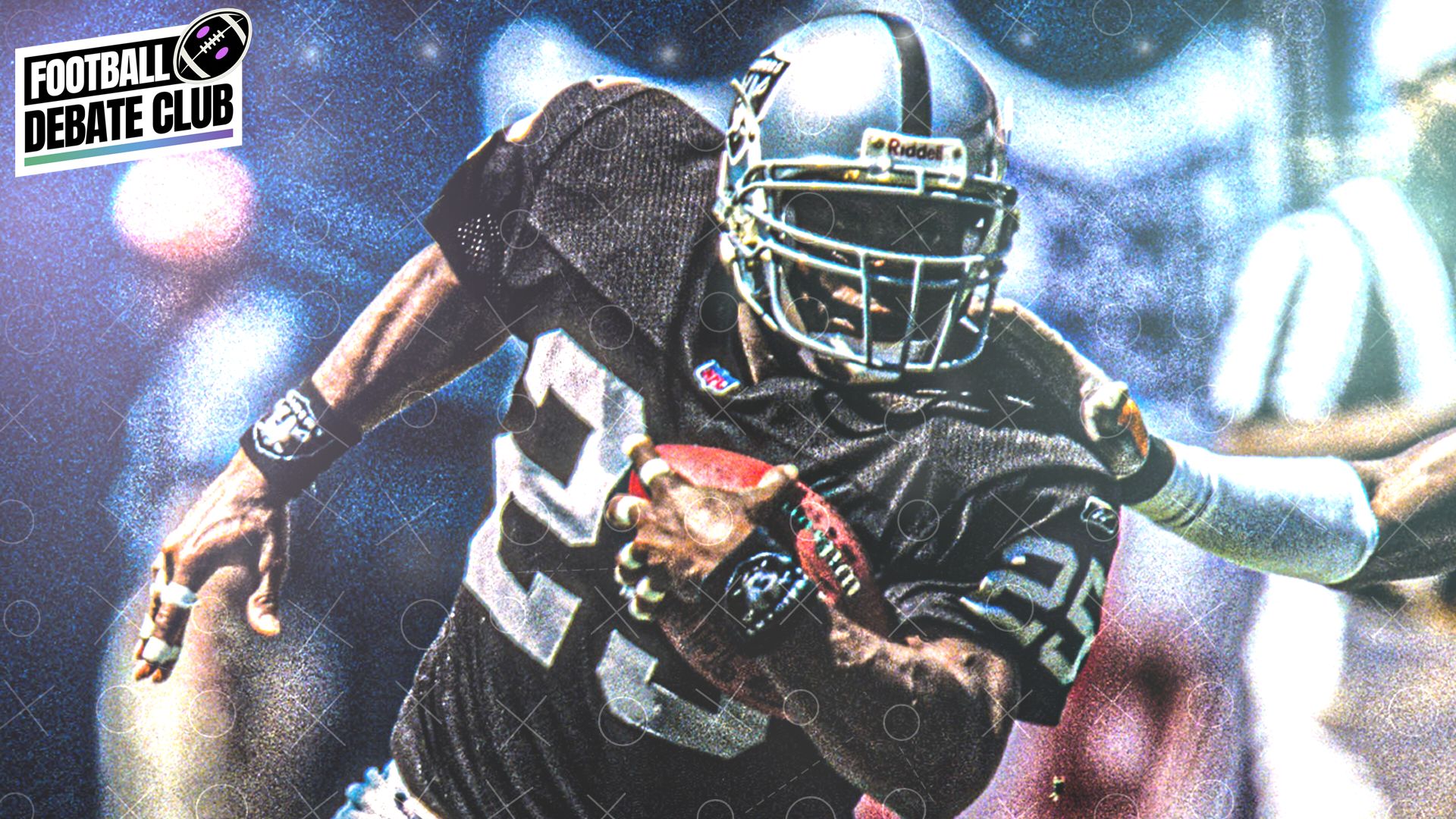
Charlie Garner finished 10th in the NFL in receptions in 2002. Not 10th among running backs. Tenth in the league, one spot behind a 40-year-old Jerry Rice on his own team. He did not make the Pro Bowl that year, and he never made another one. That combination is why Ian Cummings put him at the top of Football Debate Club‘s forgotten running back list.

Charlie Garner’s 2002 Raiders Season Still Holds Up
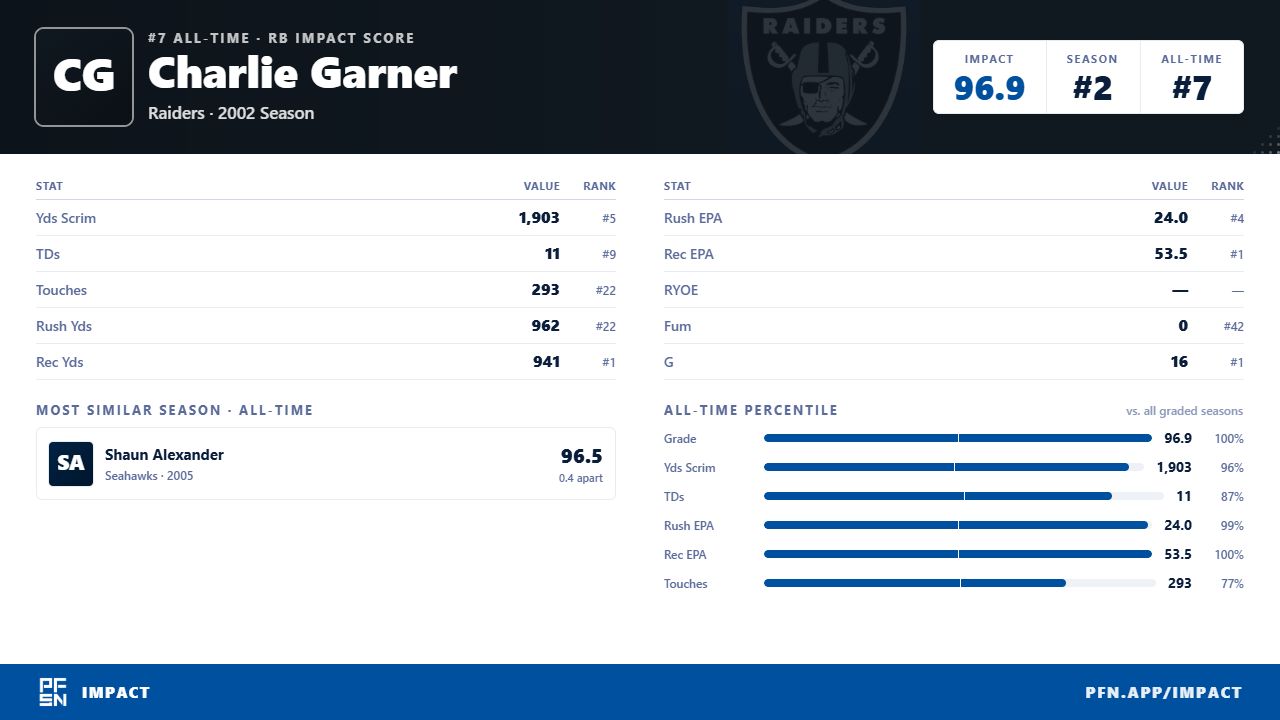
The raw line reads like a stat-sheet typo. Garner rushed 182 times for 962 yards and 7 touchdowns while catching 91 passes for 941 yards and 4 more scores, 1,903 yards from scrimmage for a team that reached Super Bowl XXXVII. He led the Raiders in rushing and finished second on the roster in catches behind Rice.
“That year, he logged a PFN RB Impact score of 96.9, that is seventh all-time,” Cummings said.
The efficiency is where it gets interesting. Garner caught 91 of 111 targets, an 82.0% catch rate, and Cummings pointed to a receiving value figure that has stood up for more than 20 years.
“His cumulative receiving EPA of 53.5 to this day is the highest mark ever achieved by a running back,” he said. “You think about the best receiving seasons among RBs in recent history, Christian McCaffrey, Jahmyr Gibbs, Austin Ekeler, Charlie Garner had better efficiency than all of them in 2002.”
Some of that is circumstance. Rich Gannon won MVP that season throwing 618 times for 4,689 yards in Bill Callahan’s short, timing-heavy West Coast offense, and Garner was the release valve on a roster stocked with Rice, Tim Brown and Jerry Porter. But the volume wasn’t manufactured. Marshall Faulk, the closest thing the era had to a receiving-back archetype, caught 80 balls that year and ranked 17th. LaDainian Tomlinson caught 79 and ranked 21st. Garner beat both while carrying a bigger rushing load than either one relative to touches.
Why the NFL’s Most Forgotten Running Back Deserves Better
The scouting description Cummings offered explains why the production traveled across three offenses and four teams.
“As a runner, he won with elite spatial instincts, peripheral vision, short area twist, hip flexibility, and acute angle freedom,” he said. “As a receiver, he was hyper versatile with [YAC] utility on screens, but also dynamism on wheel routes and seam routes.”
That is a 5-10, 190-pound back who could win on a wheel route and a stretch zone in the same series, in 2002, when most teams still used their third-down back as a checkdown target and nothing more. It wasn’t a one-year spike either. Garner caught 211 passes across three seasons in Oakland. He had two nicknames, IO for instant offense and Lightning, and neither one stuck to his legacy the way it should have.
The forgetting has a cause. Garner never won anything. The Raiders lost Super Bowl XXXVII 48-21, he landed on injured reserve with a knee injury four games into his one season in Tampa, and he last played at 32 with 7,097 rushing yards and no defining moment. Then there is the snub itself. Eight running backs made the Pro Bowl for the 2002 season, and Garner wasn’t one of them, though Faulk got in on 953 rushing yards and 80 catches. Garner had 962 and 91.
MORE FDC: Muhsin Muhammad Is the NFL’s Most Forgotten Wide Receiver
“This was the true two-phase transcendent threat a full two decades early,” Cummings said, “and he’s a forgotten RB who deserves to be remembered.”
The argument lands because the position finally caught up to him. Teams now draft receiving ability into the first round, pay for it on second contracts and build passing concepts around it. Garner did the job before there was a name for it, on a Super Bowl offense, and got a Pro Bowl for a lesser season two years earlier instead. Go look at the 2002 receiving leaderboard yourself. Nine wide receivers, then Charlie Garner, and no other running back until Faulk seven spots later.