
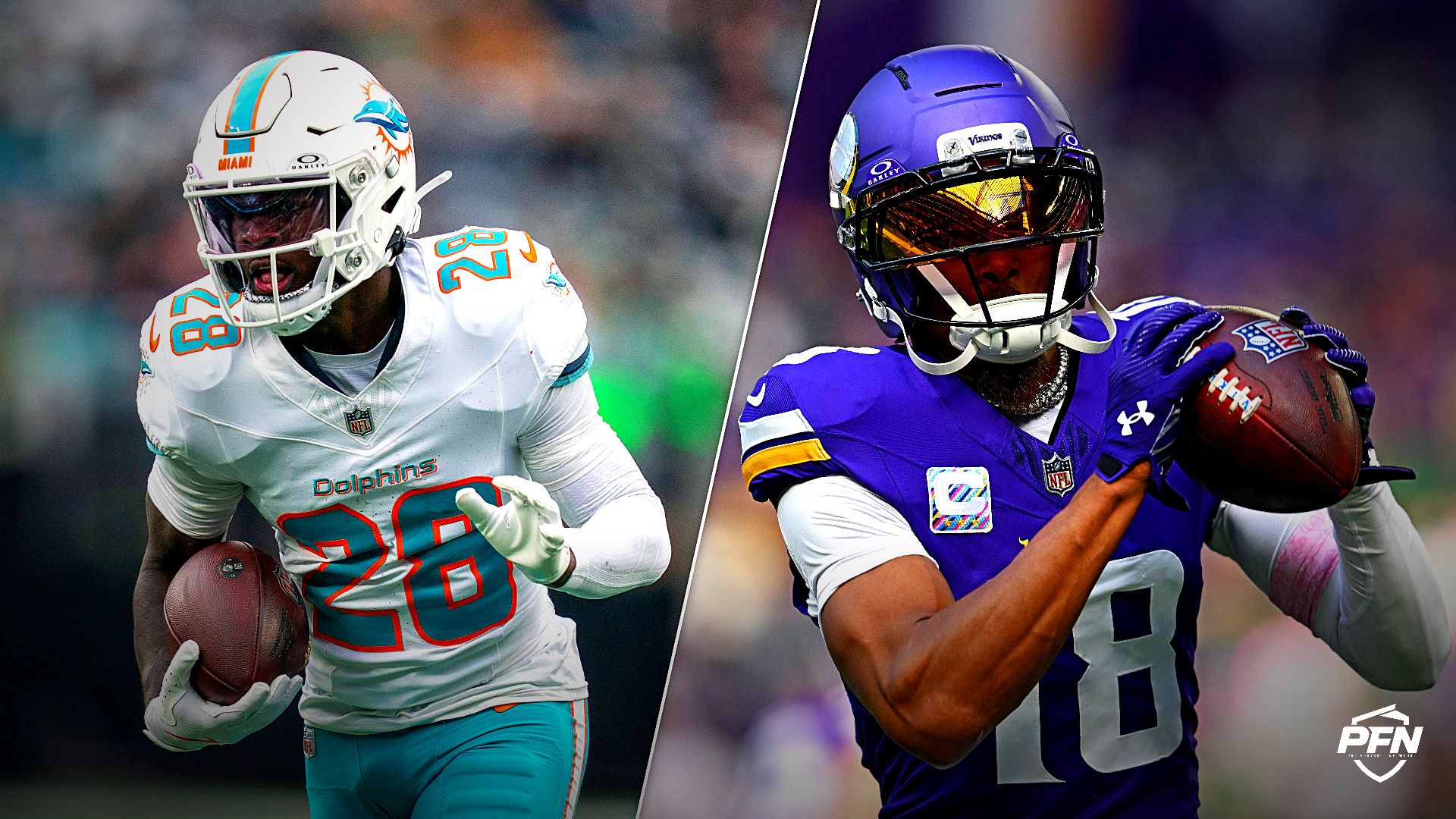
Every fantasy football season features a handful of players who turn draft rooms into arguments. You either love them or you fade them, and both sides can make a compelling case. Two managers can study the exact same profile and walk away with opposite conclusions. These are the players I find most polarizing heading into 2026,
De’Von Achane, RB, Miami Dolphins
No player splits the room quite like De’Von Achane. The talent side of the argument is airtight. Achane is a proven three-down back with explosiveness you cannot teach. Last season, he paired that ceiling with a floor nobody expected. He was the only running back in the league to score at least 12 fantasy points in every game. He did that while mixing in three outings of 26-plus points, including one over 30 and one over 40. On talent and usage alone, this is a mid-first-round player, at worst.
DIVE IN: PFN’s Fantasy Football HQ
What the other camp sees has nothing to do with Achane himself. The Miami Dolphins tore the whole thing down this offseason. Mike McDaniel is out, with Jeff Hafley taking over as head coach and former Texans coordinator Bobby Slowik calling the plays. Miami cut Tua Tagovailoa and Tyreek Hill. They also traded Jaylen Waddle, leaving a receiver room fronted by Malik Washington, Jalen Tolbert, Tutu Atwell, and three rookies. A team that finished 25th in points last season may field the worst offense in football this year.
From an opportunity standpoint, nothing stands in Achane’s way. He is the favorite to lead the team in carries and targets, and he should own the goal line. The bear case is that opportunity means little if the offense cannot function, and the quarterback is the crux of it.
Malik Willis has never attempted more than 23 passes in an NFL game. Even with Miami trailing and throwing more, the total passing volume could fall by as many as 100 attempts.
Willis is also a scrambler, which threatens the short-area and goal-line work that fueled Achane’s scoring. That leaves the questions the fade is built on. How does Achane repeat 12 touchdowns if the Dolphins cannot reach the end zone? What is a target share near 20% worth if Willis throws just 25 to 28 times a game?
Here is where I come down. The fantasy community already sees the problem, which is why Achane has slid to RB8 and an early-second-round ADP. I have him a hair lower at RB9, and I am not excited to draft him there.
Mega-talents can overcome bad situations. Christian McCaffrey was the best fantasy back in the league on dreadful Carolina Panthers teams. Saquon Barkley finished as the overall RB1 as a rookie on a bad New York Giants team. Achane outplayed his own situation a year ago. If anyone can hold elite RB1 production in the worst conditions, it is Achane. It is just not a bet I want to make this year.
TreVeyon Henderson, RB, New England Patriots
TreVeyon Henderson is the rare player who could genuinely finish anywhere from a league winner to a complete bust. The bull case is all about the talent.
As a rookie for the New England Patriots, Henderson rushed for 911 yards and nine touchdowns on 5.1 yards per carry. He set a franchise record with four rushing scores of 50-plus yards, a feat only a handful of players in NFL history have matched in a single season, let alone as a rookie. When he finally got a real opportunity in Weeks 10 and 11, he piled up 243 total yards and five touchdowns. The ceiling is a back who can win you a week by himself.
The bear case never mentions his ability, because that was never the problem. Rhamondre Stevenson is still on the roster and still trusted. This exact arrangement just carried New England to a Super Bowl. The playoffs made it stark.
TRADE NOW: PFN’s Dynasty Trade Calculator
Across the Patriots’ four postseason games, Henderson played snap shares of 38%, 40%, 7%, and 40% and scored 4.6, 3.3, 0.5, and 7.5 fantasy points. Stevenson, over those same four games, played 65%, 59%, 93%, and 63% of the snaps and posted 15.8, 12.1, 7.1, and 17.3 points. With the season on the line, the coaching staff picked Stevenson every time.
The efficiency data lines up with the usage. Stevenson beat Henderson in yards per route run (1.45 to 1.02), in 15-plus yard rush rate (6.9% to 5.6%), and in fantasy points per opportunity (1.07 to 0.93). By nearly every measure that matters for fantasy, the veteran was the better back last season. That is why I have Stevenson (RB25) ranked ahead of Henderson (RB26).
The reason this stays a debate and not a settled fade is that the burn path is real. Henderson is explosive enough to win a week on his own, and we already saw what he does when Stevenson sits. Should Stevenson get hurt, or should the fumbles that have followed him resurface, Henderson could smash his ADP in a hurry. That outcome is very much on the table. I am just not paying this price to find out.
Bhayshul Tuten, RB, Jacksonville Jaguars
Bhayshul Tuten is one of the biggest wild cards in fantasy, which is exactly what makes him so polarizing. The bull case starts with the athletic profile. Tuten’s 4.32 40-time puts his speed score in the 98th percentile, and his burst lands in the 97th. At 5’9″ and 206 pounds, he is only slightly undersized for a lead back.
The runway is just as enticing. Travis Etienne is gone, which leaves the lead job in a Trevor Lawrence and Liam Coen attack there for the taking. The Jacksonville Jaguars were the No. 6 scoring offense last season. This role is valuable if Tuten can earn it.
The comparison that excites people is the man he is replacing. Etienne averaged 14.9 PPG last season and finished as the overall RB13. He posted these numbers despite not being being any kind of special talent. He was simply the back who held the job. Tuten is younger, faster, and more explosive. The thinking goes that he could match or clear that line if he seizes the same role.
STAY UPDATED: PFN’s Fantasy News Tracker
The bear case is just as strong, and it starts with a rookie year that produced almost nothing. Tuten managed 93 touches, 5.9 PPG, and a 3.7 yards-per-carry mark. He could not wrestle the passing-down role away from seventh-round rookie LeQuint Allen.
Jacksonville has since signed Chris Rodriguez, who took the starting job from Jacory Croskey-Merritt in Washington last year and ran for 4.5 yards per carry on 112 attempts with six scores. Rodriguez is a genuine two-down grinder and short-yardage option, and Allen still looms on passing downs. Stack those up and the nightmare version is a three-way timeshare that leaves Tuten gobbling up the least valuable touches on the field.
Here is my honest position: I do not have a strong take. Liam Coen has no allegiance to any of these backs. This will be a true meritocracy where the one who plays best will play the most. In theory, that should be Tuten. The practical problem is that we have one year of NFL data and it told us very little.
Justin Jefferson, WR, Minnesota Vikings
Justin Jefferson is a classic talent-versus-situation argument. Nobody disputes the talent. What the community cannot agree on is how to price a player coming off the ugliest season of his career.
Prior to last season, Jefferson had averaged between 17.1 and 21.7 PPG every year. That cratered to 11.9 PPG in 2025. He finished as the WR28, and in a down year for receiver scoring that number sat closer to a WR36 pace. A perennial top-five receiver was one of the worst picks in fantasy.
The most important part of the crash is that Jefferson did not decline. His underlying usage held up. He drew a 30.3% target share, was targeted on 26.9% of his routes, and still squeezed out 2.0 yards per route run in miserable conditions. The production dip traced entirely to his quarterback.
Jefferson has averaged 18.9 PPG for his career with every passer other than JJ McCarthy, and just 11.0 PPG in McCarthy’s starts. In 2024, he retained WR1 value catching balls from Nick Mullens, Josh Dobbs, and Jaren Hall. The 2025 collapse reads as a McCarthy problem, not a Jefferson one.
MORE: Best Spots to Draft From in Fantasy Football
That is the bull case in a sentence: the quarterback problem is fixed. The Minnesota Vikings moved on from McCarthy and signed Kyler Murray. Whatever you think of Murray as a real-life player, he lands squarely in the “anyone else” bucket.
Murray had never averaged under 17.8 PPG before last year’s injury-shortened season, and he once supported WR1 production for both DeAndre Hopkins and Hollywood Brown. Believers see a top-five talent reunited with competent quarterback play and pencil the old Jefferson back in.
The bear case is not about talent at all. Skeptics simply do not trust Murray, a former No. 1 overall pick the Arizona Cardinals gave up on. They see a first-round, WR6 ADP as far too steep for a receiver who just finished outside the top 25. If you were redrafting the 2025 season today, Jefferson would barely crack the top 10 rounds. That is the risk you are paying up to ignore.
Where do I land? I believe in the bounce-back. The McCarthy split is too stark to ignore, and Murray is a big enough upgrade to unlock the talent again. My one hesitation is the price. Given how badly last season went, I am surprised the market is not offering a steeper discount, and at his current cost, I am probably not the one drafting him.
DJ Moore, WR, Buffalo Bills
DJ Moore might be the most divisive receiver in the entire pool. Moore averaged 10.0 PPG in 2025, his worst mark since his rookie year, and finished with a 50-682-6 line despite playing all 17 games as the Chicago Bears’ healthy, unquestioned WR1.
Moore’s target share fell from a career-long 24-to-27% range to 16%, and his 1.26 yards per route run was a career worst by a wide margin. This is from a receiver who had been a top-36 producer for six straight years.
The reason this is a real debate is that Moore has bounced back from a bad year before. In 2022, he cratered to 11.7 PPG, but that was pure circumstance. He still commanded a 27.7% target share stuck with Justin Fields in an offense that barely threw.
Last season offered no such alibi. Moore was catching passes from Caleb Williams on an 11-6 team that won its division, in a scheme run by Ben Johnson. The efficiency decline was real and it was two years in the making, with his first downs per route run sliding from 13th in the league in 2023 to 74th in 2025.
STAY UPDATED: PFN’s Fantasy News Tracker
Here is what the believers see. Moore was miscast and possibly checked out in a crowded Chicago receiver room that featured Rome Odunze, Colston Loveland, and Luther Burden III. Now he lands with the Buffalo Bills as the clear WR1, with only slot man Khalil Shakir and tight end Dalton Kincaid for competition. He gets Josh Allen, the best quarterback of his career, on one of the highest-scoring offenses in football. Project him to lead the Bills in targets and the rebound writes itself.
Here is why I am not buying it. The situation looks a lot like 2022 Allen Robinson, another age-29 receiver coming off a career-worst year who moved to a better offense with an elite quarterback and lighter competition, with the fantasy community buying the bounce-back. Robinson was no better in Los Angeles than he had been in his final Chicago season, and that was the whole problem.
Even though wide receivers typically don’t fall off a cliff until age 31 or 32, age 29 is when we should start considering the possibility. When an older wide receiver shows those signs of decline, history says we should believe him.
My bigger issue is the ceiling. The Buffalo offense does not throw enough to make the cost worth it. Josh Allen averaged 28.75 pass attempts per game last season and has stayed under 29.0 in both years under Joe Brady. Even if Moore claims a 25% target share, that is roughly 120 targets, which maps to about 75 catches, just over 1,000 yards. He would need an outlier touchdown number to live up to ADP.
That best case lands around 12.5 PPG, or WR30-to-36 production, from a player going as the WR27.
I don’t think Moore is completely cooked. This is probably not Amari Cooper to the Bills 2.0. He will be worth rostering and will lead the Bills in targets, serving as their top pass catcher. The problem is I don’t see much upside. Meanwhile, the downside is he is, in fact, cooked, and fantasy managers are dropping him by mid-October. If Moore is going to burn one side of the coin, he’s far more likely to underperform than massively overperform.
Brian Thomas Jr. and Parker Washington, WRs, Jacksonville Jaguars
No debate in fantasy is quite as intertwined as the one in the Jacksonville Jaguars’ receiver room. Brian Thomas Jr. and Parker Washington cannot be evaluated in isolation, because every target one earns is a target the other does not.
A year ago, the question was where Thomas ranked among all receivers in the league. He was a 1/2 turn pick coming off one of the best rookie seasons in NFL history. Now the question is which of these two you would rather roster, and the answer splits the community right down the middle.
Thomas is the one with the pedigree and the disappointment. After a dynamic rookie campaign, he managed just one top-12 week and three top-24 finishes last season. That’s two fewer top-24 weeks than Washington, a teammate barely on the radar a year earlier.
The how behind the collapse matters. His red zone target rate fell from 28.6% as a rookie to 9.4%, stripping away the easy scoring chances. 46.2% of his targets traveled 15-plus yards downfield, up from 31.6% the year before. That is a boom-or-bust, downfield profile, closer to the Gabe Davis archetype than an every-week alpha.
Washington is the one with the momentum. A sixth-round pick out of Penn State with 48 career catches, he was an afterthought buried behind Thomas and Travis Hunter, and then he took off. Washington posted a 2.6 yards per route run mark with Jakobi Meyers on the field last season, a genuinely impressive number that was not fueled by him being the last man standing. He closed the year with three top-12 weeks over his final six games. That is the kind of stretch that moves a player onto the top-100 radar.
Both carry real risk, which is what keeps this a debate. Jacksonville ranked 24th in red zone pass rate last season, and a low-volume scoring script leaves limited touchdown equity for anyone in the room.
Plus, the room is crowded. In addition to Washington and Thomas, Meyers, Hunter, and tight end Brenton Strange are all in the mix for targets.
Washington’s college production never screamed featured role, with 1,920 receiving yards across three Penn State seasons. His late surge could be a new baseline or a hot streak that already priced itself in. We’ve seen plenty of random Day 3/UDFA wide receivers have a few hot weeks before fading back into obscurity. Thomas, meanwhile, still has the talent and pedigree that made him so coveted a year ago.
Here is where I break from the crowd. Most of the industry still treats Thomas as the alpha and Washington as the risk. I lean the other way. The reports out of Jacksonville have Coen speaking glowingly about Washington as a do-it-all receiver, the kind of versatile piece that earns steady, every-down targets.
Thomas, by contrast, keeps being described as a downfield weapon, which points to him staying in the high-aDOT X role he grew into after the Meyers trade. That role produces big plays and quiet weeks in equal measure. Give me the do-it-all profile over the boom-or-bust one. I prefer Washington.
