

Every offseason, managers in the world of fantasy football find themselves chasing the next big breakout. We often cling to the pedigree of young wide receivers, assuming that a change in environment or a veteran quarterback will finally unlock their true potential. However, history tells a much more rigid story about when a pass catcher actually reveals his ceiling. A recent deep dive into decades of production raises a serious question about whether a certain star can ever reach the elite tier.

Fantasy WR1s Typically Show Themselves Early In Careers
When evaluating the long-term value of a wide receiver, the 16.0 fantasy points per game (PPG) mark in PPR formats is a critical benchmark. While the exact threshold fluctuates each year (and 2025 was a historically bad year for WRs), for the better part of 25 years, 16.0 PPG has typically signified WR1 production.
To understand how often players reach this level late in their careers, I did a study on every wide receiver drafted since 2000. This data set included over 1,400 players with the express purpose of seeing how many were able to hit 16.0 PPG for the first time beginning their fifth NFL season or later.
The results show that late bloomers are incredibly rare. Out of the massive sample size, only 18 wide receivers since 2000 managed to record a 16.0 PPG season for the first time in year five or later. This means that the vast majority of elite fantasy assets show us exactly who they are within their first four years. If a player has not reached that ceiling by the end of his rookie contract, the statistical probability of him doing so later drops to nearly zero.
START PREPARING: PFN’s FREE Fantasy Draft Simulator
While many of the players in this data set were late-round picks, the numbers remain discouraging even for those with high draft capital. In fact, it should not be surprising that the majority of late bloomers were players taken later in the NFL draft, as they were not afforded the same immediate opportunities that Day 1 and early Day 2 players often get.
Fantasy managers often give more leeway to former first-round picks, but the historical record suggests that even pedigree cannot overcome a slow start. The path to becoming a fantasy superstar is usually paved in the first three or four years of a career.
The Elite Round 1 Exceptions
Focusing specifically on first-round talent, the list of outliers becomes even smaller. Of the 18 players who hit the 16.0 PPG mark for the first time in year five or beyond, only five were original first-round selections. This small group consists of Andre Johnson, Tee Higgins, Santana Moss, Jeremy Maclin, and DJ Moore. While these names offer some hope for late breakouts, a closer look at their early career production reveals a shared trait that sets them apart.
Johnson, Higgins, Moss, and Moore were not struggling before they finally crossed the elite threshold. In fact, all four of them came extremely close to the 16.0 PPG mark during their first four seasons. Each of these players posted at least one season where they averaged between 15.4 and 15.7 PPG early in their careers. They were already performing at a high level and simply needed a small push to reach the elite WR1 tier.
These players were not outliers in the sense that they came from nowhere. They were already highly productive assets who had proven they could carry a passing game. Their eventual jump to 16.0 PPG or higher was a natural progression rather than a sudden, unexpected spike. For a player to join this exclusive list of first-round success stories, they typically need to show that they can at least flirt with elite numbers during their first four years.
Garrett Wilson and the Outlier Dilemma
This brings us to the current evaluation of Garrett Wilson. Despite being drafted with the 10th overall pick and viewed as a cornerstone of dynasty rosters, Wilson has now completed four seasons in the NFL. During that time, he has failed to post a single season of WR1-caliber production. Even more concerning is the fact that he has never even reached the 15.0 PPG mark in any of those four years.
Unlike the other first-round outliers like Johnson, Higgins, Moss, and Moore, the New York Jets WR1 has not shown the “near elite” production that could signal a late-career spike in production. While his supporters often point to poor quarterback play, subpar coaching, or ineffective offensive schemes, the historical data is indifferent to these excuses. The reality is that Wilson has not reached the benchmarks that almost every other future WR1 hit early in their journey.
DIVE IN: PFN’s Free Fantasy Football HQ
If Wilson were to suddenly post a 16.0 PPG season in 2026 or later, he would not just be a late bloomer; he would be one of the most significant outliers in the history of fantasy football. He would be one of just two players in over two decades’ worth of data to lack a 15.0 PPG season in his first four years and still go on to the WR1-caliber tier as a veteran. Relying on such a historic anomaly is a risky bet for any fantasy manager to make.
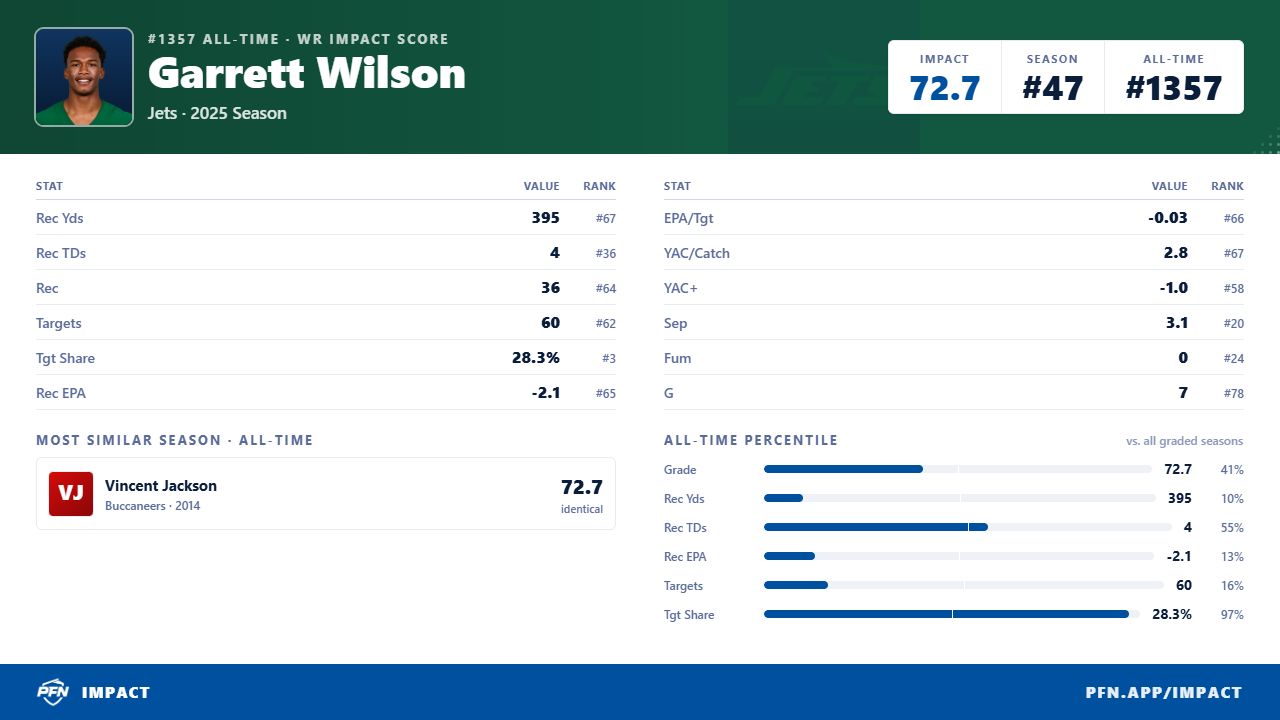
History suggests that by year four, the NFL has already told us who a player is. Certainly by year five. For Wilson, the window to prove he belongs in the elite category is virtually shut based on two decades of wide receiver trends. While the talent may be visible on tape, the fantasy production has yet to follow a path that leads to the top of the rankings. If you are betting on Wilson ever posting a WR1-caliber season, you are betting on the ultimate outlier.
