
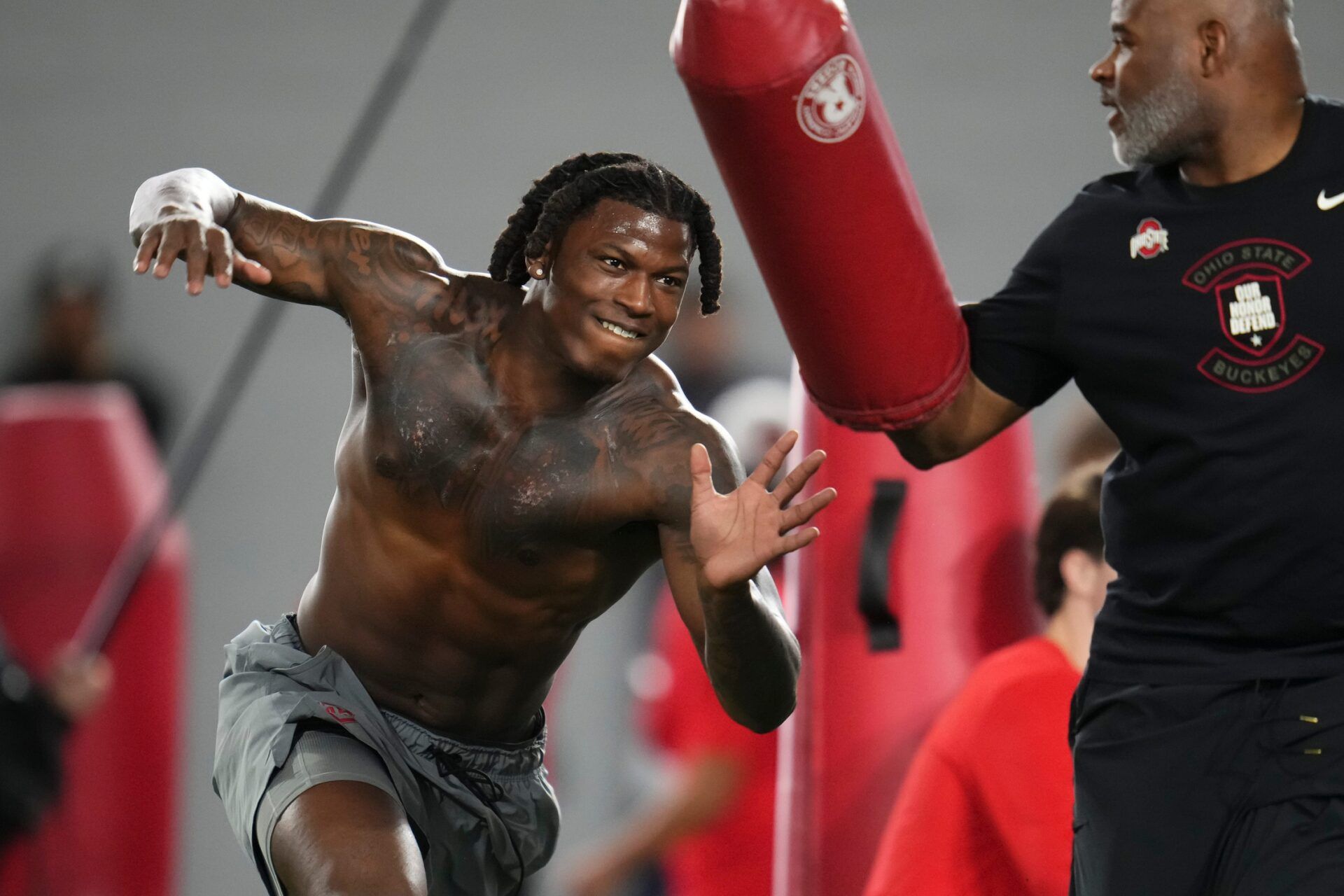
Draft season has a way of messing with people. Every year, fans across the league have the same feeling: they start convincing themselves that one player can make everything fall into place. And that conversation has sort of landed on Arvell Reese for the New York Jets.

Eric Mangini Sees Upside In Arvell Reese, But the Projection Isn’t Simple
Reese is big, runs well, and has shown greatness. But then, you sit with the thought process a little longer, and it’s not quite as clean. Some people see exactly where he fits, but others don’t.
The athlete, for certain, looks the part, standing 6-foot-4 and weighing 241 pounds, and he had a 4.46s time for the 40-yard dash at the NFL Combine.
At Ohio State, when things were working, they really worked. In 14 games during his last season with the Buckeyes, Reese recorded 6.5 sacks, 10 tackles for loss, 69 combined tackles, and 2 passes defended. But it is also where things can get a bit misleading. And Eric Mangini, the former Jets head coach, is not really interested in filling in blanks.
When he talked about Reese during Wednesday’s episode of “First Things First,” his comment brought up Vernon Gholston, who was from the same school, same kind of physical profile, same sort of pre-draft talks where everyone talks themselves into what a player could be. The Jets, who drafted Gholston with the sixth overall pick in the 2008 NFL Draft, never for sure figured out what the player actually was once he got there.
“I like Arvell Reese, and this is not me saying, ‘He’s gonna be a bust.’ This is not me saying that I don’t think he’ll have a lot of success,” Mangini said. “This is just a cautionary tale based off my very personal experience. So, during my last season with the Jets, we had the sixth overall draft pick, and there was a great linebacker out of Ohio State named Vernon Gholston.”
Mangini then presented a statistical comparison of Gholston and Reese, showing that the two players had similar athletic measurables, but the former’s stats were much better in fewer games.
“But Vernon was a little bit of a projection, just like Reese is,” Mangini added. “Is he truly an edge rusher? Well, there’s some good qualities there, but not truly that. Is he truly a linebacker? Well, there’s questions about how well he’s going to drop into coverage. So, anytime you make these projections, you don’t know what you’re going to get out of that guy.”
At No. 2, teams usually aren’t guessing this much. They take someone, and are usually sure about what the player is right away. Reese is currently the third-best prospect on PFSN’s Big Board and has a PFSN grade of 91.6. His upside is obvious, but the role isn’t.
There are safer options. David Bailey, for example, looks a lot more like a traditional edge rusher. And there is also a more practical layer to this. Reese is incredible as an athlete, no doubt about that, but the fit matters as well, especially this high in the draft.
And with the Jets, it matters a bit more. According to PFSN’s Defense Impact Metric, New York’s defense ranked second-worst in the league last season, with an impact score of 62.8. They’ll need their draft picks to make an impact instantly, or head coach Aaron Glenn could get fired.
BE AN NFL GM: PFSN’s Ultimate GM Simulator
The Jets will not be doing anything unusual schematically. Edges will get after the quarterback, and linebackers handle space and coverage. Reese sits somewhere in between those jobs, which sounds useful until the team has to decide where exactly to put him.
Put him on the edge, and you’re betting on traits more than what he’s consistently shown there. Keep him at linebacker, and you’re asking about coverage, and that hasn’t been especially convincing. Teams didn’t really avoid him in that area last season. So it ends up being less about talent and more about comfort. How much projecting are you okay with at No.2? Because with Reese, that’s part of the deal.