
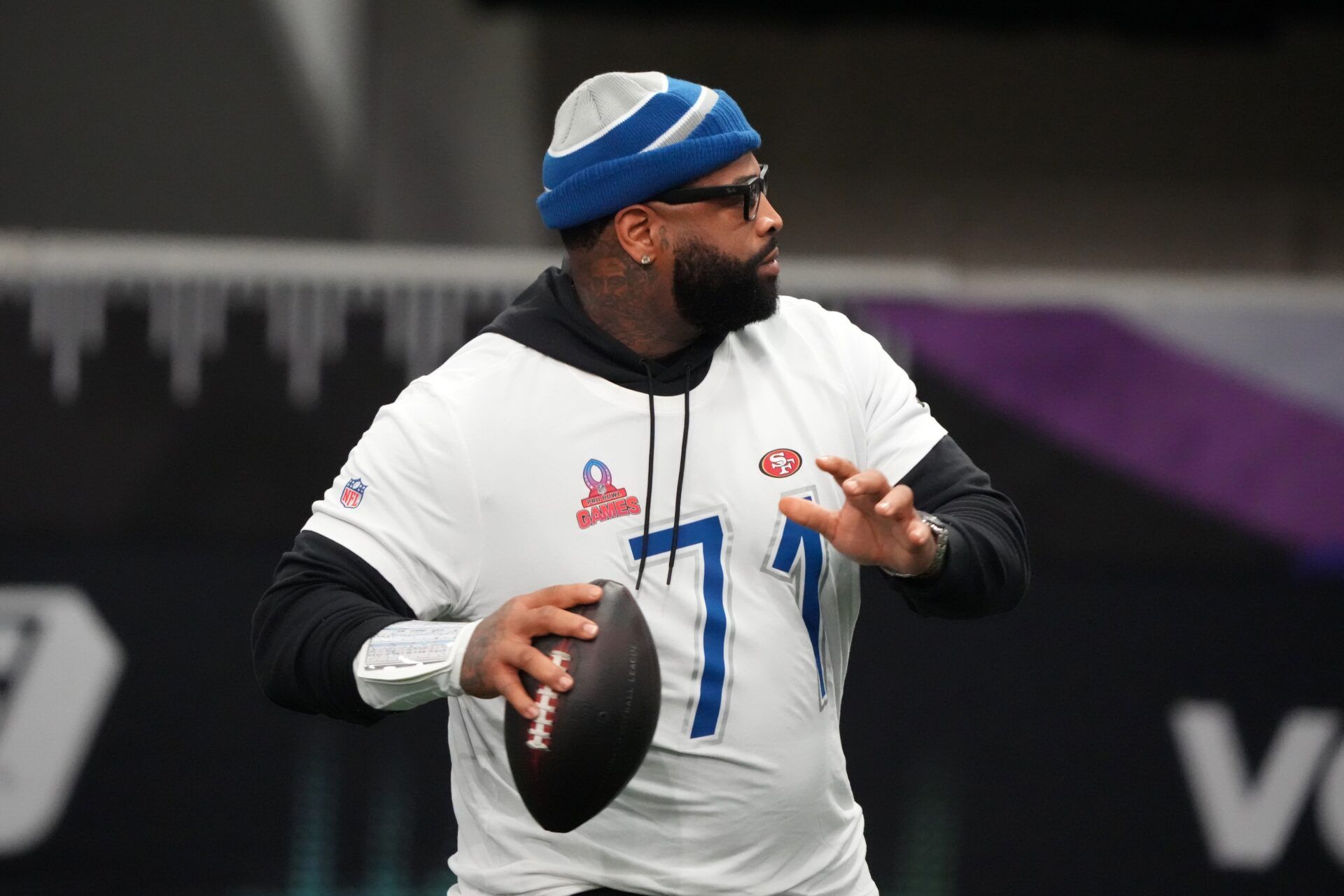
For weeks, the situation between the San Francisco 49ers and Trent Williams has felt like one of those slow, simmering standoffs. But over the weekend in Phoenix, general manager John Lynch offered something new: not closure or certainty per se, but the suggestion that things might finally be shifting.

How Trent Williams and the 49ers Are Threading the Contract Needle
Lynch chose his words carefully on Sunday, like someone who knows better than to promise an ending before the final page is written.
“We’ve had good communication throughout,” Lynch said, via ESPN. “I would say in the last week it’s kind of intensified and feel like we’re on the precipice of something good happening, but we’ll see. Don’t want to make any statements that, like, ‘Hey, we’re right there,’ because these things have felt like that before, but I do feel like we’re in good communication and hopeful.”
Beneath the polite optimism is a negotiation shaped by two competing truths. Williams is still, somehow, playing at an elite level deep into his 30s, collecting accolades, anchoring the line, and making a brutally difficult position look almost effortless, with an 89.1 score on PFSN’s Player OL Impact metric, ranking eighth. At the same time, he’s turning 38 this summer, and time, even for the greats, is never a neutral factor in contract talks.
Williams’ ask isn’t dramatic. He wants security.
With no guaranteed money left on his deal entering this season, the idea of playing out the final year without protection doesn’t exactly align with a career that already borders on Hall of Fame certainty. A short extension, a reshaped structure, something that acknowledges both what he’s been and what he still is.
The 49ers, meanwhile, are staring at a spreadsheet that doesn’t quite cooperate. By declining a $10 million option bonus earlier this month, they allowed Williams’ 2026 cap number to swell to an unwieldy figure north of $46 million.
It’s the kind of number that forces decisions, even for contenders. So while they want him back, they also need to make the math make sense.
And that’s where things get delicate. As Lynch himself said, describing the process as something of a balancing act, like threading a needle between respect, reality, and financial practicality.
It’s not just about keeping their cornerstone athlete; it’s about structuring a future.
BE AN NFL GM: PFSN’s Ultimate GM Simulator
Still, there’s something reassuring in how this has all unfolded. No public fallout. No sharp-edged quotes. No sense that either side has drifted too far from the table.