
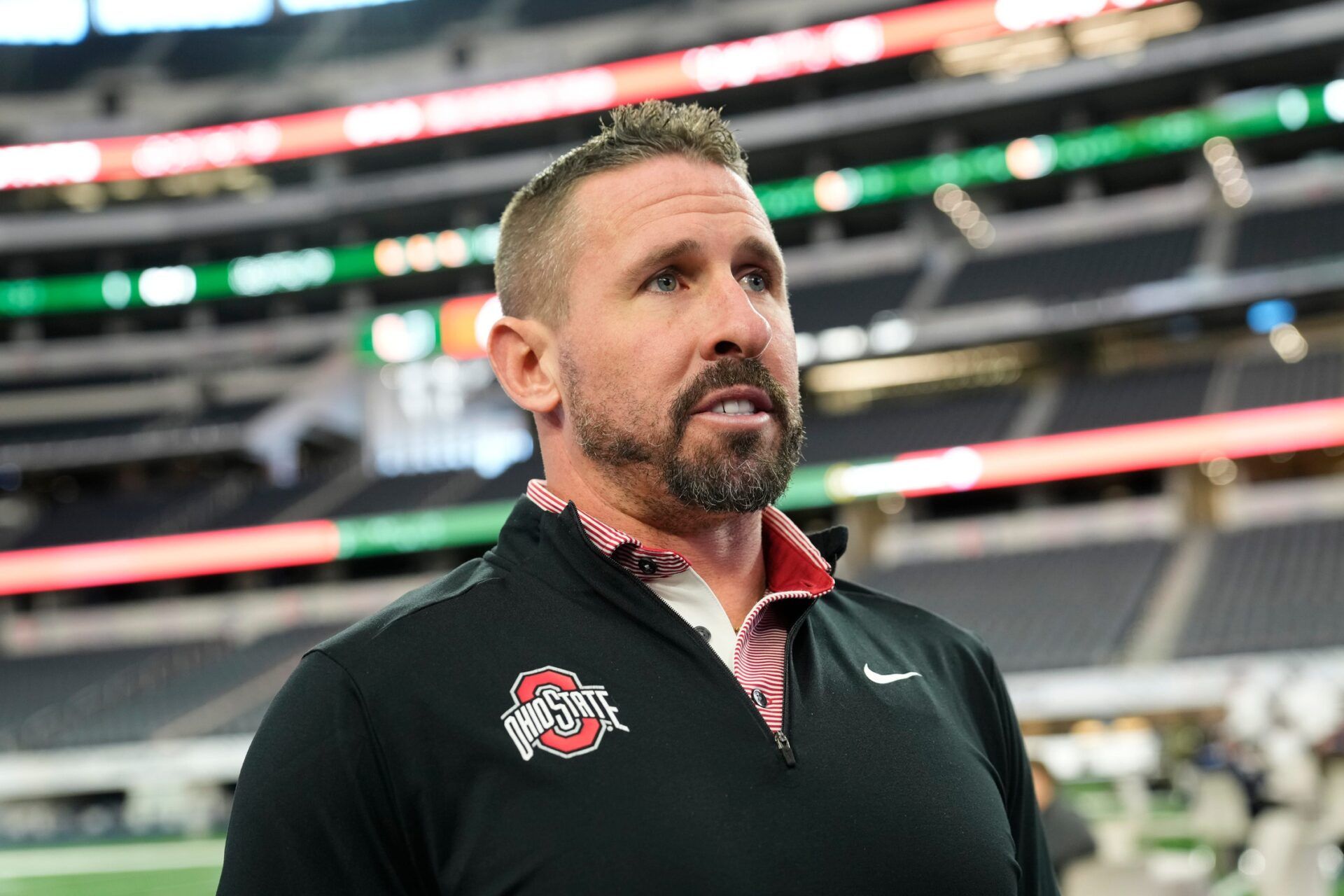
For most of his adult life, Brian Hartline was connected to Ohio State University. He first played as a standout wide receiver, helping the Buckeyes post a 31-5 record from 2005 to 2008. After a seven-year NFL career, he returned to Columbus. Over the next eight seasons, Hartline held three different coaching roles at Ohio State. In December, he made a major career move.

USF Head Coach Brian Hartline Discusses Choosing to Leave Ohio State
Building on his eight-year tenure at Ohio State and a national championship, Hartline relocated to Tampa, Florida, in December. The former offensive coordinator signed a six-year deal worth $21 million. He recently joined Urban Meyer on the “Triple Option” podcast to discuss the move. Starting at 18:00, Hartline delved into the rationale.
“I kind of went through the process, between the resources, the people, the vision, acquisition of players, and being in the hotbed of Florida for recruiting,” he said.
Beyond recruiting advantages, new facilities are reinforcing USF’s commitment to football. The university is building a 35,000-seat on-campus stadium, further displaying the administration’s ambition. USF sits on Florida’s western coast, in a state renowned for producing elite high school prospects year after year.
Under these circumstances, the job and environment align well with Hartline’s strengths. His reputation as a top recruiter is well-established; for example, 24/7 Sports highlights his recruits such as Jeremiah Smith, Jaxon Smith-Njigba, CJ Stroud, Emeka Egbuka, and Marvin Harrison.
In the wake of Alex Golesh’s departure to Auburn, with 13 USF players following him to Alabama, Hartline faced immediate roster challenges. Rising to the occasion, the new coach aggressively pursued talent through both the portal and recruiting trail.
According to 24/7 Sports, USF will welcome 54 new players to the program, 41 of whom arrived via the transfer portal. Under Hartline, USF will need to replace an offense that landed at No. 32 in PFSN’s CFB Offense Impact Rankings.
Facility planning often plays a crucial role in a coaching transition. At USF, the commitment ran deeper: the administration had started stadium construction planning long before the head coaching search began. During the interview process, Hartline could see the construction in progress firsthand.
“I point because I literally see it being built right now. Everything they said that they wanted to happen, they were putting their kind of their money where their mouth was, and they kept checking boxes,” he said.
Off-the-field considerations also factored into his decision. When married coaches with children change jobs, thinking about family becomes almost second nature. For Hartline, his spouse played a key role in motivating the move to USF.
“Ultimately, in the end, Kara looked at me and said, ‘Brian, it’s time,’ and she eventually made — family made the last push, the last comments, and the rest was off and running.”
As Hartline and USF plan for the season, key dates stand out. The spring game is April 19. USF’s early schedule could build momentum for an American Conference title run, with three of four games (FIU, Delaware State, Bowling Green) outside the conference. USF faces Army’s option attack Sept. 12 in New York.
