
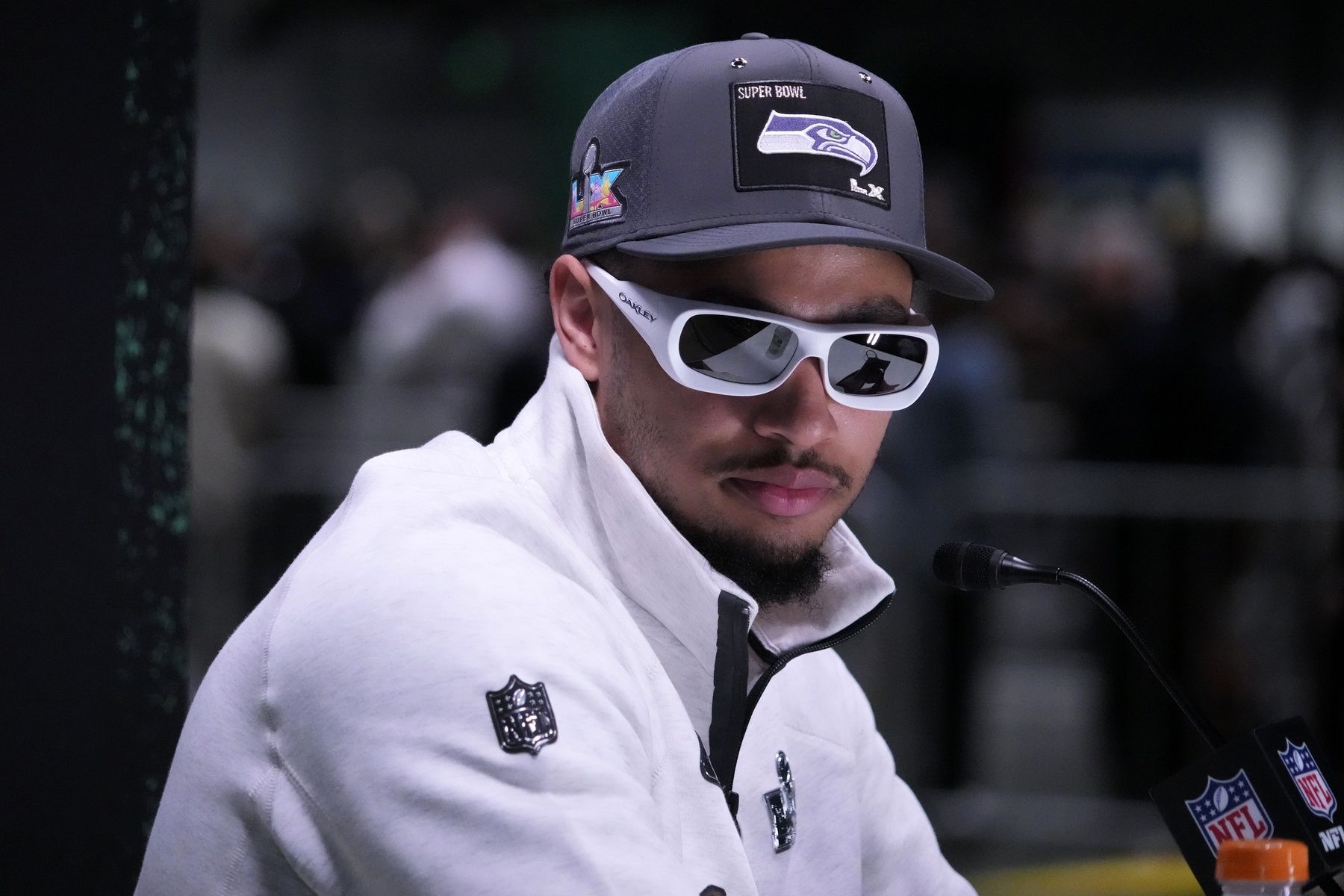
There are compliments, and then there are confessions. The kind that slips out casually, almost accidentally, and tells you everything you need to know. As the Seattle Seahawks settled into the controlled chaos of Super Bowl 60 Opening Night, head coach Mike Macdonald was handed one of those harmless, hypothetical questions.

Mike Macdonald on How Defenses Can Contain Jaxon Smith-Njigba
If he were game-planning against his own defense, how would he stop Jaxon Smith-Njigba? Macdonald replied in a way that felt like something between humor and a warning: “Can I put three guys on him?”
Under offensive coordinator Klint Kubiak, Seattle did not just feature Smith-Njigba; it let him wander. Outside, inside, in motion, briefly in the backfield, wherever the defense looked most uncomfortable. JSN became less of a position and more of a presence.
That freedom unlocked something rare. His separation skills, paired with his feel for leverage and timing, turned routine routes into quiet wins. Defensive backs were rarely beaten badly, just consistently, subtly, until the numbers told the story they’d been trying to ignore.
Those numbers were incredible. Smith-Njigba led the NFL with 1,793 receiving yards and 119 catches for 10 touchdowns. According to PFSN’s NFL WR Impact Metric, he has a WRi score of 94.4 with an A grade, ranking second among all receivers behind Puka Nacua.
READ MORE: Top 100 2026 NFL Free Agent Rankings
He earned unanimous First-Team All-Pro honors and carried that dominance straight into January, where defenses stopped pretending balance existed and dedicated entire game plans to slowing him down. It didn’t help much.
Seattle, meanwhile, kept winning. The Seahawks finished 14-3, claimed the NFC’s No. 1 seed, and paired a league-best scoring defense with an offense that grew more confident by the week.
Macdonald isn’t a coach prone to exaggeration. He built the NFL’s top-ranked defense on clarity, communication, and control. His job is to solve problems, and Smith-Njigba, by his own admission, doesn’t offer a clear solution.
That mindset mirrors the Seahawks’ season as a whole, as Macdonald also brushed aside the idea that anyone outside the building ever defined his team.
“We didn’t care,” he said. “We really don’t. I think what was important for us was to become a championship team. We weren’t that in the Spring. We were on our way, that’s what we wanted to become, but in order to get to a stage like this and win a game like this, it’s got to be real.”
That reality took shape on offense as much as defense. Kubiak’s first year brought cohesion quickly. Sam Darnold quietly climbed into the league’s top five in passing yards. The run game, slow to ignite, caught fire late, averaging over 170 rushing yards across important stretches.